
Sand Casting Is Dead. Long Live Binder Jetting. — September 2026
Sand casting has shaped defense manufacturing for longer than the United States has operated a standing military. From Civil War cannon barrels to the aluminum housings of Cold War-era jet engines, the process has been foundational — and for the better part of a decade, it has been quietly losing ground to a technology that produces better parts faster with fewer people. Binder jetting is not a future threat to sand casting. It is the present replacement.
The Process That Built the Arsenal Is Now the Process Slowing It Down
To understand why binder jetting is displacing sand casting in defense and aerospace supply chains, you have to understand what sand casting actually costs — not in material, but in time. A conventional sand casting for a structural aerospace component requires pattern tooling, which can take six to fourteen weeks to produce, followed by mold preparation, pour, cooling, shake-out, and finishing. For a program like the F-35 Joint Strike Fighter, where Lockheed Martin manages a supply chain spanning more than 1,700 suppliers, that timeline compresses the margin for iteration to near zero. A design change at the casting level can cascade into months of schedule slippage and contract exposure.
The Department of Defense has been tracking this constraint explicitly. The DoD's Manufacturing Technology Program has funded multiple initiatives aimed at reducing casting lead times for readiness-critical components. The logic is straightforward: if you cannot cast a part in time, you cannot fly the aircraft, and if you cannot fly the aircraft, the contract value — whether that is a $13 billion F-35 LRIP lot or a $2.4 billion B-21 sustainment vehicle — is at risk before a single sortie.
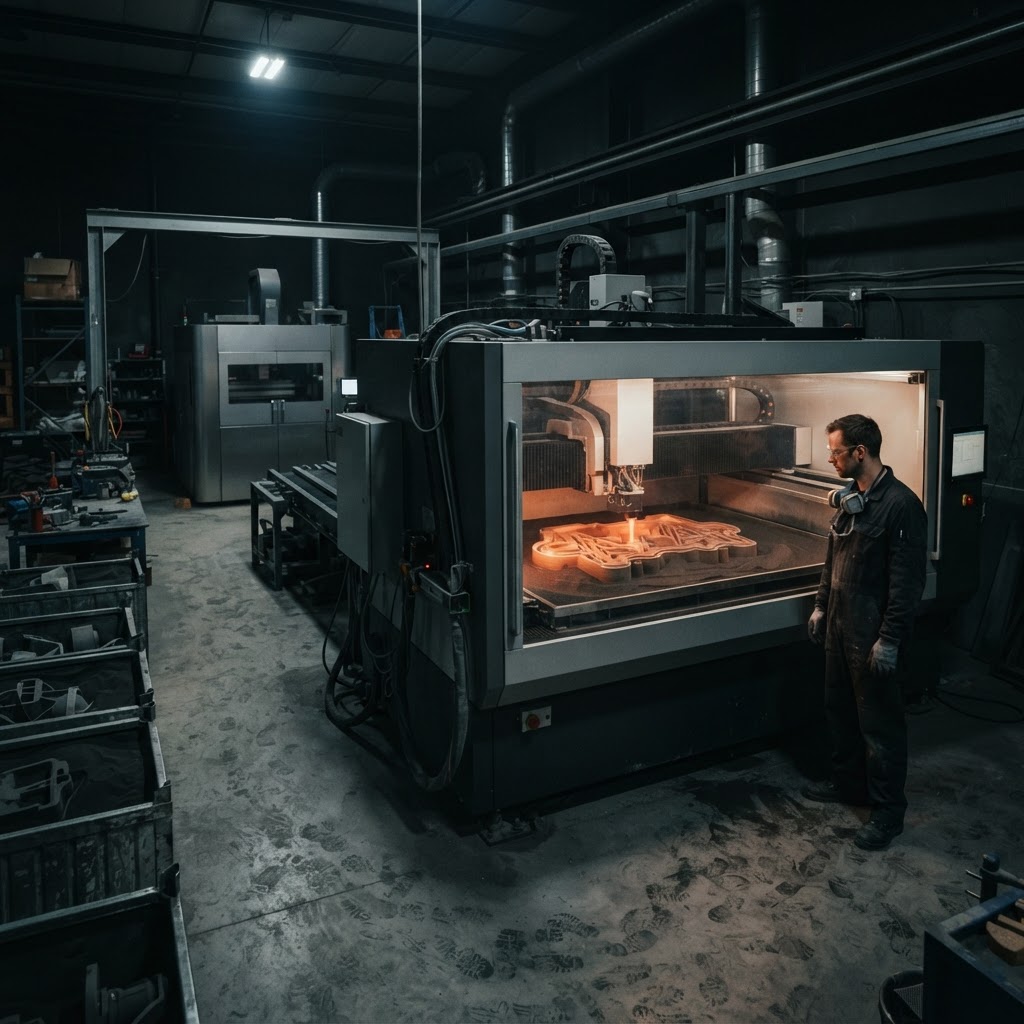
Binder jetting addresses this directly. The process uses a printhead to deposit a liquid binding agent onto layers of metal or sand powder, building a mold or a near-net-shape metal part without tooling. Lead time for a sand mold drops from weeks to hours. Pattern costs, which can run into the tens of thousands of dollars for complex geometries, disappear entirely. For low-volume, high-complexity defense castings — exactly the kind that populate legacy aircraft sustainment programs — this is not an incremental improvement. It is a structural change in how the part gets made.
Where the Primes Are Already Moving
General Electric Aerospace has been among the most aggressive adopters, integrating binder jetting into its engine component supply chain through its partnership with GE Additive — now operating under the broader GE Aerospace advanced manufacturing umbrella. GE's work on binder-jetted components for the GE9X engine, which powers the Boeing 777X, demonstrated that production-grade metal parts with acceptable porosity and dimensional stability were achievable at scale. That proof of concept has since migrated into defense-facing programs.
Raytheon Technologies, now RTX, has similarly invested in binder jetting through its internal manufacturing development programs, with applications targeting missile system housings and radar component brackets — parts that historically sat in sand casting queues for eight to twelve weeks and are now being produced in days. DARPA's Rapid Assured Modular Platforms program has explored additive manufacturing broadly as a hedge against single-source casting suppliers, a supply chain fragility that became acutely visible during the COVID-era defense production disruptions of 2020 and 2021.
ExOne, acquired by Desktop Metal in 2021, remains the most prominent binder jetting equipment manufacturer with defense-adjacent customers. Desktop Metal's Production System platform is now operating in supplier facilities that hold ITAR registrations, a non-trivial qualification that signals the technology has cleared the compliance threshold for defense work. That is not a footnote. That is a market signal.

What will it take to turn demand into delivered output?
Explore The Capacity Imperative, our report on U.S. advanced manufacturing and the priorities shaping 2027.
"The tooling cost was never the real problem. The real problem was that tooling cost bought you time you no longer have."
The Congressional and Procurement Dimension
The National Defense Authorization Act has, in successive fiscal years, included provisions directing the services to expand additive manufacturing adoption for sustainment and readiness applications. The Air Force Research Laboratory has issued multiple Other Transaction Authority agreements — a procurement vehicle that bypasses traditional FAR-based contracting to accelerate technology insertion — targeting additive processes for legacy aircraft component replacement. The Naval Air Systems Command has been similarly active, with NAVAIR's additive manufacturing roadmap specifically identifying casting replacement as a primary use case for binder jetting in depot-level maintenance.
The dry observation worth making here: Congress has been directing the military to modernize its manufacturing base for the better part of three consecutive NDAAs, and the primary obstacle has consistently been the Tier 2 and Tier 3 suppliers who still run the same pattern shops they operated in 1987. The primes can mandate technology adoption through their supply chain requirements, and increasingly, they are.
The Army Materiel Command awarded contracts in 2025 under its organic industrial base modernization initiative that explicitly required additive manufacturing capability certification as a condition of award for certain casting-adjacent work. That language in a contract vehicle is the clearest possible signal to a supplier that the transition is no longer voluntary.
What This Means for Tier 2 and Tier 3 Suppliers
This is where the editorial becomes operational. If you are running a job shop or a small foundry with sand casting as your primary revenue line, the question is not whether binder jetting will affect your business. It already is. The question is whether you are going to manage that transition or absorb it.
Specific implications:
-
Tooling revenue is in structural decline. Pattern and tooling work tied to sand casting is a recurring revenue stream that binder jetting eliminates at the customer level. If your margins depend on pattern fabrication charges, model that revenue against a three-to-five year sunset.
-
Equipment investment thresholds are lower than assumed. Entry-level binder jetting systems capable of producing sand molds for prototype and low-volume work are available at capital costs that a mid-size job shop can finance. The barrier is not the machine. The barrier is the process knowledge and the quality management infrastructure to certify output for defense applications.
-
ITAR registration is a prerequisite, not an afterthought. If you intend to pursue defense casting replacement work using binder jetting, your ITAR compliance posture needs to be established before you pitch a prime. Several smaller shops have lost first-mover positioning in this space because they approached a defense prime with the technology and without the registration.
-
AS9100 certification requirements will extend to binder jetting process controls. The AS9100 quality management standard, which governs aerospace manufacturing, is being interpreted by prime contractors to require documented process validation for additive methods. A supplier cannot simply run a binder jetting system in an otherwise conventional shop and expect prime approval. The process needs to be controlled, documented, and auditable.
-
Nearshoring pressure amplifies the opportunity. As defense primes accelerate domestic supply chain consolidation — driven by both congressional mandate and geopolitical risk — domestic suppliers with demonstrated binder jetting capability are in a preferential position. A Tier 3 foundry that converts even a portion of its capacity to binder jetting and achieves prime qualification is not competing against offshore alternatives. It is competing against a short list of domestic peers, which is a significantly more favorable market structure.
The foundries that recognize binder jetting as a capability expansion rather than an existential threat will capture the transition revenue. The ones that wait for the pattern orders to stop before they act will find the qualification runway considerably shorter than they expected.
Sand casting is not going to vanish from defense manufacturing in the next five years. But the marginal work — the prototype runs, the low-volume sustainment castings, the rapid-turn components for readiness — is already moving. The primes know it. The agencies know it. The suppliers who know it earliest will set the terms for everyone else.
Sources: Department of Defense Manufacturing Technology Program · DARPA Rapid Assured Modular Platforms · Desktop Metal / ExOne · Naval Air Systems Command Additive Manufacturing · SAE AS9100D Standard

