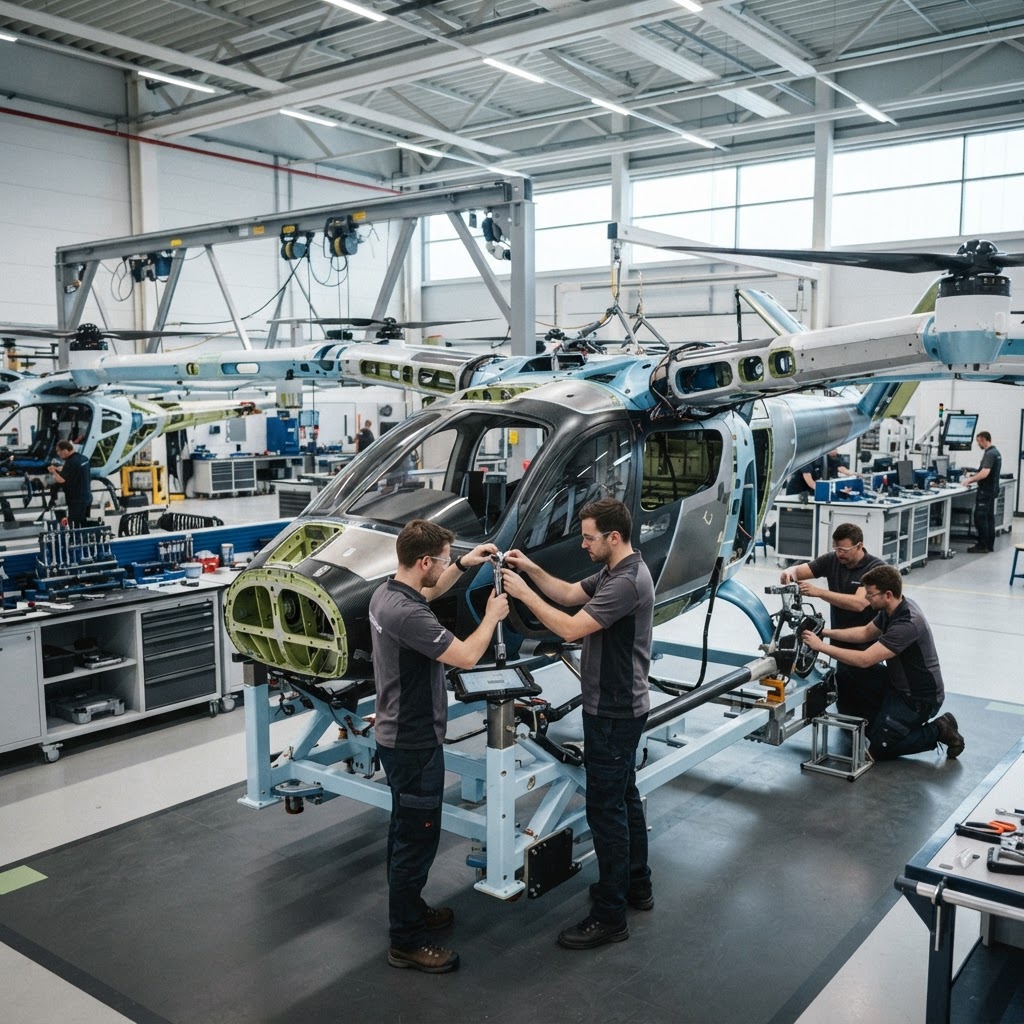

How eVTOL Is Creating an Entirely New Manufacturing Supply Chain — October 2026
When Sikorsky delivered the first production UH-60 Black Hawk in 1979, it inherited a rotorcraft supply chain that had been stress-tested through Vietnam, refined through decades of Army procurement, and backstopped by the full weight of the American defense industrial base. The electric vertical takeoff and landing sector enjoys none of those advantages. What it does have is roughly $15 billion in committed capital across competing programs, a Federal Aviation Administration certification apparatus struggling to keep pace, and a manufacturing supply chain being assembled largely from scratch — borrowing from automotive, semiconductor, and defense aerospace in roughly equal measure.
"The eVTOL industry is not inheriting a supply chain. It is conscripting one from three industries that have never been asked to work together at this tolerance level."
The eVTOL Market Is Not One Market — It Is Four Simultaneous Manufacturing Problems
The commercial eVTOL segment is routinely discussed as a unified industry. It is not. Joby Aviation, which holds the most advanced FAA G-1 certification basis agreement of any air taxi developer, is building a five-seat, 200-mph aircraft with a powertrain that shares almost no heritage components with anything currently in volume production. Archer Aviation is pursuing a similar urban air mobility mission profile but has structured its manufacturing relationship with Stellantis to leverage automotive-scale production tooling — a bet that composite airframe fabrication can be disciplined the way door panel stamping was disciplined in the 1990s. Lilium, reconstituted after its 2023 insolvency, is building a jet-powered eVTOL with ducted electric fans that require motor tolerances closer to turbine manufacturing than anything in the automotive world. And on the defense side, DARPA's SPRINT program is pushing X-plane demonstrators toward 250-knot cruise speeds that will stress both the structural and thermal management supply chains in ways commercial air taxi operators have not yet encountered.
Four programs. Four distinct manufacturing paradigms. One nascent supplier base expected to serve all of them.
Where the Supply Chain Gaps Are Widest
The component categories creating the most acute sourcing pressure are not exotic. They are, in several cases, mundane — which makes the shortfall more embarrassing and more structural.
Electric motors and inverters at aerospace tolerances: Automotive-grade motors from suppliers like BorgWarner and Nidec are cost-competitive but not certified for the vibration, thermal cycling, and single-point-failure requirements the FAA imposes under Part 23 and emerging Part 21 eVTOL special conditions. The gap between what automotive Tier 1s produce and what an FAA-certified propulsion component requires is not a small engineering delta. It is a full qualification program, typically running 18 to 36 months and costing eight figures for a single motor variant.
High-density battery systems: The energy storage supply chain is dominated by cell manufacturers — Panasonic, CATL, Samsung SDI — none of whom are structured to provide the traceability documentation, lot-level testing, and airworthiness data packages that aerospace integration requires. Joby and Archer are both managing this by developing proprietary battery integration capabilities in-house, which solves their immediate program needs and creates a vertical integration dynamic that effectively shuts out Tier 2 battery pack assemblers.
Structural composites at production volume: Carbon fiber airframe structures for low-rate defense programs are well understood. What is not well understood is how to manufacture them at 500 to 1,000 units per year with automotive cycle times and aerospace reject rates. Spirit AeroSystems, currently restructuring under Boeing reacquisition, has the composite expertise but not the business model flexibility. Smaller shops are being asked to bridge that gap.
Avionics and fly-by-wire architecture: Honeywell Aerospace and Garmin Aviation are actively developing eVTOL-specific avionics stacks, but the certification timelines for novel autonomous flight management systems under FAA MOSAIC rulemaking remain a gating item for every program in the sector.

What will it take to turn demand into delivered output?
Explore The Capacity Imperative, our report on U.S. advanced manufacturing and the priorities shaping 2027.
Defense Procurement Is Quietly Reshaping the Demand Curve
The commercial narrative dominates press coverage, but the procurement signals coming out of the Department of Defense deserve more analytical attention than they typically receive. The U.S. Army's FARA program — canceled in 2024 after $2 billion in development expenditure — left a capability gap in armed reconnaissance that several eVTOL-adjacent programs are now being positioned to partially address. The Air Force Research Laboratory's Agility Prime initiative, which has issued Other Transaction Authority agreements to Joby, Archer, Wisk, and Overair successors, represents a deliberate DoD strategy to co-invest in commercial eVTOL development in exchange for defense-relevant performance data and priority access to mature platforms.
The practical implication for manufacturers: OTA agreements under Agility Prime do not carry the full FAR/DFARS compliance burden of traditional defense contracts, which has lowered the barrier to entry for suppliers without established government contracting infrastructure. That window will not remain open indefinitely. As platforms mature toward program of record status — and the Army's interest in eVTOL for logistics resupply in contested environments is well documented in the FY2027 Army Aviation budget justification — procurement vehicles will formalize, compliance requirements will expand, and the supplier base that established relationships during the OTA phase will hold structural advantages.
It is worth observing, with minimal editorial embellishment, that an industry premised on eliminating traffic congestion in coastal cities has become a meaningful line item in Army aviation modernization. History contains stranger pivots.
What This Means for Tier 2 and Tier 3 Suppliers
For operations directors and procurement leads at mid-market manufacturers, the eVTOL supply chain transition presents a narrow but genuine window of competitive entry — with specific actions that determine whether a shop captures a position or watches from the outside.
-
Pursue AS9100 Rev D certification now, not when a contract is on the table. Every eVTOL OEM conducting supplier qualification audits in 2026 is using aerospace quality management system compliance as a baseline filter. Shops holding only ISO 9001 are being screened out at the RFI stage regardless of capability.
-
Invest in composite fabrication process documentation. The bottleneck is not carbon fiber expertise — it is the documented, repeatable process control that allows a Tier 2 shop to generate the material traceability records an FAA-certificated airframe supplier is required to maintain. This is a documentation and quality systems investment as much as a capital equipment investment.
-
Target motor housing, gearbox, and structural bracket work before full assemblies. Full propulsion assembly contracts will flow to Tier 1 primes. The near-term volume opportunity for Tier 2 and Tier 3 manufacturers is in the machined and fabricated structural components that surround propulsion systems — housings, mounts, thermal management enclosures — where precision machining shops with aerospace experience can compete without full system integration capability.
-
Register in SAM.gov and establish an OTA-capable contracting posture. Agility Prime and DARPA SPRINT awards are accessible to suppliers who have never held a defense contract, but only to those with active SAM registration and a basic understanding of OTA agreement structures. This is a half-day administrative task that most small manufacturers have not completed.
-
Monitor the FAA's eVTOL certification roadmap for special condition publications. Each new special condition issuance signals which component categories are approaching certification maturity — and by extension, which supply chain positions are transitioning from development to production procurement. Reading the regulatory calendar is, at this stage of the industry, a competitive intelligence function.
The eVTOL supply chain is being built in real time, by manufacturers who in many cases are making supplier selection decisions before their own production volumes are fully defined. That creates risk. It also creates the kind of entry opportunity that rarely exists in mature aerospace programs, where incumbency is the primary qualification and every LTA was signed before most current operations managers held their current titles.
Sources: FAA eVTOL Certification · DARPA SPRINT Program · AFRL Agility Prime · Joby Aviation · DoD Budget Materials

