

Inside Custom Plastic Forming: An Industrial Plastics and Thermoforming Shop Built on Precision and Pride
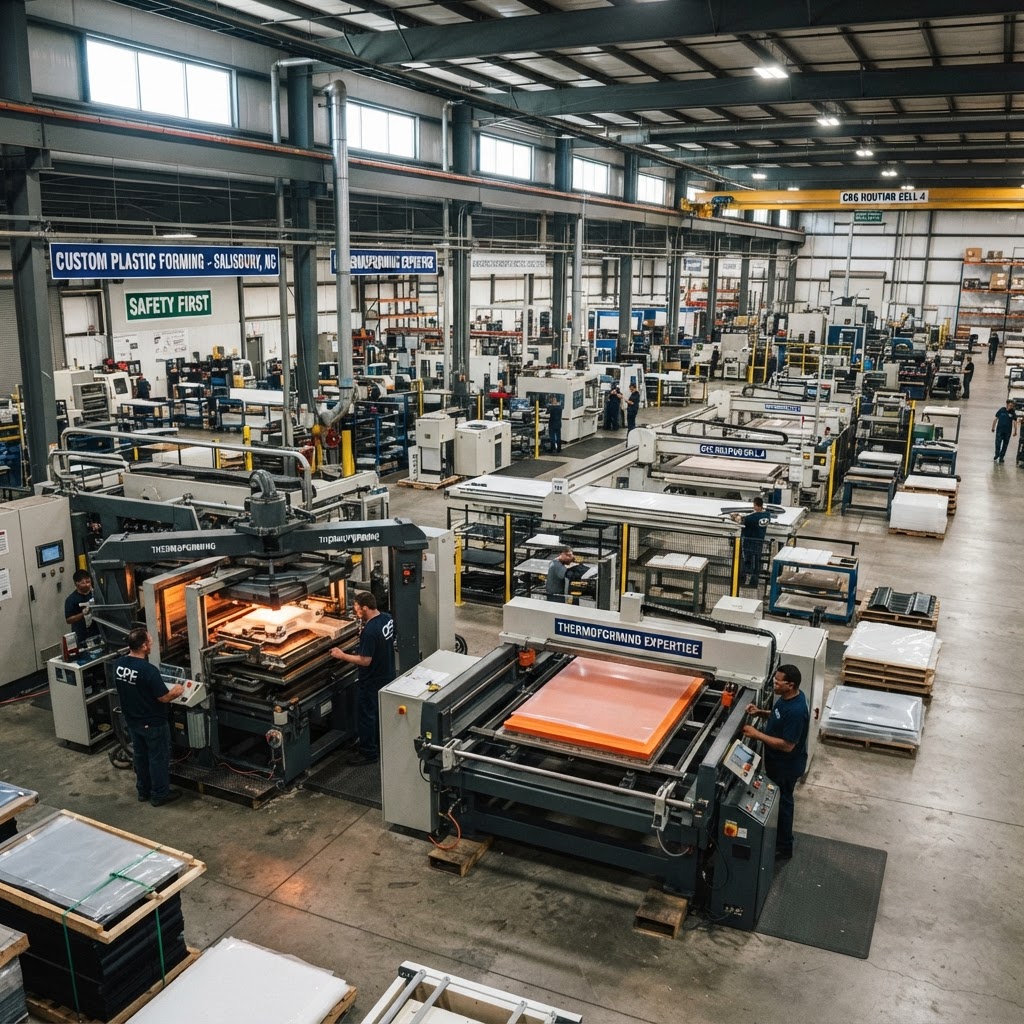
The hum hits you before you get through the door. Inside Custom Plastic Forming's facility in Salisbury, North Carolina, rolls of plastic sheet feed into in-line thermoforming equipment with the steady rhythm of a shop that knows exactly what it's doing. Overhead, material staged for the next run sits organized and labeled. On the floor, finished parts move toward trim stations where operators check edges, dimensions, and surface quality with the kind of attention that doesn't come from a checklist — it comes from experience. This is not a flashy operation. It's a working one, and that distinction matters.
Salisbury sits in the Piedmont region of North Carolina, a part of the state with deep manufacturing roots. The town has made things for a long time, and Custom Plastic Forming fits naturally into that tradition. Since its founding in the early 2000s, the company has built a reputation as a serious thermoforming shop — one that handles the full range of the process, from the thinnest packaging films to the heaviest structural components, all under one roof.
What They Actually Do
Thermoforming is one of those processes that sounds simple until you try to do it right at scale. You heat a plastic sheet, press or vacuum it over a mold, trim it, and ship it. In practice, the variables are unforgiving. Material thickness, temperature uniformity, mold geometry, cooling rate, trim tolerance — every one of those factors has to be controlled, and controlling them across two fundamentally different categories of work is where Custom Plastic Forming earns its credibility.
The shop runs thin-gauge thermoforming on in-line equipment capable of processing material from 0.010 inches up through 0.090 inches. This is the territory of packaging — clamshells, blisters, trays, and formed components where material economy and cycle speed matter. The in-line configuration means the sheet feeds, forms, trims, and stacks in a continuous process, which keeps tolerances consistent and output predictable.
On the other end of the floor, heavy-gauge thermoforming machinery handles sheet stock well beyond the 0.090-inch threshold. This is where the work shifts from packaging into industrial and structural components — equipment housings, protective panels, interior liners, formed parts that carry load or need to hold geometry under real-world conditions. Heavy-gauge work is slower and more deliberate, demanding different tooling, different process controls, and a different eye from the operators running it.
Most thermoforming shops pick a lane. They build their equipment list, their tooling inventory, and their workforce around either thin-gauge or heavy-gauge work, because the two disciplines have different demands. Custom Plastic Forming chose not to make that choice. That decision — to carry both capabilities and develop genuine depth in each — defines what the shop is.
Turnkey Is Not a Marketing Word Here
Custom Plastic Forming positions itself as a turnkey plastic manufacturer, and in this context that phrase carries specific meaning. The shop manages the process from initial design concept through tooling, production, and final delivery. For procurement managers and sourcing teams working against tight timelines, that kind of single-source accountability reduces the coordination burden significantly.
Design engagement early in the process matters more in thermoforming than many customers initially expect. Part geometry affects draw ratios, wall thickness distribution, and trim line placement in ways that aren't always obvious on a CAD screen. Getting the shop involved at the design stage — rather than handing over a finished print and hoping for the best — typically produces better parts at lower cost. Custom Plastic Forming's full-service model is structured to support that kind of upstream collaboration.

What will it take to turn demand into delivered output?
Explore The Capacity Imperative, our report on U.S. advanced manufacturing and the priorities shaping 2027.
For engineering teams developing new products, that's a real resource. The company's website at customplasticforming.com provides a starting point for understanding their capabilities before the first conversation, which is worth reviewing if you're trying to determine whether your application fits their process range.
Who They Serve
The capability profile here — thin-gauge packaging through heavy-gauge structural components, with full-service project management — maps onto a wide customer base. Consumer goods companies that need retail-ready packaging. Industrial equipment manufacturers that need formed housings or protective covers. Medical and food-adjacent businesses that require tight tolerances and material documentation. Point-of-purchase display producers. Agricultural and outdoor equipment makers who need parts that can take abuse.
Salisbury's location in the Piedmont gives the shop reasonable logistics access across the Southeast and Mid-Atlantic, and their capabilities travel further than their geography for customers who prioritize process depth over proximity.
What Makes This Shop Different
The honest answer is the breadth they've maintained without losing the shop-floor discipline that makes either category of work reliable.
Most thermoforming operations optimize for one thing. They build expertise in thin-gauge high-volume runs, or they specialize in heavy-gauge low-volume prototype and production work. The economics push that way — equipment, tooling, and workforce development all favor specialization. Custom Plastic Forming has resisted that gravity, and that resistance has a cost. It requires a broader equipment base, operators trained across both disciplines, and process engineers who understand the different variables at play in each.
The payoff for the customer is access to a single qualified supplier who can handle both sides of a product program. If you're sourcing packaging and structural components for the same assembly, or if your product line spans both categories, managing one shop with proven depth in each is genuinely more efficient than managing two.
There's also something worth noting about the company's size. At somewhere between 50 and 200 employees, Custom Plastic Forming is large enough to carry real capacity and process infrastructure, but small enough that customer relationships aren't managed by committee. Procurement teams working with shops in this range frequently report faster response times and more direct communication with people who actually run the equipment. That matters when a production issue surfaces or a design revision needs to move quickly.
About Custom Plastic Forming
- Location: Salisbury, North Carolina
- Founded: Early 2000s
- Employees: 50–200
- Core Capabilities: Thin-gauge thermoforming, heavy-gauge thermoforming, turnkey plastic manufacturing
- Material Range: 0.010" through 0.090"+ sheet thickness
- Process: In-line thin-gauge equipment and dedicated heavy-gauge forming machinery
- Service Model: Design through delivery, single-source project management
- Website: customplasticforming.com
Where to Find Them
Custom Plastic Forming operates out of Salisbury, North Carolina, in the heart of the Piedmont manufacturing corridor. For sourcing teams, engineers evaluating suppliers, or operations managers looking to qualify a thermoforming partner with genuine dual-capability depth, the shop is worth a direct conversation.
Start with their capabilities overview and contact information at Visit Custom Plastic Forming. If your application involves thermoformed plastic parts — whether you're sourcing packaging, structural components, or both — this is a shop that has earned a place on the evaluation list.
Sponsored by Manufacturing Ultra
This Manufacturer Spotlight is brought to you by Manufacturing Ultra — a zero-upfront-cost website development and digital growth program built exclusively for American manufacturers. Whether you need a modern website, SEO, or digital marketing, Manufacturing Ultra delivers without the upfront cost. Visit manufacturingultra.com to learn how they help shops like Custom Plastic Forming grow their digital presence.

