
The True ROI of Lights-Out Manufacturing in 2026 — October 2026
North American manufacturers who committed to lights-out operations between 2023 and 2025 are now reporting fully loaded payback periods under 30 months — and the numbers are forcing every holdout to recalculate.
Lights-Out Is No Longer a Moonshot — It Is a Competitive Baseline
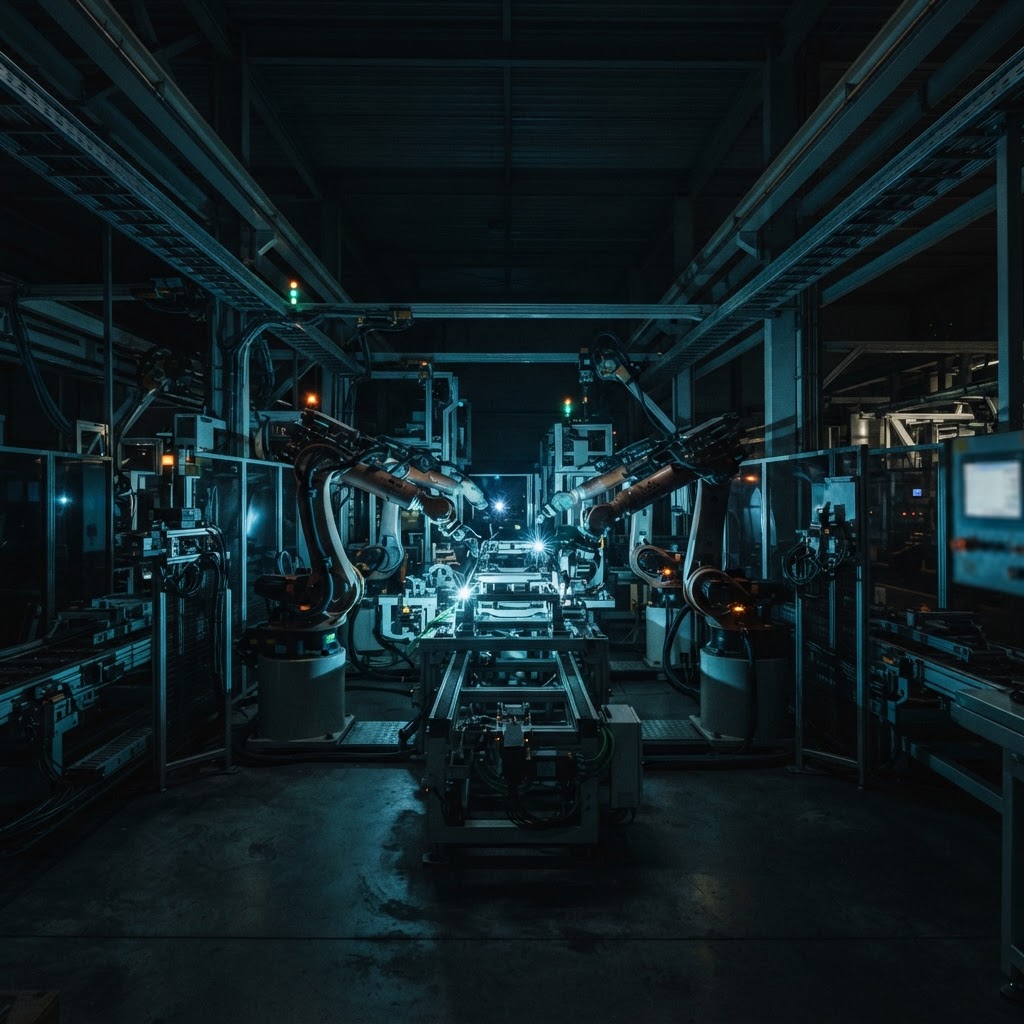
The conversation shifted this year. Lights-out manufacturing — fully automated production running with zero human presence on the floor during off-hours — was once the domain of automotive tier-ones and aerospace primes with nine-figure capex budgets. In 2026, mid-market fabricators running 50,000 to 200,000 square feet are executing the same playbook, scaled down and backed by dramatically cheaper robotics hardware.
The technology stack driving this has matured fast:
- Robotic machining and welding cells from FANUC and ABB Robotics now ship with integrated vision and adaptive path correction as standard, not add-ons
- Collaborative and autonomous mobile robots (AMRs) from Mobile Industrial Robots (MiR) handle inter-cell material movement without fixed infrastructure
- AI-driven quality inspection platforms integrated directly into the line eliminate the last hard dependency on overnight staffing
- Edge PLCs and IIoT gateways from Rockwell Automation now support real-time fault detection that pages on-call technicians rather than requiring floor presence
The result: a factory that runs from 10 PM to 6 AM producing finished parts, consuming electricity at off-peak rates, with one remote operations technician monitoring five or more cells simultaneously.
The Real Cost Equation Has Three Layers Most Operators Miss
Payback period calculations for lights-out conversions routinely get quoted at the robot hardware level. That is the wrong starting point. The true ROI calculation has three distinct cost layers:
Layer 1 — Direct Labor Displacement The most obvious. A lights-out shift eliminates two to four direct labor positions per cell per shift. At fully loaded labor costs averaging $58,000–$78,000 annually per operator in Midwest and Southeast manufacturing corridors, a four-cell conversion displacing eight overnight positions generates $460,000–$624,000 in annual savings before touching anything else.
Layer 2 — Energy Arbitrage Off-peak industrial electricity rates in states like Texas, Ohio, and Tennessee run 18–35% below peak-hour rates. A facility running energy-intensive CNC machining or resistance welding during off-peak windows captures real margin on every part produced. This layer is almost never modeled in initial ROI decks — and it compounds.
Layer 3 — Throughput Multiplier A lights-out cell does not take breaks, does not have shift-change gaps, and does not slow down at hour seven. Effective utilization on a properly configured automated cell runs 85–92%, versus 55–68% for a human-staffed equivalent. That utilization delta translates directly to capacity without adding square footage.
"The operators who only model labor replacement are leaving the energy arbitrage and utilization uplift on the table — which is often 40% of the total ROI case."
The Integration Stack That Actually Enables Overnight Autonomy
Hardware alone does not make a factory lights-out capable. The integration layer is where projects succeed or stall. Here is what a functional 2026 lights-out stack looks like in practice:

What will it take to turn demand into delivered output?
Explore The Capacity Imperative, our report on U.S. advanced manufacturing and the priorities shaping 2027.
- Cell-level autonomy — Robotic arms from FANUC or Universal Robots with vision-guided part location, automatic tool wear compensation, and alarm escalation logic built into the controller
- Material flow automation — AMR fleets from MiR or Omron operating on dynamic maps that adapt to floor changes without re-programming
- Quality gate automation — Inline vision inspection from platforms like Cognex running 100% inspection at line speed, with automatic part rejection and MES logging
- Remote monitoring infrastructure — Unified dashboards built on Rockwell's FactoryTalk or Siemens MindSphere aggregating cell status, OEE, and fault codes into a single remote operations view
- Predictive maintenance integration — Vibration, thermal, and current-draw sensors feeding ML models that flag impending failures before they cause unplanned downtime — the single biggest risk to lights-out reliability
System integrators with demonstrated lights-out commissioning experience — including System Integrators of America member firms and automation-focused SIs like Concept Systems — are commanding premium rates in 2026 because demand has outpaced supply of qualified integration talent.
What This Means for Your Floor
If you are an operations director or plant manager evaluating lights-out feasibility right now, the decision framework has changed materially from even 18 months ago. Here is what to act on:
- Start with a single high-volume, high-repeatability cell. Lights-out is not an all-or-nothing facility transformation. Identify the one cell running the most predictable parts geometry with the lowest setup frequency — that is your pilot.
- Model all three ROI layers before presenting to finance. Labor displacement alone rarely clears hurdle rates. Energy arbitrage and utilization uplift together frequently push IRR past 35%.
- Invest in the monitoring infrastructure before the robots. Facilities that go lights-out without robust remote monitoring create liability, not efficiency. The OT security and remote access architecture needs to be in place first.
- Audit your integrator's lights-out track record specifically. General automation experience is not sufficient. Ask for references from facilities running unmanned overnight operations, and ask about their first-year unplanned downtime rates.
- Engage your utility provider early. Time-of-use rate structures vary widely by utility and state. Some providers offer demand response incentives for manufacturers willing to shift load — money that goes directly to payback acceleration.
The manufacturers executing this well in 2026 are not waiting for perfect conditions. They are running pilots, measuring hard, and scaling what works. The ones waiting are watching their cost-per-part gap widen every quarter.
The Labor Conversation Is More Nuanced Than the Headlines Suggest
Lights-out manufacturing does not eliminate your workforce — it restructures it. The overnight direct labor positions that disappear are replaced by a smaller number of higher-skill roles: controls engineers, remote operations technicians, and predictive maintenance specialists. The net headcount impact is a reduction, but the skill profile of the remaining workforce shifts sharply upward.
Manufacturers navigating this transition successfully are partnering with community colleges and technical institutes participating in DOL Registered Apprenticeship programs to pipeline robotics and controls talent. The workforce planning problem is as real as the technology problem — and it needs to be solved in parallel, not after commissioning.
The facilities that treat lights-out as purely a capital deployment exercise, without modeling the workforce transition, are the ones that go dark for the wrong reasons.
Sources: FANUC Robotics · Rockwell Automation FactoryTalk · Universal Robots · U.S. Department of Labor Apprenticeship · Cognex Machine Vision

