
Apprenticeships Are Back. Can They Scale Fast Enough? — October 2026
America's apprenticeship system is experiencing its most significant expansion in decades — but the pace of that growth is racing against a workforce gap that isn't waiting around.
A Morning in Rockford, Illinois
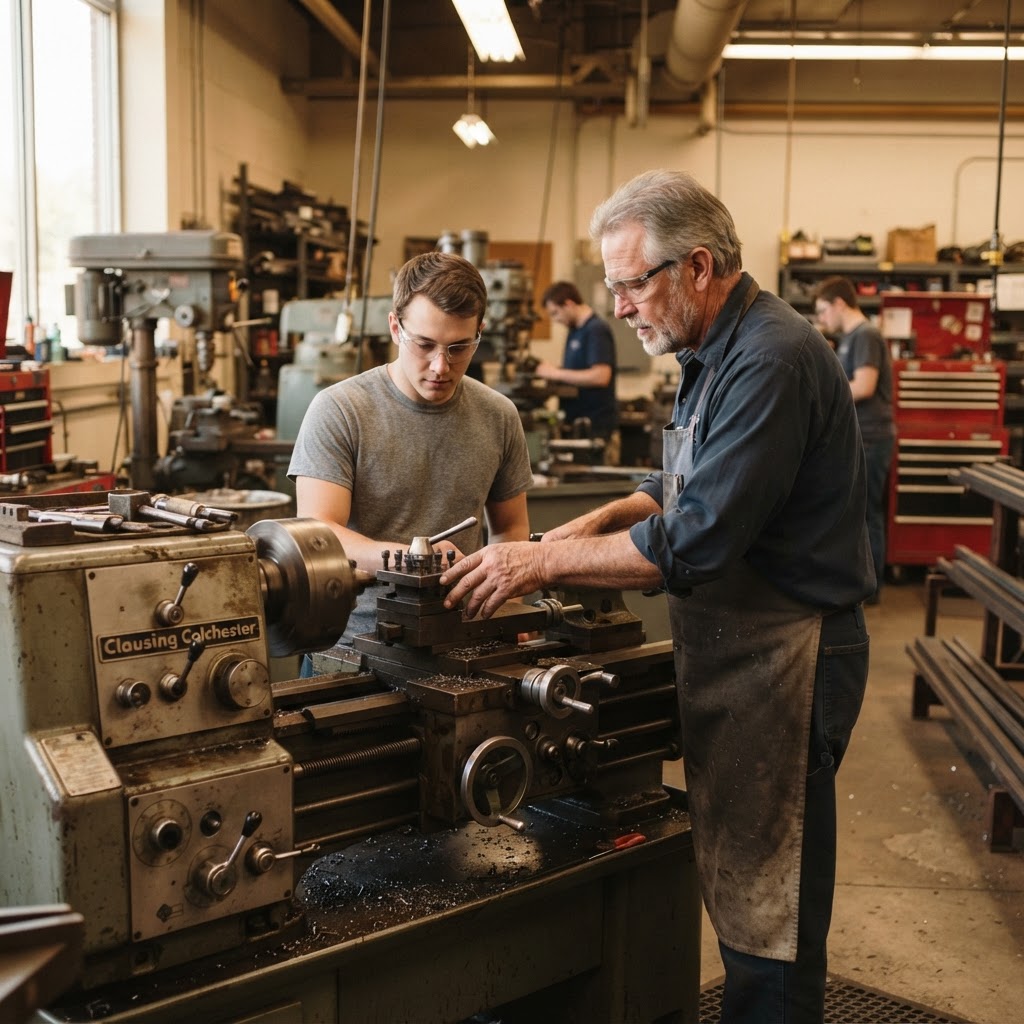
At 6:45 a.m. on a Tuesday in September, Marcus Tillman laced up his steel-toes and clocked into his second year at Ingersoll Machine Tools. He is twenty-three years old, earns $24.80 an hour, and spends three days a week on the floor and two days in class at Rock Valley College. He does not have a four-year degree. He does not have student debt. He has a registered apprenticeship — and by next spring, he will have a journeyman credential in precision machining that most manufacturers in the Midwest will compete to hire.
"I didn't want to sit in a classroom for four years and come out not knowing how to actually make anything," Marcus said during a break between setups. "Here, I'm making things on day one."
His story is not unusual anymore. It is becoming a template.
The Numbers Behind the Revival
The United States currently has approximately 593,000 active apprentices, according to the U.S. Department of Labor's Office of Apprenticeship — a figure that has grown steadily since the federal government expanded the Registered Apprenticeship Partners in Industry framework in 2021 and accelerated funding through the CHIPS and Science Act workforce provisions in 2022.
Manufacturing accounts for the largest single share of those enrollments, with industrial maintenance, welding, machining, and mechatronics — a blend of mechanical and electronic systems work — leading program growth. The Bureau of Labor Statistics projects manufacturing will need to fill over 3.8 million jobs by 2033, with roughly half of those going unfilled at current training rates.
The gap is not hypothetical. It is already showing up on production schedules.
Key program growth indicators as of mid-2026:
- Registered apprenticeship completions in manufacturing are up 34 percent since 2022
- Average apprentice wage nationally sits at $22–$28 per hour during training, competitive with associate-degree starting salaries
- Completion rates for employer-sponsored programs run between 67 and 72 percent, well above traditional community college certificate completion rates
- Siemens USA and Volkswagen Group of America both report that apprenticeship graduates are retained at rates exceeding 85 percent after three years
Where the Model Is Working — and Why
The programs gaining the most traction share a few structural features that separate them from older, more bureaucratic versions of the model.
First, they are employer-led but school-supported. Companies like Caterpillar and Lincoln Electric anchor curriculum design around real production needs, then partner with community colleges to deliver the classroom component. That eliminates the chronic problem of graduates trained on theory that doesn't match shop-floor reality.
Second, they are paid from day one. The earn-while-you-learn model removes the financial barrier that has historically kept working-class candidates out of skills training. For a 22-year-old who needs to pay rent, an unpaid or stipend-based program simply isn't viable.

What will it take to turn demand into delivered output?
Explore The Capacity Imperative, our report on U.S. advanced manufacturing and the priorities shaping 2027.
Third, they are short enough to actually finish. Most manufacturing apprenticeships run two to four years — long enough to build genuine expertise, short enough to prevent dropout from life pressures.
"The companies that are winning the talent war right now aren't poaching — they're growing their own. Apprenticeship is how you do that at scale."
That observation comes from operations directors across the Midwest who have watched neighboring plants scramble for CNC operators while their own pipelines stay full. The difference, consistently, is whether the company made the institutional commitment three years ago to build a registered program rather than wait for qualified applicants to appear.
The Scaling Problem Nobody Wants to Talk About
Here is the honest part: 593,000 active apprentices sounds significant until you compare it to Germany's 1.3 million — in a country with roughly one-quarter of America's population. Proportionally, the U.S. is still decades behind peer manufacturing nations.
The bottlenecks are real and specific:
- Small and mid-sized manufacturers lack HR infrastructure to administer registered programs. The paperwork burden of federal registration discourages shops with fewer than 200 employees, which represent the overwhelming majority of U.S. manufacturers.
- Community college capacity is strained. Instructors who can teach mechatronics or precision metrology are in short supply, and many colleges cannot expand cohorts fast enough to meet employer demand.
- State-level inconsistency creates a patchwork. States like South Carolina, which has run one of the most successful apprenticeship systems in the country since 2007, show what's possible — but their model has not been replicated at scale elsewhere.
- Awareness gaps persist among the populations who would benefit most. First-generation workers, recent high school graduates, and career changers often don't know registered apprenticeship exists as a path.
The Biden-Harris Apprenticeship Building America grants, extended and rebranded under current administration workforce policy, have directed over $300 million toward expansion since 2023. That funding is helping — but it is channeled primarily toward program creation, not toward the harder problem of long-term program sustainability for smaller operators.
What Comes Next
Marcus Tillman will complete his apprenticeship in March. He already has two offers. He is thinking about whether to stay at Ingersoll, where he knows the machines and the people, or move to a composites manufacturer in Belvidere that is offering a lead technician role he wasn't expecting to be eligible for at twenty-four.
That is a good problem for him to have. The question the industry is working through is whether enough young workers get to face that same choice.
The infrastructure for scale exists — the federal framework, the community college network, the employer interest. What the system still needs is simplification for small manufacturers, sustained public awareness investment, and the patience to measure outcomes in years rather than quarters. The apprenticeship revival is real. Whether it arrives fast enough to close the gap is the manufacturing workforce story of this decade.
Sources: U.S. Department of Labor — Apprenticeship.gov · Bureau of Labor Statistics Employment Projections · ApprenticeshipCarolina · DOL Apprenticeship Building America Grants · Lincoln Electric Education Programs

