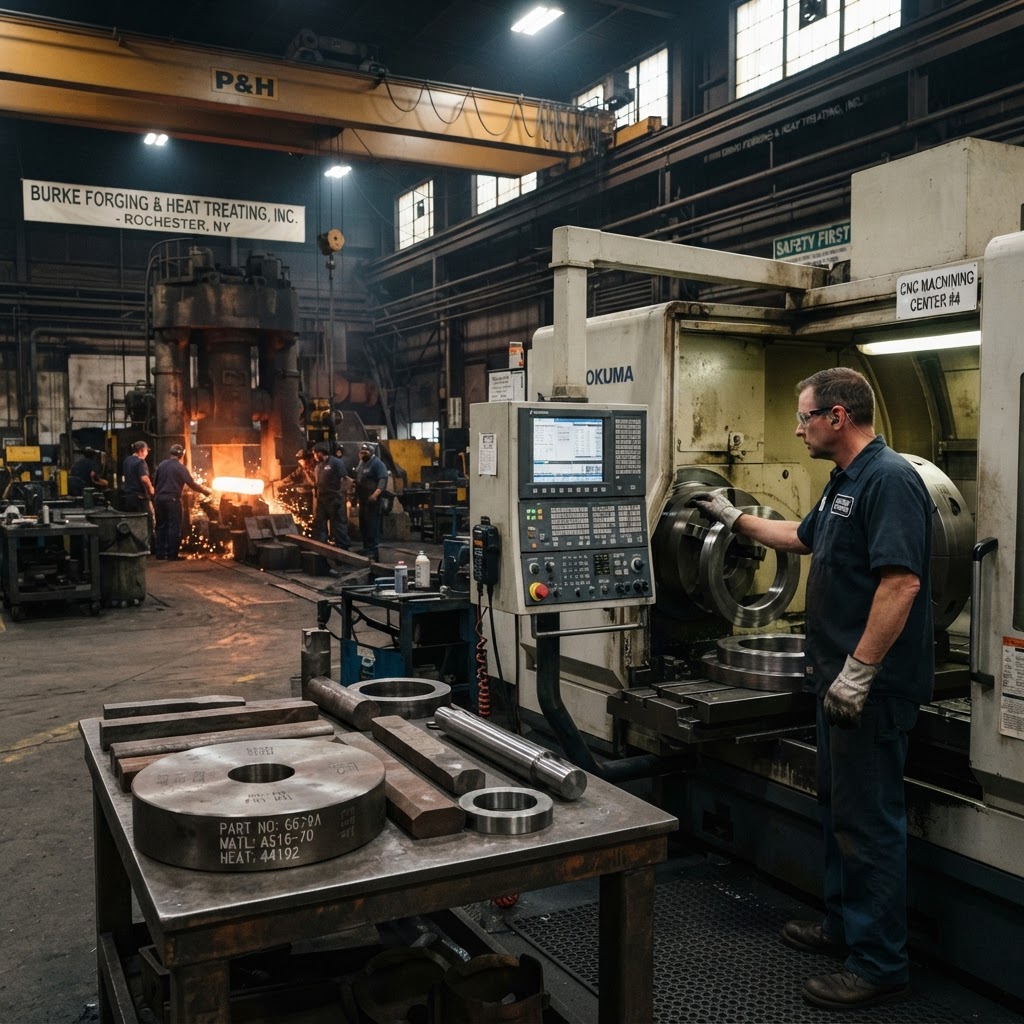


Inside Burke Forging & Heat Treating, Inc.: A Forging and Heat Treatment Shop Built on Precision and Pride
The press comes down hard. You feel it before you hear it — a low concussive thud that moves through the concrete floor and up through your boots. A glowing billet of carbon steel, pulled from the furnace minutes ago, takes a new shape under the die. The operator watches, repositions the workpiece with practiced economy of motion, and the press cycles again. No wasted movement. No second-guessing. This is open-die forging, one of the oldest and most demanding metalworking disciplines in American manufacturing — and at Burke Forging & Heat Treating, Inc. in Rochester, New York, it's what they've been doing since the 1980s.
For procurement managers sourcing forgings for aerospace assemblies, defense components, or oil and gas equipment, the search for a reliable, capable forge shop is never trivial. Lead times, material certifications, post-forge processing, dimensional consistency — the variables stack up fast. Burke Forging operates as a deliberate answer to most of those variables, offering forging, heat treatment, and machining under one roof in a facility that has been refining its process for decades.
What They Make
Burke Forging produces a focused but practical range of forged products. Their catalog includes forged discs, bars, shafts, blocks, hubs, pinions, and seamless rolled rings — the kind of geometries that show up repeatedly in rotating equipment, structural assemblies, pressure-containing components, and drivetrain applications across demanding industries.
Seamless rolled rings deserve particular attention here. Ring rolling is a specialized process that produces near-net-shape annular components with grain flow oriented circumferentially — which is exactly what you want in flanges, bearing races, gear blanks, and similar parts that see rotational stress. Not every forge shop offers this capability. Burke does.
Material coverage spans carbon steel, low-alloy steel, and stainless steel, which covers the vast majority of industrial forging requirements outside of titanium and nickel superalloy territory. For engineers specifying components in the 4140, 4340, 17-4 PH, or 304/316 families, Burke's material capability is a natural fit.
The Equipment Behind the Work
Open-die forging demands capital equipment built to handle serious tonnage and thermal cycling. Burke operates industrial forging presses sized for the kind of production work that aerospace and defense supply chains require, paired with heat treating furnaces capable of executing the controlled thermal cycles — normalize, anneal, quench and temper, stress relieve — that transform raw forgings into finished material meeting tight mechanical property specifications.
Heat treatment is not a footnote at Burke. It's a core competency. The ability to forge and then immediately control the downstream heat treatment in the same facility eliminates a handoff that introduces scheduling risk, handling damage, and documentation gaps. For quality engineers managing AS9100 or API supply chain requirements, that integrated process chain matters.

What will it take to turn demand into delivered output?
Explore The Capacity Imperative, our report on U.S. advanced manufacturing and the priorities shaping 2027.
Machining capability rounds out the picture. Rough machining of forgings — facing, turning, boring to near-net dimensions — can be completed in-house, reducing the number of vendors a procurement team has to manage for a single part number.
Who They Serve
Burke Forging operates in three sectors that have little tolerance for marginal suppliers: aerospace, defense, and oil and gas. These aren't markets where a shop stays in business on price alone. Customers in these verticals require material traceability, dimensional repeatability, and the kind of process discipline that holds up under audit.
A forge shop that has been running production for aerospace and defense customers since the 1980s has survived qualification cycles, customer audits, and the periodic sourcing reviews that large OEMs and Tier 1 suppliers conduct. That longevity in demanding verticals carries real informational weight for sourcing teams evaluating new suppliers.
The oil and gas sector adds another layer of process rigor — NACE compliance concerns, sour service material requirements, and the pressure vessel and wellhead component standards that come with downhole and surface equipment. Burke's multi-decade presence in this market signals that they understand these requirements at an operational level, not just a sales level.
What Makes This Shop Different
In an era where manufacturers are often evaluated on the sophistication of their digital quoting platforms or the square footage of their facility, Burke Forging represents a different value proposition. This is a focused, vertically integrated forge shop where the work gets done by a team of experienced people operating specialized equipment they know intimately.
The integrated forge-heat treat-machine workflow is the operational differentiator. Many job shops can do one or two of those steps. Doing all three in sequence, under one quality system, with one point of accountability, is a genuinely different service model. For program managers dealing with complex supply chains, consolidating three operations into one purchase order is a meaningful efficiency gain.
Rochester, New York also places Burke in a region with deep industrial manufacturing heritage — precision optics, aerospace components, industrial equipment. The regional workforce and supplier ecosystem reflect that history. Finding skilled press operators and heat treat technicians is easier in a community that has been producing industrial workers for generations.
For procurement and sourcing teams who want to evaluate Burke's capabilities directly, their website at burkeforging.com provides the clearest picture of their product and service offering. It's a practical resource for establishing contact and beginning the supplier qualification conversation.
About Burke Forging & Heat Treating, Inc.
- Founded: 1980s
- Location: Rochester, New York
- Employees: 11–50
- Core Capabilities: Open-die forging, seamless rolled ring production, heat treatment, in-house machining
- Materials Processed: Carbon steel, low-alloy steel, stainless steel
- Markets Served: Aerospace, defense, oil and gas, general industrial
- Products: Forged discs, bars, shafts, blocks, hubs, pinions, seamless rolled rings
- Website: Visit Burke Forging & Heat Treating, Inc.
Where to Find Them
Burke Forging & Heat Treating, Inc. is located in Rochester, New York — a historically strong manufacturing region in the northeastern United States with ready access to East Coast industrial markets and Midwest supply chains.
Manufacturing engineers, procurement managers, and operations teams looking to qualify a capable, integrated forge shop for aerospace, defense, or oil and gas applications should start the conversation directly.

