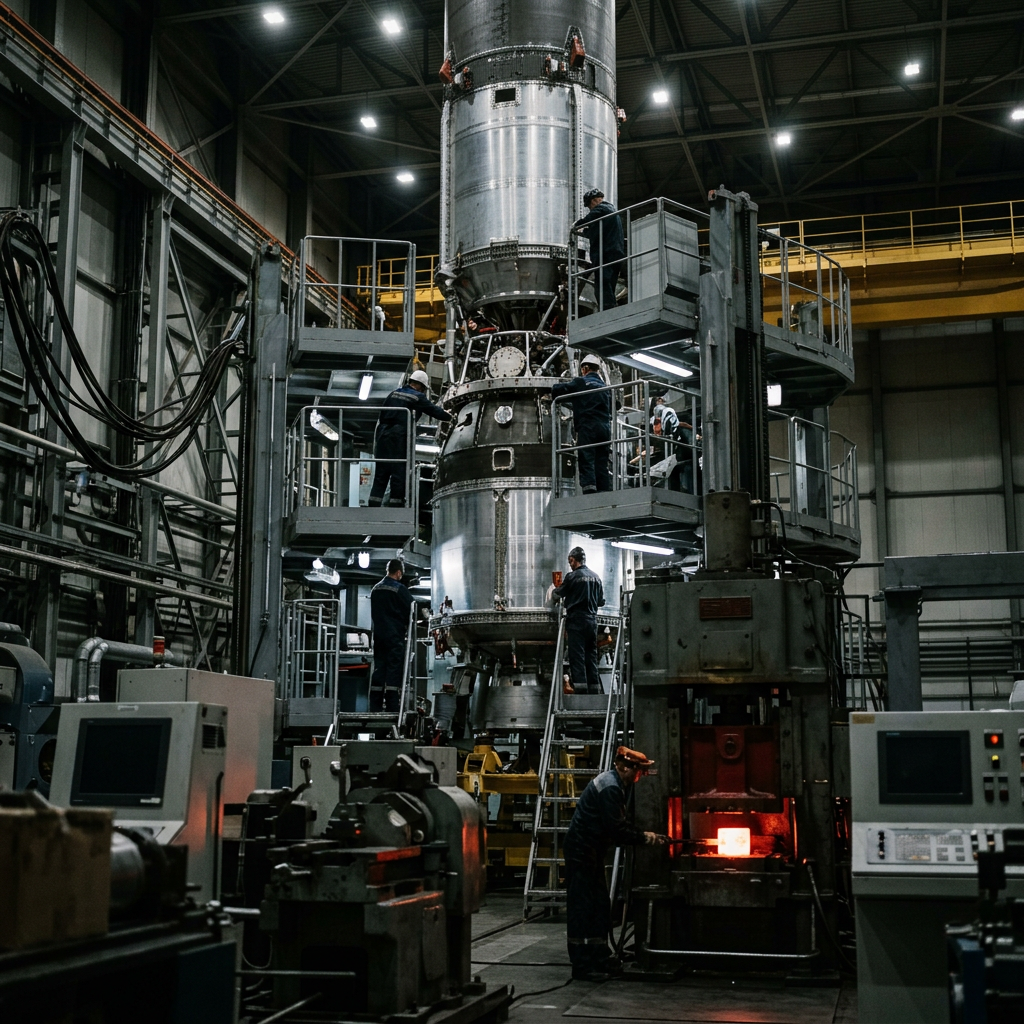

Space Manufacturing: The Next Frontier for Advanced Production — October 2026
When NASA's Apollo program drove the development of integrated circuits in the 1960s, no one in the supply chain fully understood they were building the foundation of modern computing. The same dynamic is now unfolding in low Earth orbit, where microgravity manufacturing is transitioning from laboratory curiosity to serious production consideration — and the American industrial base is, once again, either positioned to lead or destined to watch from the ground floor.
The Physics of Orbit Are a Manufacturing Advantage, Not a Novelty
The core argument for space manufacturing is not promotional — it is material science. Microgravity eliminates the buoyancy-driven convection that causes defects in fiber optic cable production, pharmaceutical crystallization, and high-purity metal alloy solidification. The vacuum environment of low Earth orbit removes contamination vectors that require extraordinary mitigation costs inside terrestrial cleanrooms. These are not marginal improvements. In certain product categories, particularly ZBLAN fiber optic cable and protein crystal structures for drug development, the quality differential between Earth-manufactured and orbit-manufactured product is measurable and significant.
Redwire Corporation, which has operated manufacturing payloads aboard the International Space Station, has demonstrated ZBLAN fiber production with attenuation characteristics that outperform ground-manufactured equivalents. Varda Space Industries has moved further, deploying free-flying reentry capsules specifically designed to manufacture pharmaceutical compounds in orbit and return them to Earth — a process that bypasses the ISS entirely and treats space as an industrial zone rather than a research platform. Their W-1 mission completed reentry in early 2024 after navigating an extended regulatory dispute with the FAA, a preview of the jurisdictional friction that will characterize this industry for the next decade.
The Department of Defense has taken notice. DARPA has funded research into in-space manufacturing of structural components through its NOM4D program — Novel Orbital and Moon Manufacturing, Materials, and Mass-efficient Design — which targets the fabrication of large antenna structures and optical systems that cannot be practically launched from Earth due to size constraints. The strategic logic is straightforward: a 100-meter aperture antenna assembled in orbit is both more capable and more survivable than anything deployable from a launch vehicle fairing.
The Industrial Stack Is Being Built Right Now
Space manufacturing does not exist in isolation. It requires a supply chain, and that supply chain is American manufacturing's immediate opportunity. The infrastructure layer — launch vehicles, in-space tugs, orbital platforms, reentry systems — is being built by a generation of companies that are procurement-hungry and technically demanding.
SpaceX's Starship, assuming its launch cadence matures through 2026 and into 2027, dramatically reduces the cost per kilogram to orbit and changes the economic calculus of sending manufacturing equipment to space. Northrop Grumman's Cygnus resupply vehicle and its Mission Extension Vehicle program demonstrate that complex orbital servicing hardware can be produced at commercial scale. Sierra Space's Dream Chaser spaceplane, under contract with NASA, adds a reusable return vehicle to the equation — relevant for any manufacturing process that requires returning finished goods to terrestrial markets.
The NASA Commercial Low Earth Orbit Destinations program has awarded development agreements to Axiom Space, Northrop Grumman, and a Blue Origin-led consortium to construct private space stations that will succeed the ISS. These are not research vessels. They are designed as operational platforms, and manufacturing tenancy is explicitly part of their commercial models. The contracting vehicles attached to these programs — Other Transaction Agreements, Firm Fixed Price milestone contracts — are the procurement mechanisms through which the broader supply chain will eventually flow.
"Space manufacturing's competitive advantage is not ambition — it is the elimination of physical constraints that cost American manufacturers billions annually in process mitigation on the ground."
The U.S. Space Force, activated in 2019 and now a maturing procurement entity, is driving parallel demand through its Proliferated Warfighter Space Architecture program, which requires manufacturing throughput for satellite buses and components at a pace that legacy defense prime production lines were not designed to sustain. This is creating subcontract pressure across the RF systems, precision machining, and composite structures sectors — pressure that will intensify, not ease.

What will it take to turn demand into delivered output?
Explore The Capacity Imperative, our report on U.S. advanced manufacturing and the priorities shaping 2027.
Quality Systems and Autonomous Inspection Will Define Orbital Production
One dimension of space manufacturing that receives insufficient attention from the industrial press is quality assurance — specifically, the impossibility of human inspection at orbital production facilities in any near-term scenario. If Varda or Redwire is running a manufacturing process aboard a free-flying platform, the quality control architecture must be entirely autonomous. This connects directly to trends already reshaping terrestrial manufacturing: AI vision systems capable of defect detection at tolerances exceeding human inspector performance.
The parallel is not incidental. The same machine vision platforms being deployed on automotive and aerospace production lines — trained on convolutional neural networks and capable of sub-millimeter anomaly detection — are the foundational technology for autonomous quality management in orbit. Companies investing in AI-driven inspection infrastructure today are, without necessarily intending to, building competency relevant to space manufacturing supply chains within five years. The defense primes understand this. Lockheed Martin's Space division and Boeing's Defense, Space and Security segment have both expanded internal autonomous systems programs that span terrestrial and orbital applications.
For manufacturers currently implementing AI vision systems in their facilities — whether for semiconductor inspection, composite layup verification, or precision machined part validation — the process knowledge being developed is directly transferable. The hardware differs. The methodology does not.
It is worth noting, with no particular editorializing, that the United States government is simultaneously funding in-space manufacturing research, building orbital platform infrastructure, and developing autonomous quality systems — while Congress debates whether to extend the ISS to 2030. The policy coherence is, shall we say, a work in progress.
What This Means for Tier 2 and Tier 3 Suppliers
The actionable implications for mid-tier American manufacturers are specific and near-term:
-
Precision component opportunities are materializing now. The orbital platform programs — Axiom Station, Northrop's station module, Dream Chaser — require the same high-tolerance machined components, welded structural assemblies, and composite structures that Tier 2 and Tier 3 suppliers already produce for aviation and defense. These are not exotic new capabilities. They are existing capabilities applied to a new customer set with rigorous AS9100 and NASA quality requirements.
-
Autonomous inspection investment is no longer optional for this market. Any supplier seeking to qualify for orbital hardware programs will face quality documentation requirements that manual inspection processes cannot efficiently satisfy. Investments in AI vision systems and automated CMM workflows made for terrestrial customers will be table stakes for space hardware qualification.
-
DARPA and Space Force OTAs are accessible to non-traditional contractors. The Other Transaction Authority mechanism explicitly exists to bring companies into defense work that would not navigate traditional FAR-based contracting. Suppliers with novel process capabilities — particularly in advanced welding, additive manufacturing for metals, or precision optics fabrication — should be monitoring DARPA's BAA pipeline and Space Force procurement notices actively.
-
Material certifications for the space environment demand early investment. Space hardware requires material traceability and environmental qualification (thermal cycling, vacuum outgassing, radiation tolerance) that differs from aviation standards. Suppliers who begin building familiarity with NASA material specifications and ASTM space-relevant standards now will have a certification lead time advantage over competitors who wait for a contract award to start the process.
-
Nearshoring dynamics reinforce domestic positioning. As the broader manufacturing sector absorbs the lesson that extended offshore supply chains introduce unacceptable risk, space hardware programs — which carry national security classification implications and ITAR controls — are structurally required to source domestically. The nearshoring trend and the space manufacturing buildout point in the same direction: American Tier 2 and Tier 3 manufacturers with certified processes and domestic production capacity are in a structurally advantaged position.
The frontier is not metaphorical. The production contracts are being written, the platforms are being built, and the quality requirements are being defined. The manufacturers who treat this as a five-year horizon problem rather than a current business development priority will find the qualification cycles have already closed by the time they engage.
Sources: Redwire Corporation · DARPA NOM4D Program · NASA Commercial LEO Destinations · U.S. Space Force Acquisition · Varda Space Industries

