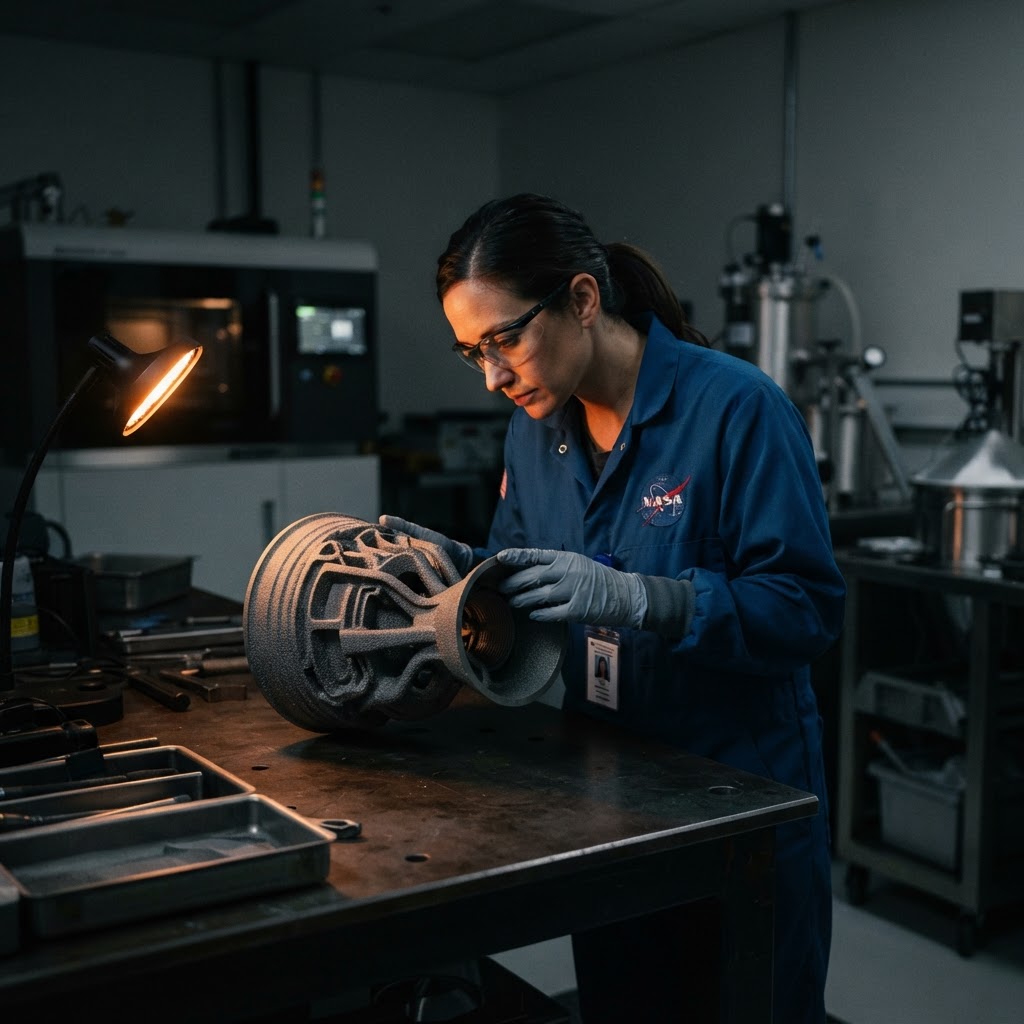

How NASA Is Using Additive to Rethink Rocket Engine Production — October 2026
When NASA's Marshall Space Flight Center began developing the F-1 engine for the Saturn V in the early 1960s, the manufacturing challenge was essentially brute force — weld it, machine it, test it to destruction, repeat. Six decades later, the agency is pursuing a fundamentally different philosophy: build fewer parts, build them faster, and build them in configurations that conventional subtractive manufacturing cannot produce at any price. Additive manufacturing is not a peripheral experiment at NASA anymore. It is load-bearing infrastructure in the next generation of American propulsion.
The Baseline Has Already Shifted at Marshall and Stennis
NASA's Marshall Space Flight Center has been the operational hub of this transition, running iterative hardware tests on additively manufactured combustion chambers, injectors, and turbopump components since the early 2020s. The agency's Game Changing Development program funded early-stage work that has since migrated into procurement-relevant hardware. What distinguishes the current phase from prior exploratory efforts is that the components being printed are no longer test articles — they are flight-candidate hardware under active evaluation for programs with real launch schedules and real congressional budget lines.
The numbers that matter here are part counts and lead times. A traditionally manufactured rocket engine combustion chamber assembly may consist of hundreds of individually machined and brazed components. NASA engineers working under the Rapid Analysis and Manufacturing Propulsion Technology (RAMPT) project have demonstrated combustion chambers produced via directed energy deposition with drastically reduced part counts — in documented cases, consolidating what were once dozens of parts into single monolithic structures. The RAMPT project specifically targeted large-scale nozzles and chamber components that had previously been impossible to print at the scale required for high-thrust engines.
Stennis Space Center has been the test validation layer, running hot-fire series on additively manufactured components that feed data back into the design-print-test loop. This closed loop is precisely what makes the current effort structurally different from prior additive initiatives that stalled at the prototype phase: test data is being used to refine print parameters in near-real time, compressing the traditional development cycle in ways that procurement offices at both NASA and the Department of Defense are watching closely.
The Industrial Partners Carrying the Manufacturing Load
NASA does not manufacture at scale — it qualifies. The actual production work flows through a network of aerospace primes and increasingly capable mid-tier manufacturers. Aerojet Rocketdyne, now operating under L3Harris following the 2023 acquisition, has been the most prominent prime integrating additive into propulsion production, with additively manufactured components appearing in the RS-25 engines that power the Space Launch System. The RS-25 program itself is a useful case study in how legacy engine designs get retrofitted for additive: rather than redesigning the engine from scratch, engineers identify components where additive offers geometric or lead-time advantages and substitute selectively.
Relativity Space represents the more aggressive end of the spectrum — the company's stated ambition to print 95 percent of a rocket by mass using its Stargate metal 3D printing systems has forced a reexamination of what vertically integrated additive production actually looks like at vehicle scale. Whether Relativity's approach proves commercially viable at high cadence is still an open question, but its existence has measurably raised the ambition threshold across the industry.
On the materials and process side, Elementum 3D has emerged as a significant supplier of aluminum alloy and refractory metal powders specifically engineered for rocket propulsion applications — a reminder that the additive supply chain in aerospace runs deeper than the OEMs and system integrators that receive the headline contracts.
"NASA is not printing rockets. It is printing the argument that the rockets of the next decade will be manufactured on terms the previous generation of tooling simply cannot meet."
Where Additive Creates Irreversible Leverage in Propulsion Design

What will it take to turn demand into delivered output?
Explore The Capacity Imperative, our report on U.S. advanced manufacturing and the priorities shaping 2027.
The engineering case for additive in rocket engines rests on three structural advantages that have proven durable across multiple programs and test campaigns:
-
Conformal cooling channels. Rocket combustion chambers operate at temperatures and pressures that require active cooling through channels embedded in chamber walls. Conventional manufacturing constrains channel geometry to what drills and milling tools can reach. Additive manufacturing removes that constraint entirely, allowing cooling channels to follow the thermal load contours of the chamber wall — a capability that improves engine efficiency and longevity simultaneously.
-
Part count reduction through topology optimization. Generative design tools, when paired with powder bed fusion or directed energy deposition systems, allow engineers to design for function rather than manufacturability. Brackets, manifolds, and injector assemblies that previously required assembly from multiple machined components can be produced as single parts, eliminating weld joints that are historically among the highest-risk features in propulsion hardware.
-
Schedule compression on long-lead items. In traditional propulsion manufacturing, turbopump housings and nozzle extensions are among the longest-lead components in an engine build sequence — often requiring six to eighteen months of machining, casting, and inspection. Additive production, once process parameters are qualified, can collapse those timelines significantly, which matters enormously when program schedules are under congressional pressure.
The dry observation worth making here: it took American aerospace roughly fifty years to accept that the manufacturing philosophy locked in during the Apollo era had become a constraint rather than a foundation. Progress, in this industry, moves at its own pace.
What This Means for Tier 2 and Tier 3 Suppliers
The NASA additive push is not an abstraction for the mid-market manufacturing base. It is a procurement shift with direct implications for suppliers currently positioned in conventional machining, casting, and welding for propulsion applications. The actionable implications are specific:
-
Qualify your powder supply chain now. Programs like RAMPT and the SLS RS-25 retrofit work require materials traceability that runs back to powder lot certification. Tier 3 suppliers feeding metal powders or print services into propulsion programs need AS9100 Rev D certification at minimum, and increasingly need NADCAP accreditation for additive processes. Suppliers without these credentials are already being screened out of RFQ processes.
-
Directed energy deposition is the growth vector for large components. Powder bed fusion dominates the public conversation around metal additive, but large-scale propulsion components — nozzle extensions, turbopump housings, large manifolds — are increasingly being produced via DED processes. Tier 2 job shops with large-envelope CNC capacity should be evaluating DED platform investments as a natural adjacency, not a leap.
-
Post-processing capability is the bottleneck. Additively manufactured propulsion hardware still requires extensive post-processing: hot isostatic pressing, heat treatment, precision finish machining, and non-destructive inspection. Suppliers with integrated post-processing capability — particularly those who can offer HIP services or coordinate CT scanning — have a structural advantage over pure-play print shops.
-
Watch the NASA Headquarters procurement portal for RAMPT follow-on contracts. The current program phase is transitioning toward larger production-representative hardware builds, which will require additional supplier capacity. Tier 2 and Tier 3 manufacturers who have invested in additive qualification should be registered in SAM.gov with relevant NAICS codes and actively monitoring for solicitations.
-
DoD propulsion programs are watching NASA's qualification data. DARPA and the Air Force Research Laboratory have parallel additive propulsion initiatives, and they are explicitly referencing NASA test data in their own program development. A supplier qualification earned on the NASA side has crossover value into defense propulsion work — an increasingly important consideration as the Space Force stands up its own organic launch and propulsion industrial base requirements.
The manufacturing base that wins propulsion additive work over the next decade will not be the one that simply owns a printer. It will be the one that has built the quality infrastructure, materials expertise, and post-processing depth to deliver flight-certified hardware on compressed schedules. The window to build those credentials is open now. It will not stay open indefinitely.
Sources: NASA RAMPT Project · NASA Marshall Space Flight Center · Aerojet Rocketdyne RS-25 · NASA Space Launch System · SAM.gov Federal Procurement

