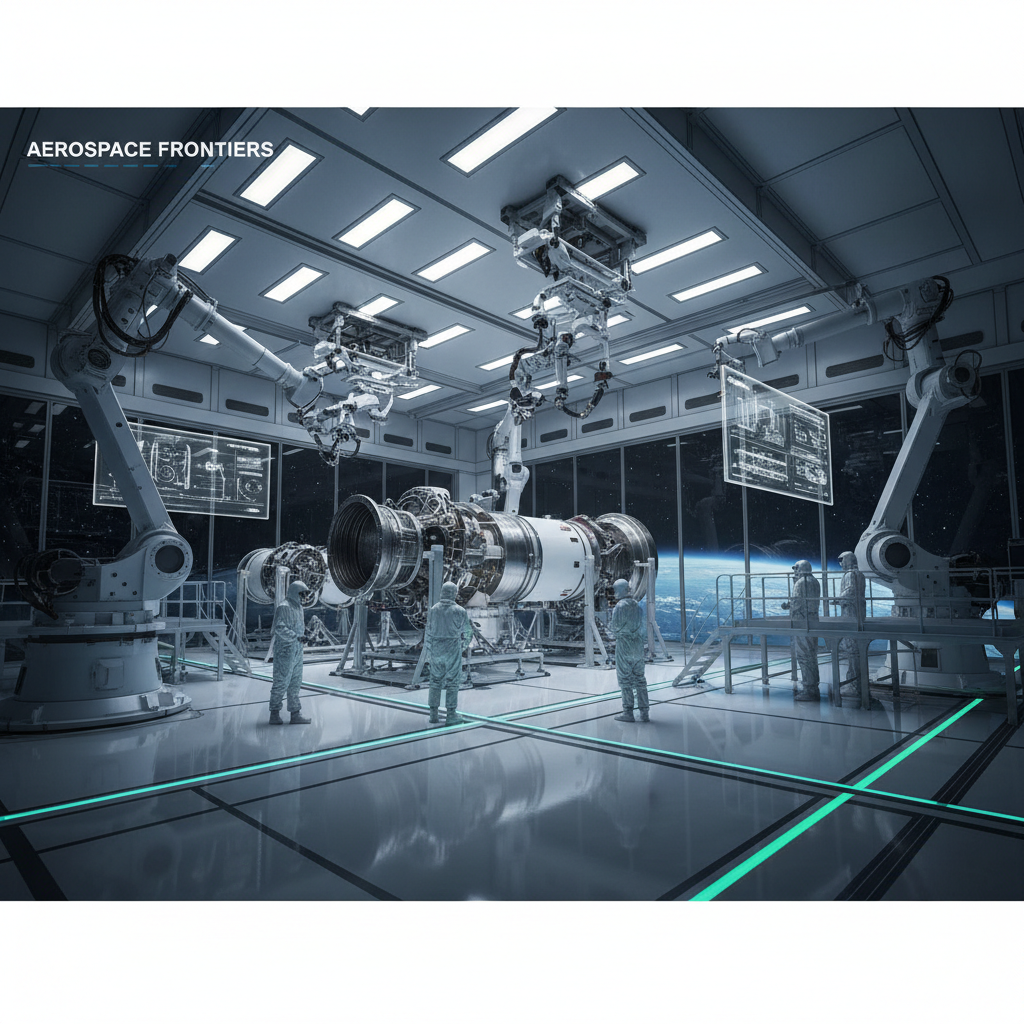

Space Manufacturing: The Next Frontier for Advanced Production
The last time American industry faced a manufacturing challenge this structurally novel, men were hand-torquing rivets into aluminum airframes and calling it aerospace. What's coming next makes that look like sheet metal work.
Space manufacturing - the actual fabrication of components, materials, and structures in orbital or near-orbital environments - has moved from a NASA PowerPoint abstraction to a funded, contracted, operationally serious industry segment in less time than most plant managers have held their current titles. The question for manufacturing executives is no longer whether this sector will mature. It's whether your organization understands what it demands before the first production contracts are locked.
Why Microgravity Changes the Physics of Production
The manufacturing case for space begins with a simple physical reality that no amount of terrestrial engineering can fully replicate: microgravity eliminates convection, sedimentation, and buoyancy-driven defects that plague Earth-based production of certain advanced materials. Fiber optic preforms grown in orbit produce ZBLAN glass - a fluoride-based optical fiber - with dramatically reduced crystalline impurities compared to ground-produced equivalents. The same logic applies to pharmaceutical protein crystals, semiconductor substrates, and specific metal alloys where gravity-induced density stratification corrupts material uniformity.
This isn't theoretical. Redwire Corporation, operating out of Jacksonville with deep roots in legacy space hardware, has been running in-space manufacturing experiments aboard the International Space Station for years, producing ZBLAN fiber and bioprinted tissue constructs. Varda Space Industries took the argument further by designing an autonomous reentry capsule specifically to manufacture pharmaceutical compounds in orbit and return them to Earth - a closed-loop production model that treats the ISS altitude as a factory floor and the Utah desert as a receiving dock.
For operations directors accustomed to thinking in terms of yield rates, throughput, and defect per million opportunities, the microgravity advantage reframes the production cost equation entirely. The launch cost is not overhead. It is a material input - the price of accessing a processing environment that cannot be purchased on the ground at any cost.
The Infrastructure Problem Is the Manufacturing Problem
Every serious manufacturing executive who has expanded into a new facility knows that the building is the least of it. Tooling, utilities, supply chain proximity, workforce density, logistics access - these are the actual constraints. Space manufacturing faces all of them, compressed into an environment where a misaligned connector isn't a maintenance ticket, it's a mission failure.
In-Space Manufacturing (ISM) as a discipline has had to invent its own tooling logic. Traditional subtractive machining produces debris that migrates unpredictably in microgravity. Thermal management operates differently without convective cooling. Robotic manipulation systems must account for Newton's Third Law in ways that a shop floor robot arm never does - applying torque to a fastener in space means the fastener and the operator experience equal and opposite reactions unless the system is properly grounded.
The companies solving these problems are not the legacy primes - at least not primarily. Made In Space (now operating under Redwire following acquisition) pioneered additive manufacturing in orbit, running the Additive Manufacturing Facility aboard the ISS and producing functional plastic components on-demand. The implication for supply chain managers is significant: for long-duration missions, the printer is the parts warehouse. Relativity Space took a different but related approach, building terrestrial rocket structures via massive-scale additive manufacturing to reduce part counts and supply chain exposure before a single kilogram reaches orbit.

What will it take to turn demand into delivered output?
Explore The Capacity Imperative, our report on U.S. advanced manufacturing and the priorities shaping 2027.
The architecture of the Commercial Low Earth Orbit Destinations (CLD) program - NASA's effort to transition from ISS dependency to privately operated stations - is where the next wave of manufacturing infrastructure will be anchored. Axiom Space, Blue Origin's Orbital Reef consortium, and Northrop Grumman's station concept are all positioning not just as research platforms but as potential industrial facilities. The companies that understand how to outfit, certify, and operate production equipment in those environments will hold structural advantages that compound over years.
What Terrestrial Manufacturers Need to Understand Now
For plant managers and operations directors whose current business is firmly on the ground, the relevance isn't abstract. Several dynamics are already creating upstream and downstream linkages that touch conventional manufacturing:
-
Launch vehicle demand is creating precision manufacturing pressure. SpaceX's Starship program and United Launch Alliance's Vulcan Centaur represent sustained, high-volume demand for turbopumps, composite structures, avionics housings, and propellant handling hardware. These are not bespoke research articles - they are production components requiring process discipline, PPAP-equivalent documentation rigor, and supplier quality systems that can operate under AS9100 expectations.
-
Reusability economics are rewriting maintenance and overhaul logic. A Falcon 9 booster that lands and reflights dozens of times is not a satellite launch vehicle - it is a reusable production asset with an inspection and reconditioning cycle that mirrors commercial aviation MRO. The facilities and workflows supporting that model are terrestrial manufacturing operations.
-
In-space-assembled structures require Earth-side fabrication of precision modules. The long-horizon vision of on-orbit assembly - building large space telescopes, power generation platforms, or eventually orbital habitats - depends on modules fabricated on Earth to tolerances that allow robotic assembly in vacuum without human hands tightening the final joint. That's a manufacturing specification problem, and it belongs to precision manufacturers.
The Workforce and Certification Gap
Here is where the dry wit earns its place: the American manufacturing workforce that built the Saturn V is, to put it diplomatically, no longer available for overtime.
The space manufacturing talent gap is real and structural. The skillsets required - fluid system fabrication, vacuum-compatible materials processing, high-reliability electronics assembly, and non-destructive evaluation of composite structures - exist in pockets across the aerospace and defense industrial base, but they are not uniformly distributed, they are not being trained at scale, and they are ferociously competed for by primes and well-funded new entrants simultaneously.
Certification frameworks have not kept pace. NASA's standards ecosystem, AS9100, and MIL-SPEC documentation provide foundations, but the specific requirements for in-space manufacturing - where the production environment itself is the spacecraft - are still being defined through programs and precedent rather than codified standards. The manufacturers who are participating in ISS experiments and CLD development contracts today are writing the standards that everyone else will certify to later. That first-mover position in a regulated industry is not a minor advantage.
The Strategic Frame
The Department of Defense has been explicit, through successive National Defense Authorization Acts and the Space Force's acquisitions posture, that assured access to space and the domestic industrial base supporting it are national security equities. The National Space Policy and the DoD's Space Industrial Base initiatives are not academic documents - they are procurement signals. Companies that develop credible in-space or space-adjacent manufacturing capabilities are positioning for a defense customer base that, unlike commercial customers, has both the budget patience and the security motivation to pay for domestic supply chain integrity.
Commercially, the near-term market for space-manufactured materials - ZBLAN fiber, high-value pharmaceuticals, advanced semiconductors - is real but not yet at scale. The economics hinge on continued launch cost reductions, which Starship's eventual operational cadence is designed to deliver. Whether that timeline holds is a separate analysis, but the directional trajectory has enough momentum and enough capital behind it that treating the sector as speculative is itself a strategic miscalculation.
The Production Frontier
American manufacturing built its twentieth-century industrial dominance by being first into new production environments - automotive mass production, jet engine fabrication, semiconductor fabs - and developing the process knowledge, workforce depth, and supplier ecosystems that made late entry by competitors structurally expensive. Space manufacturing is not a science project. It is the next production environment, and the organizations that treat it as an operational discipline rather than a research curiosity will be the ones writing supplier qualifications that others spend decades trying to meet.

