
Why Every Tier 2 Supplier Needs a Robot Readiness Assessment Right Now — October 2026
Tier 1 automakers and aerospace primes are now embedding automation compliance clauses directly into supplier contracts — and Tier 2 shops that can't demonstrate a credible robotics roadmap are getting cut from approved vendor lists.
The Pressure Is Coming From Above, Not From Your Own Floor
This isn't a technology trend anymore. It's a procurement reality. As nearshoring continues reshaping North American supply chains — a shift Strata has tracked aggressively through 2026 — OEMs are consolidating their supplier bases around facilities that can guarantee throughput consistency, traceability, and labor-independent uptime. If you're a Tier 2 metal fab, precision machining, or injection molding operation running under 30% automation penetration, you are a liability in someone else's supply chain risk model.
Rockwell Automation published supplier-facing guidance earlier this year noting that connected, automated facilities reduce unplanned downtime by measurable margins versus legacy manual operations. That's the language your customers are reading. The question is whether your floor can answer it.
A Robot Readiness Assessment Is Not an Audit — It's a Combat Map
Plant managers often confuse a readiness assessment with a capital expenditure pitch from an integrator. It isn't. Done correctly, a Robot Readiness Assessment (RRA) is a structured diagnostic that maps every production cell against four hard criteria:
- Labor dependency index: Which stations fail or slow when headcount drops?
- Cycle time variability: Where does human inconsistency create downstream defects or rework?
- Physical cell geometry: Can a collaborative or industrial arm physically integrate without a full line rebuild?
- Data infrastructure: Is there a PLC, SCADA, or MES layer that a robot controller can handshake with?
The output isn't a wish list. It's a prioritized deployment sequence with ROI brackets attached to each cell. FANUC America and ABB Robotics both offer formal assessment programs through their integrator networks. Universal Robots has a certified integrator program specifically structured around cobot entry points for smaller Tier 2 facilities — lower capital threshold, faster deployment cycles.
"The Tier 2 suppliers who survive the next consolidation wave won't be the ones who bought the most robots — they'll be the ones who bought the right robots in the right sequence."
AI Vision and Welding Automation Are the Two Fastest ROI Cells Right Now
Based on deployment data flowing through the integrator community in Q3 2026, two cell types are delivering the fastest payback periods for Tier 2 shops:
1. AI-Assisted Visual Inspection
- Systems from Cognex and Keyence are replacing end-of-line manual inspection at throughput rates that human inspectors physically cannot match
- Defect detection accuracy on stamped metal and molded plastic is now exceeding 99.2% in production environments
- Integration with existing conveyor infrastructure is typically achievable without a line stoppage longer than a scheduled maintenance window

What will it take to turn demand into delivered output?
Explore The Capacity Imperative, our report on U.S. advanced manufacturing and the priorities shaping 2027.
2. Robotic Welding Cells
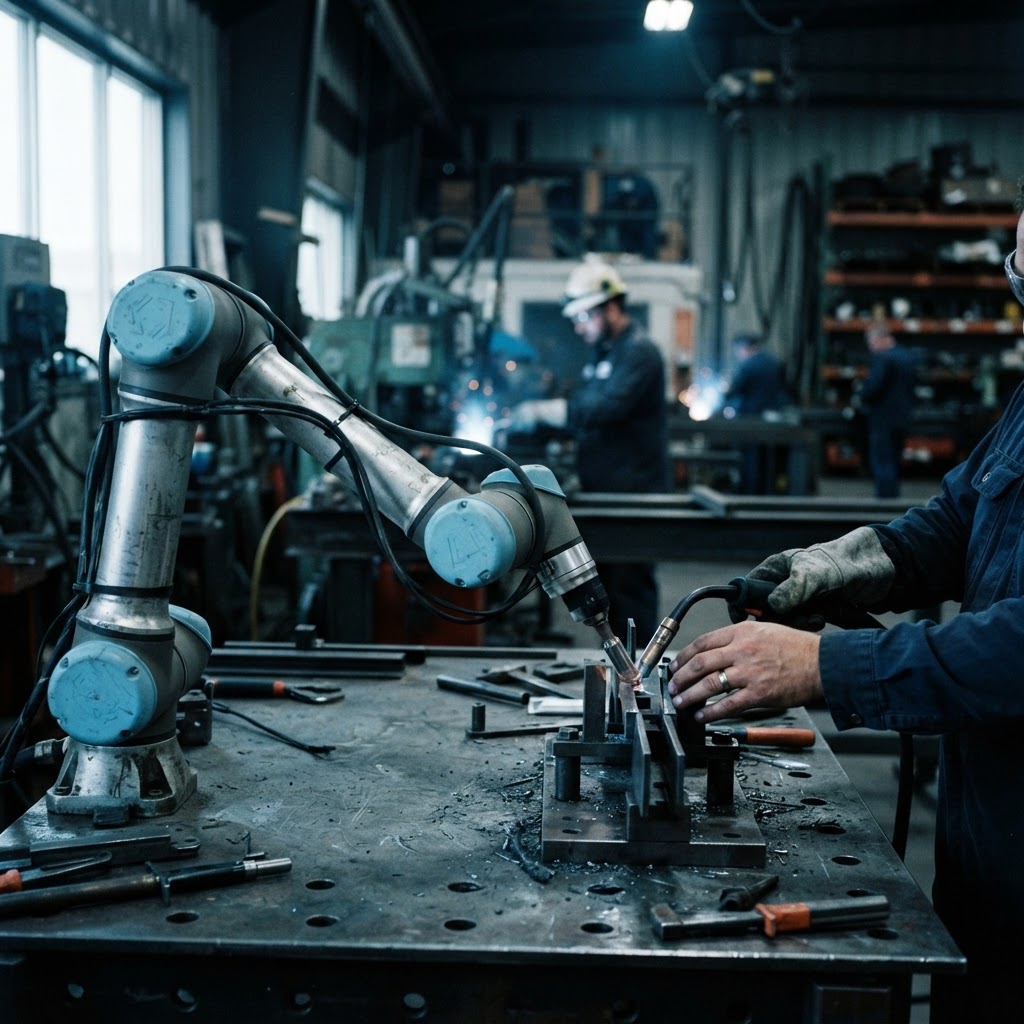
- Lincoln Electric and Miller Electric both offer turnkey automated welding systems that integrate FANUC or ABB arms with weld process controllers
- For shops running repetitive weld geometries — brackets, frames, housings — payback periods of 18 to 28 months are realistic at current labor cost levels in the Midwest and Southeast
- Collaborative welding cells using Universal Robots UR20 arms are opening access to shops with smaller footprints and mixed-SKU production
Shops that already have custom fabrication infrastructure — the kind Strata has spotlighted in our Metal Werks coverage — are often 60 to 70 percent of the way to a deployable welding automation cell without knowing it.
The Assessment Process: What Happens in Four Weeks
A credible RRA for a mid-size Tier 2 facility runs three to four weeks and follows a defined sequence:
- Week 1 — Production mapping: Document every cell, station, and manual touchpoint. Capture cycle time data, defect rates, and labor hours per part.
- Week 2 — Technology fit analysis: Match candidate cells against available robot form factors — articulated arms, cobots, linear gantries, mobile platforms.
- Week 3 — Infrastructure gap review: Evaluate PLC architecture, network connectivity, and safety compliance against OSHA and RIA standards.
- Week 4 — Sequenced roadmap delivery: Deliver a phased deployment plan with capital ranges, lead times, and projected throughput impact per phase.
System integrators like Yaskawa Motoman and Teradyne's MiR division have standardized this process enough that the assessment itself carries minimal cost relative to the decision clarity it produces.
What This Means for Your Floor
If you are an operations director or plant manager at a Tier 2 facility reading this in October 2026, here is the direct operational implication:
- Do not wait for a contract renewal conversation to start your assessment. By the time a customer is asking about your automation roadmap in a sourcing review, the leverage has already shifted.
- Prioritize cells with the highest labor dependency and the most geometric repetition — those are your fastest wins and your strongest RFQ talking points.
- An RRA positions you for federal incentive access. The Manufacturing USA network and programs under the CHIPS and Science Act include technology adoption pathways for smaller manufacturers — but you need a documented roadmap to qualify for most of them.
- Mobile autonomous robots deserve a look even if your primary need is fixed-cell automation. MiR and Omron AMR deployments in Tier 2 facilities are reducing internal logistics labor by 20 to 35 percent — freeing skilled workers for higher-value assembly and inspection roles.
The floor you have today was built for a supply chain that no longer exists at the same risk tolerance. The assessment doesn't commit you to a capital spend. It tells you exactly where you stand — and that information is worth more right now than almost anything else you could buy.
Sources: Rockwell Automation — Connected Enterprise · Universal Robots Certified Integrator Program · Manufacturing USA Network · OSHA Robotics Safety Standards · NIST CHIPS Act Programs

