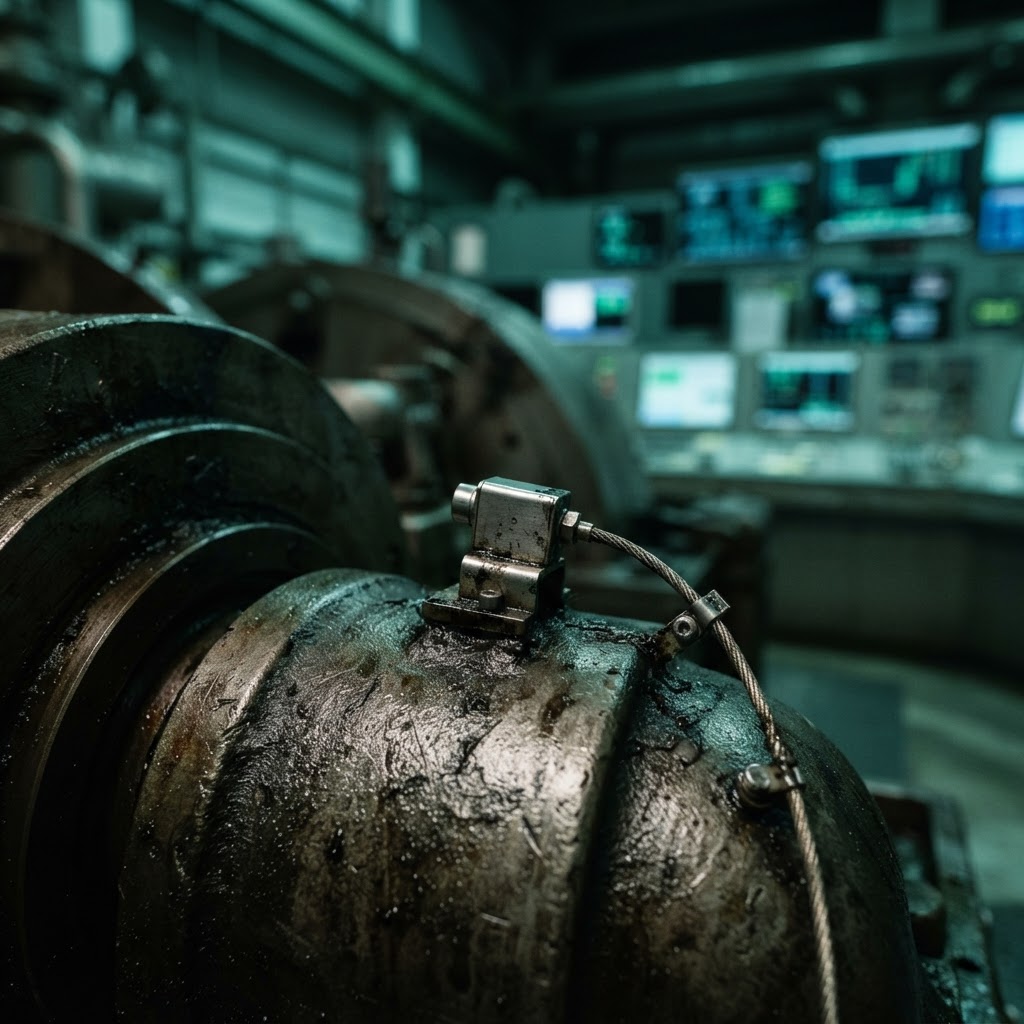

The $50 Sensor That Could Save a $5M Machine — October 2026
Unplanned downtime costs U.S. manufacturers an estimated $50 billion annually, and the majority of catastrophic equipment failures are preceded by detectable signal degradation days or weeks before collapse. The gap between prevention and crisis is often a single vibration or temperature sensor — one that costs less than a dinner tab.
Most Plants Are Flying Blind on Equipment Health
Problem: The average American mid-size plant runs critical machinery — CNC machining centers, injection molding presses, industrial compressors — with zero continuous health monitoring. Operators rely on scheduled maintenance intervals and human observation. Both methods miss early-stage failure signatures.
Insight: Emerson's 2025 industrial reliability report found that 82% of equipment failures occur randomly, not at predictable wear intervals. Scheduled maintenance catches fewer than 18% of failure modes before they cause unplanned stops. Condition-based monitoring, by contrast, identifies 70% of developing faults with enough lead time to schedule repair.
Recommendation: Stop treating scheduled maintenance as a safety net. It is not. Treat it as a floor — the minimum — and layer real-time sensing on top of every asset whose downtime costs exceed $10,000 per hour.
The Sensor Economics Are No Longer an Excuse
Problem: Plant managers historically dismissed condition monitoring as capital-intensive. Legacy vibration analysis required $15,000 handheld analyzers and dedicated reliability engineers. That cost profile killed adoption at the plant floor level.
Insight: The hardware calculus has collapsed. Sensata Technologies and ifm electronic both offer industrial-grade vibration and temperature sensors in the $40–$80 range per node. Samsara's equipment monitoring gateways connect up to 20 sensor nodes at roughly $300 per gateway. A fully instrumented 10-machine cell now runs under $2,000 in hardware — a rounding error against a single four-hour downtime event on a $5M press.
Recommendation: Run a one-page ROI calculation before your next capital review meeting. Take your three highest-criticality assets. Multiply their average hourly downtime cost by 4 hours. That number — likely $40,000 to $200,000 — is your payback threshold. The sensor stack will clear it inside 60 days of deployment.
"The question is no longer whether you can afford condition monitoring — it is whether you can afford to keep operating without it."
Edge AI Turns Raw Sensor Data Into Actionable Fault Signatures
Problem: Raw vibration data is noise without context. Plants that installed first-generation IoT sensors in 2019–2022 often drowned in dashboards and alerts with no clear failure correlation. Adoption stalled. The sensors became shelf hardware.
Insight: Edge AI has closed that gap at the hardware level. Augury deploys machine health sensors with onboard AI that classifies fault signatures — bearing wear, imbalance, misalignment, cavitation — without requiring a cloud round-trip or a reliability engineer on-call. Their published data across 700+ manufacturing sites shows a 35% reduction in unplanned downtime within the first 12 months of deployment. SparkCognition reports similar outcomes in aerospace and heavy manufacturing verticals, with average fault detection lead times of 14 days before failure.

What will it take to turn demand into delivered output?
Explore The Capacity Imperative, our report on U.S. advanced manufacturing and the priorities shaping 2027.
14 days of lead time changes everything operationally:
- Maintenance windows can be scheduled during planned downtime
- Replacement parts can be sourced without expedite premiums (typically 20–40% cost adders)
- Production schedules can be adjusted without customer impact
- Root cause analysis improves because the machine fails in a controlled context, not catastrophically
Recommendation: Require any sensor platform under evaluation to demonstrate onboard or near-edge classification capability. Cloud-dependent architectures with latency above 500ms are inadequate for high-speed rotating equipment. Fault signatures at 10,000 RPM develop and propagate in seconds.
Federal Incentives Are Funding the Transition Right Now
Problem: Even with collapsed hardware costs, capital allocation for sensor infrastructure competes against direct production investments. Finance teams deprioritize monitoring tools that do not appear on the revenue side of the ledger.
Insight: The Department of Energy's Industrial Efficiency and Decarbonization Office currently offers cost-sharing grants for smart manufacturing deployments, including condition monitoring infrastructure, under the broader Advanced Manufacturing initiative. Separately, NIST's Manufacturing Extension Partnership (MEP) provides subsidized consulting and technology adoption support to small and mid-size manufacturers in all 50 states. Several MEP centers are actively co-funding sensor pilot programs at 50% cost share in Q4 2026.
Recommendation: Contact your regional MEP center before December 31, 2026. Q4 funding cycles close with unspent allocations that can be redirected to qualified applicants quickly. A $2,000 sensor deployment becomes a $1,000 deployment with co-funding — and the ROI math becomes impossible to reject.
Tactical Recommendations
- Audit your top 10 critical assets this week. Rank by hourly downtime cost. Any asset above $5,000/hour is a priority-one candidate for continuous monitoring.
- Pilot with three machines, not thirty. Select one failure mode — bearing degradation is the highest-frequency cause of unplanned stops — and prove the signal-to-action loop before scaling.
- Specify edge classification in your sensor RFP. Require vendors to demonstrate fault detection lead times of at least 7 days on your specific equipment class. Demand reference sites.
- Engage your MEP center for Q4 co-funding. Locate your regional center at nist.gov/mep and submit a project summary before November 30.
- Integrate sensor alerts into your CMMS, not a separate dashboard. Fault alerts that live outside your CMMS platform get ignored. Close the loop from signal to work order inside one system.
Sources: Emerson Industrial Reliability Research · Augury Machine Health Data · NIST Manufacturing Extension Partnership · DOE Industrial Efficiency and Decarbonization Office · Samsara Equipment Monitoring

