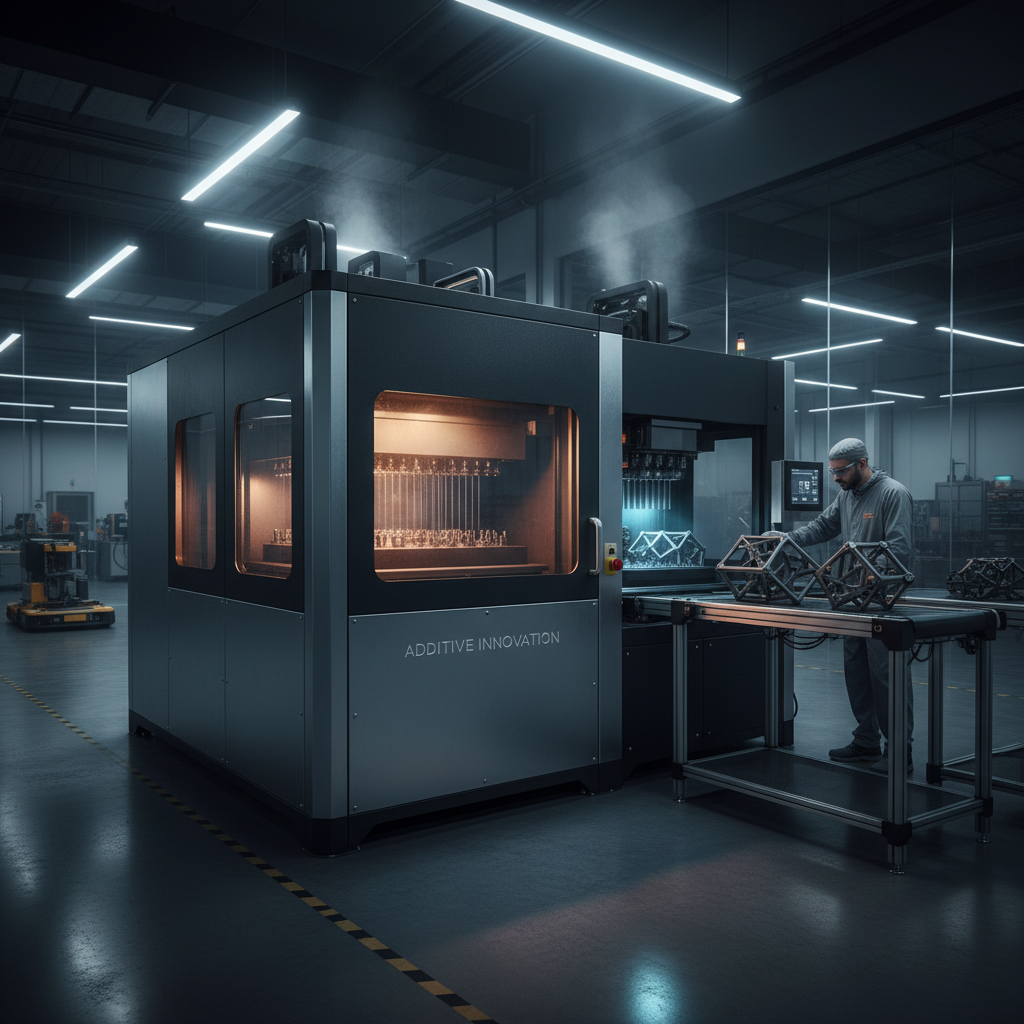

Sand Casting Is Dead. Long Live Binder Jetting.
The foundry floor has never been a place for sentimentality. Men who spent careers mastering the art of ramming sand around a pattern box will tell you the process works - and they're not wrong. Sand casting has produced everything from engine blocks to turbine housings for over three millennia. But "works" is no longer sufficient justification for a process that adds weeks to lead times, demands skilled labor that no longer exists in adequate supply, and generates scrap rates that would embarrass a sophomore engineer. The aerospace and defense sectors, rarely accused of moving quickly, are making a decisive break. Binder jetting - the additive manufacturing process that deposits a liquid binding agent onto successive layers of powder to build near-net-shape metal parts - is not a promising technology waiting for its moment. For complex, low-to-medium volume metal components, that moment has arrived.
The Problem Sand Casting Was Always Hiding
The traditional sand casting workflow has an elegant simplicity that obscures a brutal operational reality. You need a pattern. The pattern requires tooling. The tooling requires time - often eight to fourteen weeks for complex geometries - and capital expenditure that is entirely sunk the moment design requirements shift. In defense programs, they always shift. Ask anyone who has managed casting procurement on a major naval or Army ground vehicle program what happens when an engineering change order arrives after tooling is cut. The answer involves procurement officers, lawyers, and a timeline that no program manager wants to explain to a congressional staffer.
Beyond tooling lead time, conventional sand casting imposes dimensional tolerances that force downstream machining operations that are themselves expensive and time-consuming. The casting gets you close; the five-axis CNC mill gets you there. Every step is a cost center, a scheduling dependency, and a quality escape waiting to happen. When the Department of Defense began seriously examining casting as a readiness vulnerability - not merely a cost issue, but an industrial base fragility issue - the conversation about alternatives became considerably more urgent.
What Binder Jetting Actually Changes
To be precise about the technology: binder jetting does not print metal directly. In its most defense-relevant application, the process prints sand molds and cores with geometric complexity that is simply impossible to achieve through conventional pattern-and-core-box methods. Companies like Desktop Metal (through its ExOne acquisition) and Voxeljet have been advancing industrial-scale sand binder jetting systems capable of producing molds in hours rather than weeks, without any hard tooling whatsoever. The metal pour itself remains conventional - aluminum, iron, steel, bronze - which means the metallurgical properties and the supply chain for base materials are unchanged. The disruption is entirely in the front end of the process.
This is not a trivial distinction for operations directors evaluating technology adoption risk. You are not asking your foundry to learn a new metallurgy. You are not qualifying a novel alloy or rewriting your NADCAP audit procedures from scratch. You are changing how the mold is made. The path to qualification, while never simple in defense and aerospace, is meaningfully shorter when the output material properties are demonstrably equivalent to conventionally cast counterparts - which, for sand-printed molds, they consistently are.
For direct metal binder jetting - where the powder itself is the feedstock, bound and then sintered - the calculus is more complex. Companies including Desktop Metal, HP (through its Metal Jet platform), and GE Additive have been developing sintered metal binder jetting for production applications across automotive and aerospace. The technology produces parts with material properties approaching wrought equivalents at production throughput rates that laser powder bed fusion cannot match economically. For defense components where volumes are measured in dozens or hundreds rather than thousands, direct metal binder jetting occupies a compelling middle ground.

What will it take to turn demand into delivered output?
Explore The Capacity Imperative, our report on U.S. advanced manufacturing and the priorities shaping 2027.
Defense Programs Are Already Moving
This is not speculative. The Army's Combat Capabilities Development Command and the Naval Air Systems Command have both been active participants in additive manufacturing qualification programs that include binder jetting variants. The broader America Makes consortium has supported multiple programs specifically examining sand binder jetting as a solution to casting supply chain fragility for legacy platform sustainment - the CH-47 Chinook, M1 Abrams components, legacy naval propulsion hardware. These are not programs with the luxury of waiting for a technology to mature. The parts they need are frequently no longer in commercial production. The original tooling is gone. The foundry that made them may be gone.
For sustainment applications specifically, binder jetting's tooling-free approach is not merely an efficiency gain - it is the difference between a viable supply solution and telling a program office that a particular component is simply no longer supportable through traditional manufacturing. That is a conversation the defense industrial base cannot afford to have with increasing frequency as the average age of the platforms in the U.S. inventory continues to rise.
The Workforce Equation
Here is where the argument for binder jetting becomes structurally compelling rather than merely technically interesting. The skilled workforce that made sand casting viable - journeyman patternmakers, experienced foundrymen with the tactile knowledge to catch a bad pour before it becomes a bad part - is retiring without adequate replacement. This is not a new observation, but its urgency compounds annually.
Binder jetting systems are operated by technicians, not craftsmen. This is not a slight against the foundry trade; it is a recognition that a process governed by software parameters, digital files, and repeatable machine cycles can be staffed by a workforce that exists in the present tense. The training curve for a binder jetting operator is measured in weeks, not years. Process consistency is enforced by the machine, not by the judgment of a veteran who remembers how the humidity in August affects the way sand packs. For a defense industrial base already struggling with the workforce development math, this matters more than any individual cost-per-part comparison.
What Sand Casting Still Does Well - And Where That Argument Ends
Intellectual honesty requires acknowledging the boundaries of this argument. Sand casting remains economically rational for:
- High-volume, stable-design components where tooling amortizes across large production runs
- Very large castings - marine propellers, heavy structural housings - where the economics of scale and the physics of large-format pours currently favor conventional methods
- Commodity industrial components where established foundry supply chains provide competitive pricing that binder jetting cannot yet match at scale
But note the qualifiers: stable design, high volume, large scale, commodity. Defense and aerospace components are almost definitionally none of these things. They are low-volume, subject to design iteration, geometrically complex, and manufactured under regulatory frameworks that place a premium on traceability and repeatability - exactly the conditions under which binder jetting's advantages compound.
The operations director evaluating their casting supply chain for a fixed-wing sustainment program or a next-generation ground vehicle derivative is not managing a commodity foundry relationship. They are managing a technical risk that sand casting's structural limitations make worse with every engineering change and every foundry closure.
The Transition Is Not Optional, Only Timed
The foundry industry will resist this framing, as industries historically resist the framings that precede their partial displacement. There will be studies emphasizing the limitations of additive sand printing at extreme volumes. There will be procurement processes that continue to default to traditional casting because the qualification pathway is familiar. There will be program managers who absorb cost and schedule pain rather than navigate the approval process for an alternative manufacturing method. These are all understandable human responses to institutional inertia, and they will all delay but not prevent the transition.
Binder jetting is not a technology that needs advocates. It needs operations executives with enough structural authority and enough appetite for a twelve-month qualification investment to demonstrate what the technology does to lead times, scrap rates, and tooling costs at program scale. The data exists. The early adopters in automotive - where Desktop Metal and HP have been running production volumes that defense programs can only dream of - have already generated it. The question for the defense and aerospace manufacturing community is not whether binder jetting will displace sand casting for complex, low-volume components. It is whether your program will lead that transition or spend the next decade watching someone else's schedule slip while waiting for the traditional supply chain to deliver a mold it no longer has the tooling or the workforce to produce.
Sand casting is not dead. But for the programs that matter most in this industrial base, it is no longer adequate. That distinction is worth building a capital plan around.

