
Predictive Maintenance: How Smart Sensors Are Eliminating Unplanned Downtime — September 2026
Unplanned downtime costs U.S. manufacturers an estimated $50 billion annually — and most of it is preventable. Smart sensor networks are closing the gap between failure and foresight, but only plants that deploy them correctly are capturing the gains.
Unplanned Downtime Is Still a Capital Destruction Event
Problem: The average manufacturer loses 800 hours of production per year to unplanned equipment failures, according to Deloitte's manufacturing research. At $260,000 per hour for mid-scale automotive or aerospace operations, that math is brutal.
Insight: Reactive maintenance — fix it when it breaks — is still the dominant model in over 55% of U.S. plants. Preventive maintenance schedules improve on that but waste roughly 30% of replacement parts by swapping components before failure is imminent.
Recommendation: Shift capital allocation from scheduled PM labor to sensor-driven condition monitoring. The ROI difference is not marginal — plants running full predictive maintenance programs report 25–30% reductions in maintenance costs and 70–75% fewer breakdowns, per McKinsey Global Institute data.
The Sensor Stack That Actually Moves the Needle
Problem: Operations teams often deploy single-point sensors — a vibration monitor here, a thermal camera there — without integrating data into a unified decision layer. Disconnected signals don't predict failure. They just generate alerts no one acts on fast enough.
"A sensor without a decision engine is just expensive noise on the plant floor."
Insight: Effective predictive maintenance runs on a layered sensor architecture:
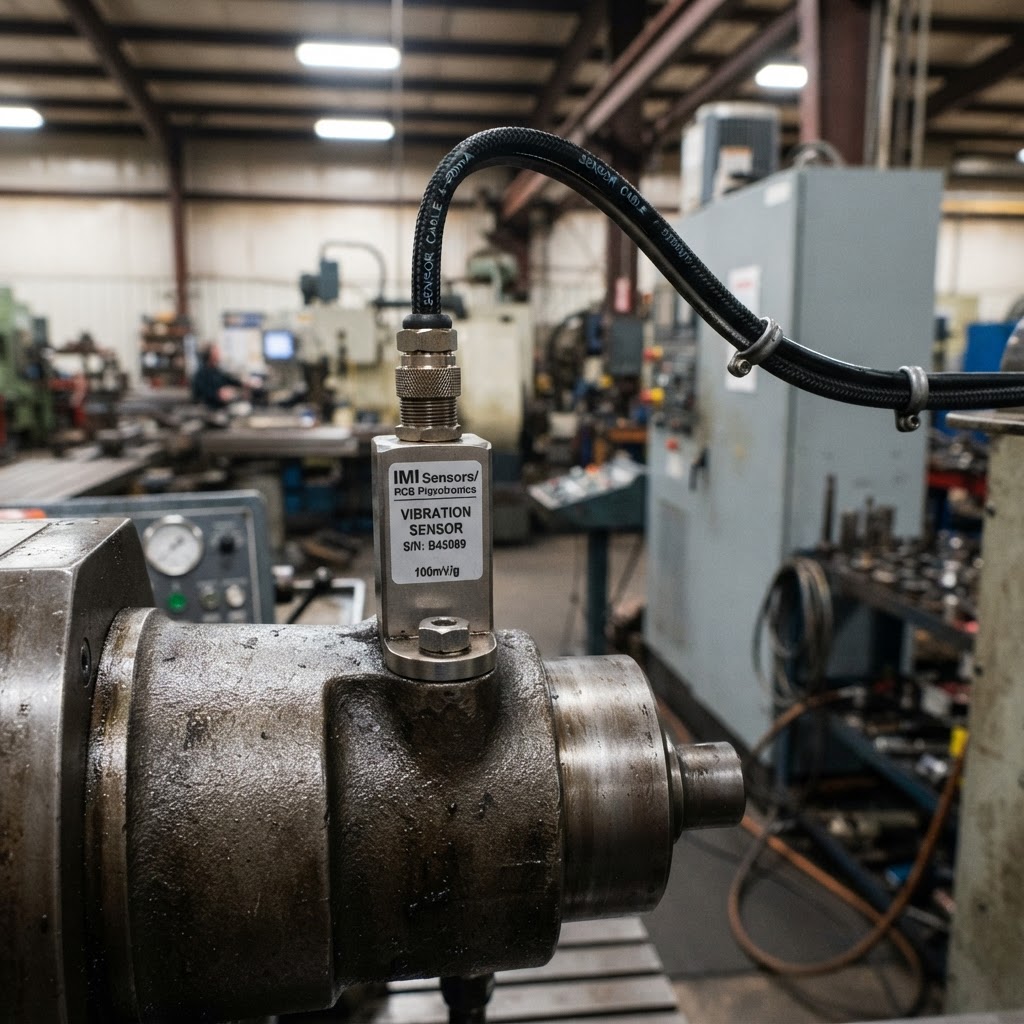
- Vibration sensors on rotating equipment (motors, pumps, gearboxes) — detect bearing degradation 2–8 weeks before failure
- Thermal imaging arrays on electrical panels and heat-generating assets — flag anomalies at 0.1°C resolution
- Ultrasonic leak detectors on compressed air and hydraulic systems — compressed air leaks alone waste 20–30% of generated capacity in most plants
- Current signature analysis on motor drives — identifies mechanical load changes invisible to vibration sensors alone
Rockwell Automation and SKF both offer integrated sensor-to-platform ecosystems purpose-built for this stack. Fluke Reliability delivers portable and fixed sensor options that retrofit onto legacy equipment without capital-intensive overhauls.
Recommendation: Audit your current sensor deployment against this four-layer model. If you're missing any layer on critical assets, treat it as an open risk position — not a future project.
Edge AI Is What Separates Monitoring from Prediction
Problem: Streaming raw sensor data to a central cloud platform works fine for low-frequency analysis. It fails when you need sub-second intervention — like catching a spindle bearing that will seize in the next 45 minutes during a live production run.

What will it take to turn demand into delivered output?
Explore The Capacity Imperative, our report on U.S. advanced manufacturing and the priorities shaping 2027.
Insight: Edge AI inference — processing data directly at the machine or gateway level — cuts response latency from minutes to milliseconds. NVIDIA's Jetson platform is now embedded in plant-floor gateways from multiple OEMs, enabling real-time anomaly detection without round-tripping to the cloud.
Platforms like Augury and SparkCognition deploy machine learning models trained on failure signatures across thousands of machines. Their models don't just detect deviation — they classify failure mode and estimate remaining useful life with lead times measured in days, not hours.
Recommendation: Require any predictive maintenance platform vendor to demonstrate edge inference capability as a baseline procurement criterion. Cloud-only architectures create latency gaps that negate the value of real-time sensor data on high-speed production lines.
Implementation Sequencing Determines ROI, Not Sensor Count
Problem: Plants that deploy sensors plant-wide simultaneously rarely achieve projected ROI. They generate data faster than maintenance teams can interpret it, which breeds alert fatigue and organizational resistance.
Insight: High-performing facilities sequence deployment by asset criticality. Start with assets that meet two criteria: high replacement cost and direct impact on throughput. A single CNC machining center or injection molding press generating $2M+ in annual output justifies a full sensor stack with dedicated dashboarding before you instrument a conveyor line.
Recommendation: Use a three-phase rollout:
- Phase 1 (Months 1–3): Deploy on top 10 critical assets. Establish baseline signatures and validate alert thresholds.
- Phase 2 (Months 4–9): Expand to secondary critical assets. Integrate maintenance work order systems — SAP PM or IBM Maximo — so sensor alerts auto-generate work orders.
- Phase 3 (Months 10–18): Scale plant-wide. By this stage, your maintenance team has been trained on the data model and alert fatigue is managed through tiered notification protocols.
Tactical Recommendations
- Baseline before you predict. Run sensors in data-collection mode for 60–90 days before activating alert thresholds. Models trained on your specific asset signatures outperform generic factory defaults by 40–60% in accuracy.
- Integrate sensor platforms with your CMMS on Day 1. Alerts that don't generate work orders automatically add latency and human error back into the loop.
- Require failure mode classification, not just anomaly detection. Any platform that only flags "deviation from baseline" without diagnosing probable failure mode forces your team to diagnose under time pressure.
- Track avoided downtime, not just maintenance cost reduction. Calculate avoided downtime in production hours and revenue equivalent — this is the metric that justifies platform expansion budgets to finance leadership.
- Benchmark compressed air and hydraulic leak reduction separately. These systems consistently deliver 15–25% utility cost reductions within the first year of ultrasonic monitoring — fast payback that funds broader deployment.
Sources: Deloitte — Industry 4.0 Manufacturing · McKinsey Global Institute — Manufacturing Operations · Rockwell Automation — Predictive Maintenance · Augury — Machine Health Platform · SKF — Condition Monitoring

