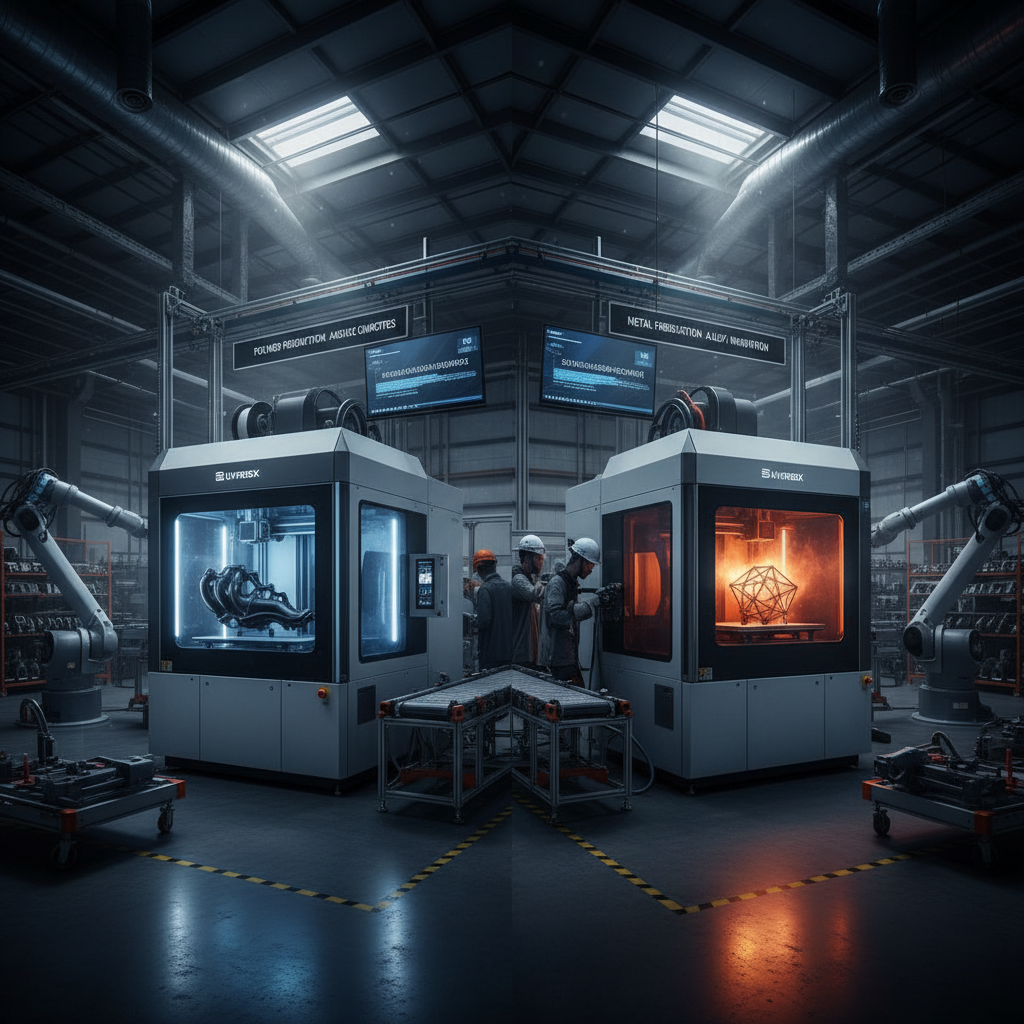

Polymer vs. Metal 3D Printing: Choosing the Right Process for Production
The graveyard of additive manufacturing pilots is well-stocked. Companies that committed early to a single printing technology - enchanted by a trade show demonstration or a vendor's optimistic roadmap - found themselves either over-engineered for simple brackets or catastrophically under-powered for load-bearing flight hardware. The decision between polymer and metal 3D printing is not a technology preference. It is a production architecture decision, and getting it wrong costs time, capital, and in defense and aerospace contexts, program credibility.
This guide is written for the operations directors and plant managers who are past the hype cycle and now accountable for making additive manufacturing perform inside a real production environment.
The Fundamental Division of Labor
Polymer and metal additive processes are not competing answers to the same question. They serve structurally different roles in a production system, and the first discipline is resisting the temptation to force one into the other's territory.
Polymer 3D printing - encompassing Fused Deposition Modeling (FDM), Selective Laser Sintering (SLS), Multi Jet Fusion (MJF), and stereolithography (SLA) - excels in low-to-medium load applications, complex interior geometries, rapid iteration cycles, and cost-sensitive tooling. Defense primes like Lockheed Martin and Raytheon Technologies have deployed polymer additive extensively for interior cabin components, non-structural brackets, training aids, and ground support equipment. The economics work because polymer machines are cheaper to run, faster to turn, and the post-processing workflow is manageable at scale.
Metal 3D printing - primarily Laser Powder Bed Fusion (LPBF), Directed Energy Deposition (DED), and binder jetting - operates in a different gravity well entirely. It is slower, more expensive per part, demands rigorous powder handling protocols, and requires post-processing steps (stress relief, HIP, machining, inspection) that can dwarf the print time itself. But it produces parts that can replace castings and forgings in structural and thermally critical applications. GE Aerospace's LEAP engine fuel nozzle, produced via LPBF and consolidating twenty parts into one, remains the canonical example of what metal additive can do when the application genuinely warrants it.
The mistake is treating metal printing as a prestige upgrade from polymer. It is not an upgrade. It is a different tool for a different job.
Material Selection Is Not a Downstream Decision
In traditional subtractive manufacturing, material selection often precedes process selection. In additive, the two are inseparable and must be resolved simultaneously - ideally before a design is finalized, not after.
For polymer applications, the relevant questions center on thermal environment, chemical exposure, and mechanical load:
- ULTEM 9085 (polyetherimide) has become a workhorse in aerospace interiors because it meets FAR 25.853 flammability requirements and machines cleanly for hybrid workflows. Stratasys built substantial aerospace business on this material.
- PEEK and PEKK push polymer performance closer to metals in thermal and mechanical terms, though they demand higher-end machines and more controlled processing environments. Solvay and Victrex supply these resins to programs where aluminum alternatives are legitimately in play.
- Nylon-based SLS and MJF materials (PA11, PA12) dominate in complex ducting, housings, and snap-fit assemblies where geometric complexity would make injection molding tooling prohibitive.
For metal applications, the material universe is narrower but the stakes are higher:
- Ti-6Al-4V remains the aerospace titanium standard. It prints well in LPBF and has an established qualification body of evidence, which matters enormously in defense procurement.
- Inconel 625 and 718 are the go-to nickel superalloys for high-temperature applications - combustors, heat exchangers, rocket nozzle components. Aerojet Rocketdyne and Rocket Lab have both qualified Inconel components for flight.
- 17-4 PH stainless and AlSi10Mg aluminum alloy are workhorses for structural components where titanium cost is unjustifiable but machined aluminum is geometrically impractical.

What will it take to turn demand into delivered output?
Explore The Capacity Imperative, our report on U.S. advanced manufacturing and the priorities shaping 2027.
The critical discipline here: do not select a material that lacks a qualification pedigree for your application class. The fastest way to stall a production program is to commit to a printed metal alloy that your customer's engineering authority has never seen in a test report.
Process Economics: Where the Real Comparison Lives
Raw machine cost is a misleading entry point. The honest comparison is cost-per-qualified-part, which incorporates machine time, material cost, build failure rate, post-processing labor, inspection overhead, and yield.
Polymer printing wins decisively on throughput and unit economics for the applications it can serve. An HP Multi Jet Fusion system can nest dozens of small components in a single build, amortizing machine time aggressively. Per-part costs for production polymer components are competitive with injection-molded parts at medium volumes, without the tooling investment - a genuine structural advantage for programs with constrained production runs or frequent design revisions.
Metal printing economics are inverted. LPBF systems running titanium or Inconel are capital-intensive, slow, and materially expensive. Powder costs alone can represent a significant fraction of part cost. The economic case for metal additive is made not through volume economics but through part consolidation, lead time compression, and geometric capability that conventional processes cannot match. When a metal printed part eliminates ten weeks of casting lead time on a program-critical component, or consolidates a twelve-part weldment into a single structural element, the per-part cost premium becomes a reasonable trade.
Binder jetting - as developed by Desktop Metal and ExOne (now part of Altair) - is attempting to rewrite metal additive economics by printing unsintered parts rapidly and then furnace-sintering at scale. The promise is legitimate; the production maturity for flight-critical applications is still accumulating. Operations directors evaluating binder jetting for structural defense components should scrutinize the qualification data carefully before committing production volumes.
Qualification and Certification: The Variable Nobody Wants to Budget For
This is where many additive programs bleed to death quietly.
In commercial manufacturing, qualification overhead is annoying. In aerospace and defense, it is existential. The Federal Aviation Administration and Department of Defense both require demonstrated process stability and material property repeatability before additive-manufactured parts can fly or serve in critical ground systems. The qualification burden for metal printed flight hardware is substantial - involving process parameter documentation, non-destructive inspection protocols, destructive coupon testing, and often witnessed builds.
Polymer parts, particularly non-structural and non-flight-critical components, carry a lighter qualification burden and can often be substantiated through analysis and functional testing rather than extensive materials characterization. This is part of why polymer additive has moved faster into production environments.
Organizations like America Makes and the Additive Manufacturing Coalition have invested in shared qualification frameworks and process data repositories precisely because individual companies were duplicating expensive qualification efforts. Defense primes working within the Defense Production Act ecosystem have access to some of this shared infrastructure. Use it.
The Integration Question
Neither polymer nor metal additive manufacturing reaches its production potential when operated as a standalone island. The programs generating real return - not pilot theater, but genuine throughput contribution - have integrated additive into a hybrid workflow that combines printing with CNC finishing, inspection automation, and ERP-connected scheduling.
Siemens and PTC have both built additive-aware modules into their manufacturing execution systems. The operational discipline of treating a printed metal part as a semi-finished blank that requires machined reference surfaces and CMM inspection - rather than a finished part that emerges from the machine - is the mindset shift that separates mature programs from perpetual pilots.
Making the Call
The decision framework, stripped to its essentials: if the application is non-structural, thermally modest, and geometrically complex, polymer is probably your path. If the application is load-bearing, thermally demanding, or replacing a casting or forging in a qualified assembly, evaluate metal additive - and budget honestly for the qualification work, not just the machine time.
The manufacturers who are extracting production value from additive are not the ones who chose the most advanced technology. They are the ones who chose the right technology, scoped the qualification honestly, and had the operational discipline to integrate the process rather than showcase it. In a sector where program timelines and certification requirements are unforgiving, that distinction is everything.

