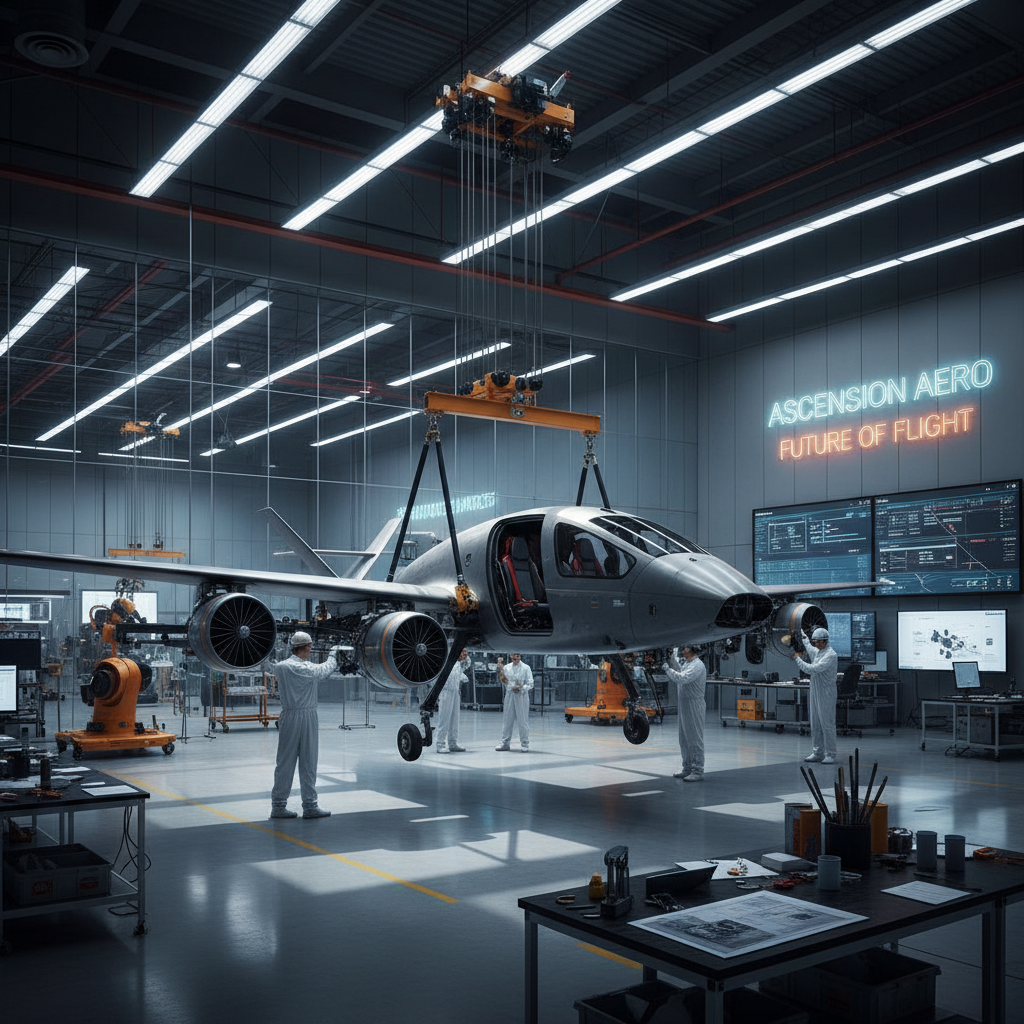

How eVTOL Is Creating an Entirely New Manufacturing Supply Chain
The last time American aerospace manufacturing faced a genuinely structural reset was the post-Cold War drawdown of the early 1990s, when defense contracts evaporated and primes spent a decade consolidating survivors. What's happening now with electric vertical takeoff and landing aircraft is the inverse - an expansion event, and one that doesn't map cleanly onto either the commercial aviation or automotive playbooks that manufacturers keep reaching for. The supply chain being assembled to support eVTOL isn't a derivative of anything that came before it. It's being built from scratch, under certification pressure, with a customer base that doesn't fully exist yet.
For operations directors and plant managers watching this from the outside, the instinct is to wait for winners to emerge before committing floor space and tooling budgets. That instinct is understandable. It is also, increasingly, a competitive liability.
The Tier Structure Is Being Rewritten
Conventional commercial aircraft manufacturing runs on a well-understood tier hierarchy. Boeing and Airbus sit at the top. Below them, Tier 1 suppliers - Spirit AeroSystems, Collins Aerospace, Safran, GE Aerospace - deliver major assemblies and integrated systems. Tier 2 and Tier 3 suppliers provide components, fasteners, raw materials, and specialty processing. The relationships are decades old, the qualification processes are brutal, and the barriers to entry are intentionally high.
eVTOL developers have neither the time nor the leverage to replicate that structure. Companies like Joby Aviation, Archer Aviation, Lilium's successor programs, and Wisk Aero are certifying novel aircraft configurations - distributed electric propulsion, tilt-rotor systems, ducted fans - that have no existing supply base. They can't call Collins Aerospace and order a certified motor controller for a twelve-rotor configuration because no such product exists in an FAA-certifiable form. So they're building supplier relationships differently: smaller partners, faster iteration cycles, and a willingness to co-develop components that would never survive a traditional Tier 1 procurement process.
This is creating what supply chain analysts are starting to call a parallel tier ecosystem - one running adjacent to legacy aerospace but governed by different qualification timelines, different volume assumptions, and different risk-sharing arrangements. For manufacturers capable of operating in that environment, the entry window is open in ways that haven't existed in commercial aerospace for a generation.
Where the Manufacturing Complexity Actually Lives
The public conversation about eVTOL tends to fixate on batteries and software. The manufacturing conversation should be focused on three areas that are generating the most supply chain stress right now.
Electric propulsion systems are the most obvious constraint. The motors, inverters, and power distribution architectures required for distributed electric propulsion don't come from aerospace's existing supplier base in meaningful volume. Automotive-adjacent suppliers - companies with experience in high-voltage EV drivetrains - are being pulled into aerospace qualification processes they were never designed to navigate. The result is a hybrid supplier profile unlike anything primes have managed before: companies with strong electrical engineering capability and weak AS9100 muscle memory trying to meet FAA Part 21 production approval requirements on aggressive schedules.
Advanced composite structures represent the second pressure point. eVTOL airframes are almost universally carbon fiber intensive, and the geometries involved - optimized for acoustic performance, structural efficiency, and aerodynamic integration of multiple rotor systems - are not producible on legacy tooling. Joby's airframe, for instance, involves complex integrated structures that require manufacturing processes closer to advanced defense programs than to general aviation. The suppliers who can hit those tolerances at eventual production volumes are a short list, and most of them are already capacity-constrained by defense and space work.
Battery systems and thermal management sit at the intersection of the most aggressive certification uncertainty and the most critical manufacturing precision. Cell-level consistency, module integration, and thermal runaway mitigation all require manufacturing process controls that are genuinely new territory for aerospace supply chains. The FAA's special conditions process for these systems is still evolving, which means suppliers are qualifying against a moving target - a situation that demands either deep regulatory sophistication or a very high tolerance for rework costs.

What will it take to turn demand into delivered output?
Explore The Capacity Imperative, our report on U.S. advanced manufacturing and the priorities shaping 2027.
The Certification-Manufacturing Interface
One dynamic that doesn't get enough attention in manufacturing circles is how FAA certification timelines are directly shaping supply chain structure. This isn't a regulatory observation - it's an operational one.
When a program's certification timeline shifts, and in eVTOL they shift constantly, every supplier in the chain absorbs the working capital consequences. Archer Aviation's path to Type Certificate, Joby's G-1 issue papers, the ongoing evolution of Wisk's autonomous certification approach - each of these programs is managing a supply base that has to stay qualified, tooled, and financially solvent through multi-year delays that weren't in the original program of record. For smaller specialty manufacturers that signed on early, that gap between projected and actual first delivery is an existential cash flow problem.
This is pushing eVTOL developers toward a model where they're taking on more vertical integration than they originally planned - not because they want to be manufacturers, but because they can't afford to lose critical suppliers to financial attrition. Joby's acquisition of manufacturing assets and its investment in production capability in Marina, California is partly a certification strategy and partly a supply chain resilience play. When your Tier 2 composite supplier can't survive another schedule slip, sometimes you buy them.
What the Automotive Crossover Actually Means
The comparison between eVTOL manufacturing scale-up and automotive production is made constantly and is mostly misleading, but it contains one useful insight: the manufacturing disciplines that matter most in early eVTOL production are not the ones aerospace traditionally rewards.
Aerospace manufacturing culture prizes precision, documentation, and process repeatability above throughput velocity. Those qualities matter in eVTOL, but so does something aerospace has historically treated as a secondary concern - design-for-manufacturability discipline during the certification phase itself. Automotive Tier 1s who've worked through launch programs on complex EV platforms understand how to build DFM feedback loops into concurrent engineering in ways that most aerospace suppliers do not. The manufacturers winning early eVTOL supply positions are frequently hybrids: companies with aerospace quality systems and automotive production engineering sensibility.
Moog, Ducommun, and Kaman Aerospace are examples of established players repositioning around eVTOL adjacent capabilities. But the more interesting signal is the number of mid-market manufacturers - companies in the $50M to $300M revenue range - that are investing in precision machining, composite layup, and high-voltage assembly capabilities specifically to pursue this market. They're betting that the supply chain consolidation that always follows initial market formation will reward early qualification investments.
The Infrastructure Dimension
Supply chain conversations about eVTOL tend to stop at the aircraft. They shouldn't. Vertiport infrastructure - the physical landing, charging, and passenger handling facilities that make urban air mobility operationally viable - represents a parallel manufacturing supply chain that is, if anything, even less developed than the aircraft side.
Charging infrastructure for aircraft operating at the power levels eVTOL requires is not a scaled-up version of an EV charging station. The power electronics, grid interconnection equipment, and structural systems for vertiport facilities are being specified and sourced by developers and airport authorities who are largely making it up as they go. For manufacturers with capabilities in power conversion, structural steel, and building systems integration, this is an underappreciated opportunity sitting one step removed from the aircraft program risk that makes some executives nervous.
The Window Is Measured in Qualification Cycles
The manufacturers who will own meaningful positions in the eVTOL supply chain five years from now are largely the ones making qualification investments today. That's not a prediction based on optimism about market timelines - it's a function of how aerospace supply chains actually work. First-article qualification, production approval, and the institutional knowledge embedded in certified processes take years to establish and are extraordinarily difficult to replicate once an incumbent is in place.
eVTOL won't look like anyone's original projections. Some developers will fail, others will consolidate, and the urban air mobility market will arrive later and in a different shape than the investor decks suggested. But the supply chain for electric, distributed-propulsion, composite-intensive aircraft is being built right now - and the manufacturers treating that as someone else's problem are not waiting for certainty. They're simply ceding the qualification window to competitors with more appetite for structured risk.
The Cold War drawdown created a decade of consolidation. This expansion event will create a decade of qualification. The manufacturers who show up for it will define the next generation of American aerospace supply chain capability. The ones who wait for proof will be buying capacity from those who didn't.

