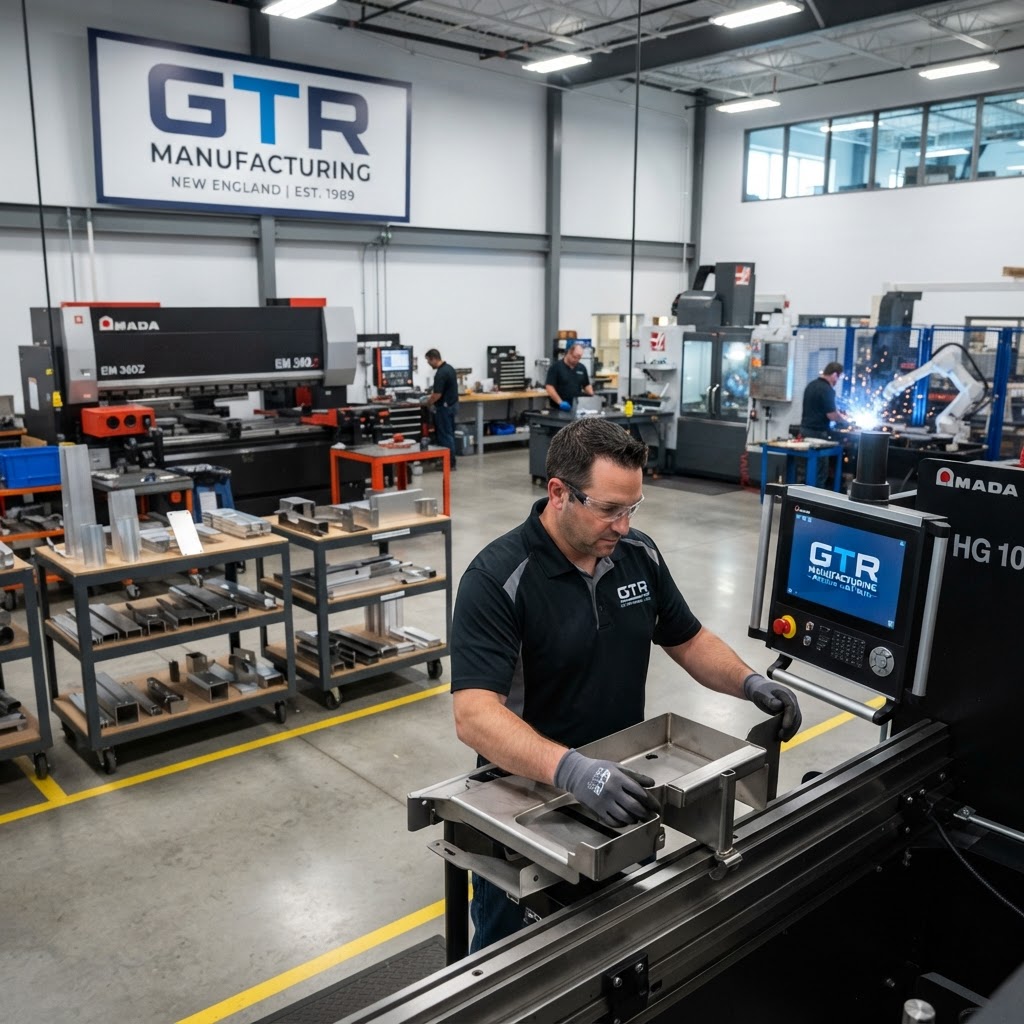


Inside GTR Manufacturing: A Sheet Metal Fabrication Shop Built on Precision and Pride
The laser head is already moving before the morning shift finishes its coffee. A sheet of cold-rolled steel — maybe 11 gauge, maybe thinner — gets positioned, registered, and cut with the kind of quiet efficiency that only comes from decades of repetition done right. Across the floor, a technician is routing a wire harness through a partially assembled enclosure, checking continuity with the practiced patience of someone who has done this a thousand times and still does it like it matters. At GTR Manufacturing, based in New England, that attitude isn't a corporate value printed on a laminated sign. It's the ambient condition of the building.
Founded in 1974, GTR has spent fifty years doing what a lot of shops claim to do but few actually pull off: taking a customer's design from raw material to finished, tested, assembled product under one roof. That's not a marketing line. It's the operational model, and for procurement managers and engineering teams tired of managing five vendors where one should do, it's worth understanding in detail.
Five Decades of Sheet Metal Work
There's a temptation to romanticize longevity, but the real story of a shop that survives fifty years in American manufacturing isn't romantic — it's disciplined. Markets shift. Customers consolidate. Overseas competition puts pressure on margins that would have been unthinkable in 1974. The shops that survive are the ones that keep investing in equipment, keep tightening their processes, and keep earning the next order.
GTR has done exactly that. Their facilities — spread across multiple locations in New England and totaling 104,000 square feet of manufacturing space — reflect the kind of incremental, deliberate buildout that happens when a company reinvests its earnings rather than coasting on past performance. The floor space alone tells you they're not a boutique job shop. This is a facility built for volume and complexity, simultaneously.
Technology on the Floor
At the core of GTR's sheet metal operation are advanced laser cutting and punching machines that handle the forming and blanking work with speed and repeatability. CNC machining centers extend their capability into precision components that require tighter tolerances than sheet metal alone can deliver. For a procurement team sourcing complex assemblies, that combination matters — it means fewer handoffs, fewer tolerance stackup problems introduced at the seams between vendors, and a cleaner audit trail.
The metal finishing lines deserve particular mention. Finishing is where a lot of fabricators fall short — they're good at cutting and forming but treat coating as an afterthought farmed out to a third party. GTR has brought specialized finishing capability in-house, which means they control the process, the schedule, and the quality at that stage. For OEM customers whose product appearance and corrosion resistance are customer-facing concerns, that's not a small detail.
Prototyping through production is the stated model, and the equipment lineup supports it. A shop with this spread of laser, punch, CNC, and finishing capability can take an engineer's first-article request seriously on Monday and be running production quantities by the end of the quarter.
Electromechanical Assembly: Where the Complexity Lives
Sheet metal fabrication is the foundation, but electromechanical assembly is where GTR differentiates itself from the typical fab shop. Building a metal enclosure is one thing. Populating it with wire harnesses, cable assemblies, and integrated electronic components — and delivering a tested, functional box build — is a different discipline entirely.

What will it take to turn demand into delivered output?
Explore The Capacity Imperative, our report on U.S. advanced manufacturing and the priorities shaping 2027.
GTR does both. Their capability in cable assemblies and wire harnesses means they're building the nervous system of industrial and OEM equipment, not just the chassis. For operations executives managing supply chains for complex capital equipment or defense-adjacent industrial products, that's a meaningful consolidation point. One purchase order, one quality system, one set of shipping paperwork.
The ITAR certification signals where some of that work goes. Defense contractors and aerospace-adjacent OEMs operating under International Traffic in Arms Regulations don't hand that work to shops that can't demonstrate controlled processes and documented compliance. GTR's certification indicates they've built the internal infrastructure to handle sensitive programs — and that they understand what's at stake when they do.
Quality That Has to Hold
ISO 9001:2015 registration is the baseline in serious manufacturing, and GTR holds it. But certifications are only meaningful in the context of what they're certifying. At a shop doing custom sheet metal, electromechanical assembly, and metal finishing across multiple facilities, maintaining a coherent quality management system requires genuine organizational discipline. It's not a binder on a shelf. It's first-article inspection data, documented NCRs, corrective action loops, and supplier controls — the infrastructure of repeatability.
For manufacturing engineers qualifying a new supplier, that infrastructure is what you're really evaluating. The machines are almost secondary. The question is whether the shop can reproduce the first good part, reliably, across a production run of five hundred.
What Makes GTR Different
A lot of shops can cut sheet metal. Fewer can finish it. Fewer still can assemble it into a functioning electromechanical product. The combination of fabrication, finishing, and assembly under one quality system, in one supply chain relationship, is where GTR earns its position.
There's also the geography. New England manufacturing has a reputation for precision work and a skilled trades culture that predates most of the current conversation about workforce development. GTR has been operating in that environment for fifty years, which means they've built and retained the kind of workforce that knows the difference between a good part and a great one — and cares enough to close the gap.
For procurement teams and sourcing managers evaluating contract manufacturers, the GTR website — Visit GTR Manufacturing — is worth a direct look. The capabilities are laid out clearly, and their one-stop shop model is detailed in enough specificity to assess fit for a given program without a preliminary phone call.
About GTR Manufacturing
- Founded: 1974
- Location: New England (multiple facilities)
- Facility Size: 104,000 sq. ft.
- Employees: Approximately 100–200
- Core Capabilities: Precision sheet metal fabrication, electromechanical assembly, metal finishing
- Products: Custom sheet metal components, box builds, cable assemblies, wire harnesses
- Markets Served: Industrial OEM, defense-adjacent, capital equipment
- Certifications: ISO 9001:2015, ITAR
- Model: Prototype through production, full-service contract manufacturing
Where to Find Them
GTR Manufacturing operates across multiple facilities in New England and has been doing precision sheet metal and assembly work since 1974. Procurement managers, engineering teams, and operations executives looking to consolidate fabrication, finishing, and assembly with a single qualified supplier should start at their website.
If your program requires tight tolerances, ITAR-compliant handling, or finished box builds delivered ready to integrate — this is a shop worth the conversation.
Sponsored by Manufacturing Ultra
This Manufacturer Spotlight is brought to you by Manufacturing Ultra — a zero-upfront-cost website development and digital growth program built exclusively for American manufacturers. Whether you need a modern website, SEO, or digital marketing, Manufacturing Ultra delivers without the upfront cost. Visit manufacturingultra.com to learn how they help shops like GTR Manufacturing grow their digital presence.

