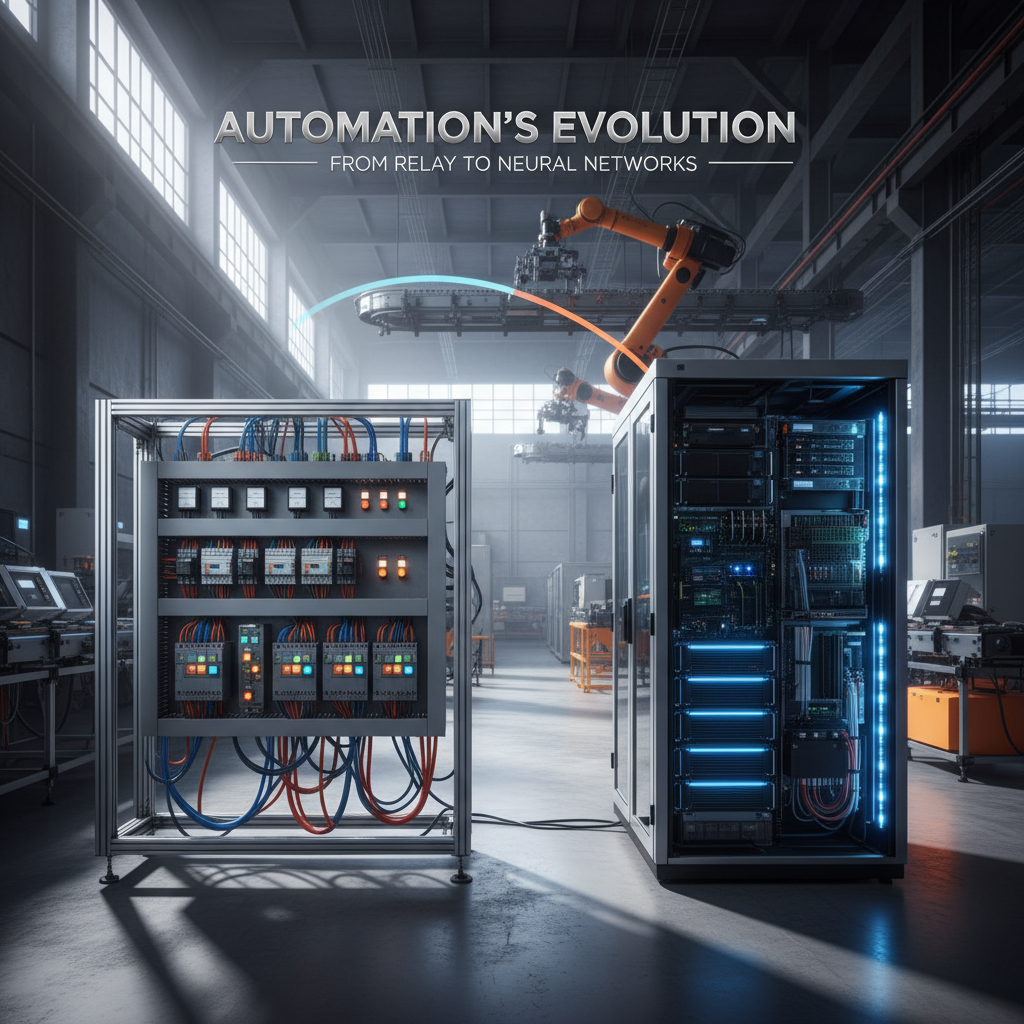

From PLC to AI: The Controller Evolution Reshaping Process Manufacturing
The PLC that stabilized your extrusion line in 1987 was an engineering triumph. Today, that same control philosophy - deterministic, ladder-logic-bound, operating in isolation - is the ceiling on your operational performance. The question isn't whether to evolve past it. It's how fast you can do it without breaking production.
The Architecture Shift Nobody Announces
Process manufacturing - chemicals, food and beverage, pharmaceuticals, oil refining - built its automation backbone on Programmable Logic Controllers precisely because they are ruthlessly reliable. Ladder logic executes in milliseconds. Scan cycles are predictable. When your PLC says the valve is open, the valve is open.
But PLCs were designed to execute decisions, not make them. They react to setpoints defined by engineers weeks or months before the process runs. The moment your feedstock changes composition, your ambient temperature shifts, or a new product SKU hits the schedule, the PLC keeps executing the old logic - accurately, reliably, and wrong.
That gap between accurate execution and intelligent adaptation is exactly where the modern controller stack is being rebuilt.
The Layers: What's Actually Being Deployed
This isn't a single-technology story. The evolution is happening across three distinct layers, often simultaneously:
1. The DCS Modernization Wave
Distributed Control Systems from Emerson, Honeywell, and ABB - the supervisory layer above PLCs in most large process plants - are being upgraded with embedded analytics and cloud connectivity. Emerson's DeltaV platform, for example, now ships with native machine learning hooks that let engineers embed predictive models directly into the control loop, not as a bolt-on application sitting on a separate server. This is not marketing. It changes the latency profile of intelligent decisions.
2. Edge AI Controllers
Companies like Rockwell Automation and Siemens are shipping edge controllers - hardware that runs inference models at the machine level, without a round-trip to the cloud. For continuous processes where milliseconds matter, this isn't optional architecture. It's the only architecture that works. FANUC and Beckhoff are pushing similar capability into motion-heavy environments. The edge layer is where AI starts touching real-time control.
3. Soft Sensors and Virtual Process Analyzers
This is arguably the most underreported development in process control. Soft sensors - AI models trained on historian data that predict quality or process variables in real time - are replacing or supplementing expensive physical analyzers. A refiner that once relied on lab samples every four hours can now run a neural-network-based octane predictor continuously, adjusting blend ratios in near-real-time. Yokogawa and AspenTech have been deploying these across petrochemical clients for several years. The ROI case is not theoretical.
Why Ladder Logic Has Limits - And Why That's Okay
Be careful with the narrative that AI replaces PLCs. It doesn't, and vendors selling that story should be questioned.
PLCs handle safety interlocks, deterministic sequencing, and hardwired logic that must not have inference uncertainty anywhere near it. The IEC 61511 functional safety standard exists for good reason. A neural network has no business deciding whether your pressure relief valve opens.

What will it take to turn demand into delivered output?
Explore The Capacity Imperative, our report on U.S. advanced manufacturing and the priorities shaping 2027.
What AI controllers do is operate in the optimization layer above the safety and execution layer - adjusting setpoints, recommending parameter changes, flagging anomalies, and learning from process drift over time. The PLC still executes. The AI decides what to execute toward.
This architecture - sometimes called hierarchical hybrid control - is how serious deployments are structured. Ignoring the layering is how pilot programs fail and why some plants have had embarrassing rollbacks.
The Industrial AI Programs Moving the Needle
Several macro-level initiatives are accelerating adoption faster than organic plant-level decisions would:
- DOE's Industrial Efficiency and Decarbonization Office has been funding AI-driven process optimization projects specifically in energy-intensive manufacturing - chemicals, paper, glass, and cement.
- CESMII (the Clean Energy Smart Manufacturing Innovation Institute) has built a Smart Manufacturing Platform that standardizes data infrastructure specifically so AI applications can be layered in without custom integration work for every facility.
- AWS Industrial and Microsoft Azure IoT have both published reference architectures for process manufacturing AI, giving mid-market manufacturers a deployment playbook that didn't exist five years ago.
These aren't pilot programs in a lab. They are active deployments shaping how the next decade of process control is designed.
The Integration Problem Is Real - Don't Minimize It
Every vendor demo shows a clean dashboard and a smooth control loop. Every actual deployment has a data problem first.
Legacy historian systems - OSIsoft PI, Wonderware - store enormous amounts of process data in formats that require significant engineering to make AI-ready. Timestamp alignment, sensor calibration drift, missing data imputation - these are not IT problems. They are process engineering problems that require people who understand both the chemistry and the data pipeline.
Plants that have succeeded in moving from PLC-only control to hybrid AI architectures share one characteristic: they staffed the integration with domain experts first, data scientists second. The order matters.
What This Means for Your Floor
If you're running a process plant and looking at your automation roadmap for the next three to five years, here's the practical read:
- Your PLC investment is not stranded. Modern AI controllers are designed to sit above existing PLC infrastructure, not rip it out. Protect your safety-critical hardwired logic.
- Start with the data layer. Before any AI controller delivers value, your historian needs to be clean, contextualized, and accessible. That project is unglamorous and non-negotiable.
- Soft sensors are the fastest ROI path. If you have a quality measurement that's slow, expensive, or infrequent, a soft sensor program is a tractable first deployment with measurable payback.
- Edge hardware decisions lock in your architecture. The controller you buy in the next procurement cycle will determine your AI readiness for the next decade. Ask vendors hard questions about inference capability, model update workflows, and integration with your existing DCS.
- Build the hybrid skills now. The engineer who can tune a PID loop and validate a machine learning model is your most valuable hire in the next five years. Start developing that capability internally before the labor market prices you out.
The Competitive Gap Is Opening
The manufacturers moving fastest on this aren't doing it because they love technology. They're doing it because continuous AI-optimized processes run tighter, yield higher, and respond to disruption faster than fixed-setpoint control ever will. The gap between a plant running hybrid AI control and one still fully reliant on 1990s PLC philosophy is measurable in margin - and it widens every quarter. The controller evolution isn't a future event you'll prepare for later. It's a present condition you're already operating inside, whether you've acknowledged it or not.

