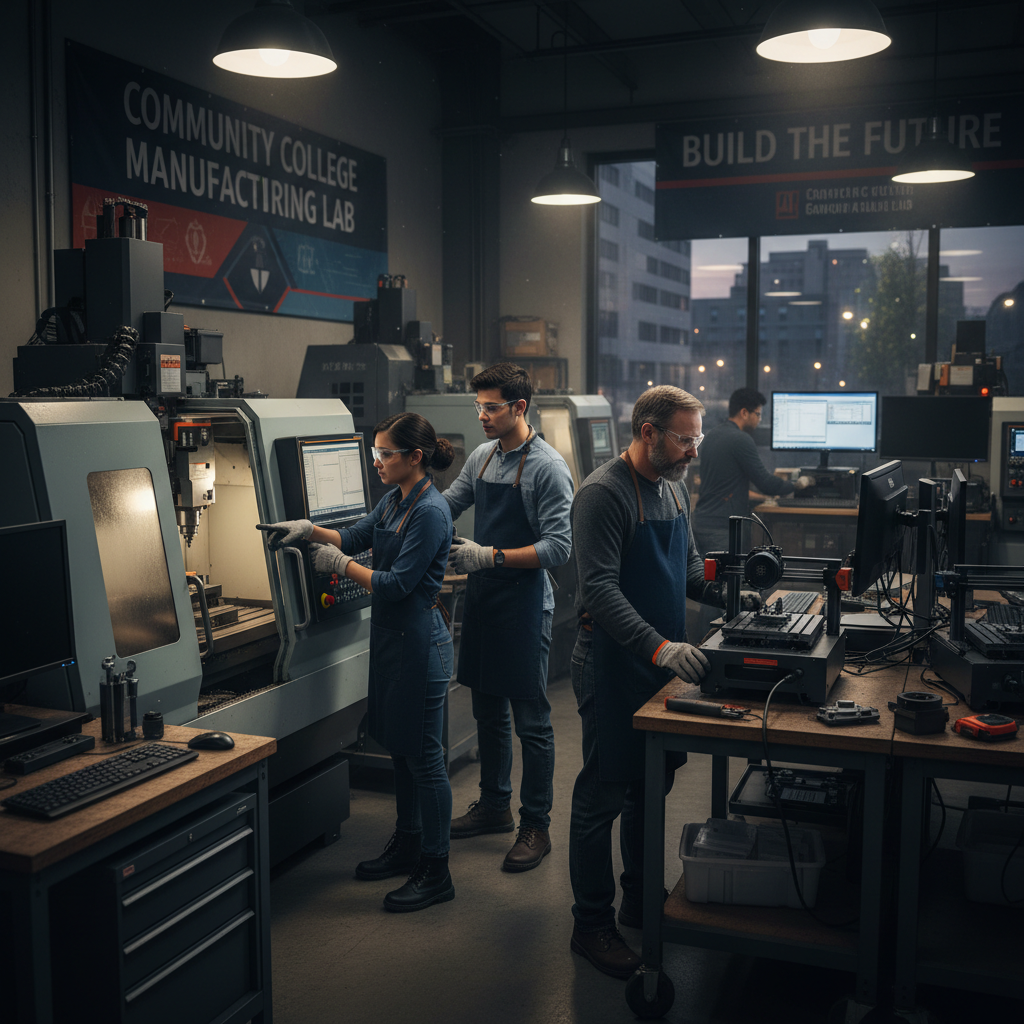

Community Colleges Are Building the Next Generation of CNC Machinists
On a Tuesday morning in Spartanburg, South Carolina, a 23-year-old named Marcus is running a five-axis mill for the first time. His hands are steady. His instructor watches from two feet back, arms crossed, nodding. Marcus has been at Spartanburg Community College for eight months. In three weeks, he'll have a job offer waiting. This scene - unremarkable to the instructors who've watched it repeat for years - is quietly becoming one of American manufacturing's most important stories.
The skilled trades gap is not a new headline. Plant managers have been sounding the alarm on CNC machinist shortages for the better part of a decade. But something has shifted in the last few years. Community colleges, long underfunded and underappreciated, are beginning to close that gap in ways that four-year universities simply cannot - and the smartest manufacturers in the country are starting to pay attention.
The Case Against Waiting for the Market to Fix Itself
The shortage of qualified CNC operators and programmers is structural, not cyclical. The retiring Baby Boomer workforce is taking decades of tacit knowledge with it. Meanwhile, cultural momentum pushed an entire generation toward four-year degrees, leaving precision machining programs thin on enrollment for most of the 2010s.
The result: manufacturers are competing for the same shrinking pool of experienced talent, driving up wages without a corresponding increase in supply. That's not a market correction - that's a bottleneck. And bottlenecks don't resolve on their own.
What community colleges offer is a pressure-release valve - if manufacturers choose to use it.
Why Community Colleges Are Uniquely Positioned
Four-year programs in manufacturing engineering are valuable, but they produce engineers, not machinists. The shop floor needs both. Two-year technical programs at community colleges train students specifically for the G-code, the fixturing, the tolerances, and the machine-specific workflows that define daily production reality.
Several things make community colleges especially effective at this:
- Speed to job readiness. Most CNC machining certificates run 12 to 18 months. That's a fraction of the time a traditional degree requires, and it matches manufacturing's hiring timelines far better.
- Geographic proximity. Community colleges exist in the communities where factories operate - rural Georgia, central Ohio, western Michigan. Students don't have to relocate. Employers don't have to recruit from far away.
- Employer-integrated curriculum. Schools like Haywood Community College in North Carolina and Moraine Valley Community College in Illinois have built programs in direct partnership with regional manufacturers. Equipment donations, curriculum co-design, and guaranteed interview pipelines are increasingly standard arrangements.
- Accessible entry points. These programs reach students who would never pursue a four-year degree - second-career workers, veterans, recent high school graduates from working-class families. That's a talent pool manufacturers haven't historically tapped well.

What will it take to turn demand into delivered output?
Explore The Capacity Imperative, our report on U.S. advanced manufacturing and the priorities shaping 2027.
What the Best Partnerships Look Like
The manufacturers seeing the most benefit from community college pipelines aren't passive donors. They're active co-designers.
Companies like Haas Automation have invested heavily in educational partnerships, providing CNC equipment to schools at preferential pricing while building relationships that feed their dealer and customer networks with trained operators. Tooling suppliers like Kennametal and Sandvik Coromant have developed curriculum resources specifically for two-year programs. These aren't acts of philanthropy - they're supply chain development.
The most effective plant-level partnerships tend to share a few characteristics. Apprenticeship models - where students spend time on the actual production floor before they graduate - outperform classroom-only programs consistently. Manufacturers who offer paid co-ops during enrollment see higher retention of those students post-hire. And programs with real industry advisory boards, where the curriculum is reviewed and updated annually, produce graduates who don't need months of remediation before they're productive.
For operations directors reading this: if your company is writing a check to a community college and walking away, you're leaving most of the value on the table.
The Policy Dimension Manufacturers Can't Ignore
State-level workforce development funding has become a genuine variable in manufacturing site selection decisions. States like Georgia, with its Quick Start program, and South Carolina, with readySC, have built nationally recognized infrastructure for training workers at the point of new facility investment. These programs often run through community colleges.
Federal appetite for workforce investment is also shifting. The CHIPS and Science Act, the Infrastructure Investment and Jobs Act, and the Inflation Reduction Act collectively represent a bet on domestic industrial capacity that requires workers - skilled, credentialed, ready. Community college systems are positioned to absorb that demand, but only if manufacturers make the case loudly to legislators that the funding matters and that it works.
This isn't abstract advocacy. It's protecting your own hiring pipeline.
The Honest Limitation
Community colleges are not a complete solution. They can't single-handedly offset decades of underinvestment in vocational education. Instructors are hard to recruit - experienced machinists with teaching credentials can make significantly more on the shop floor. Equipment ages. Enrollment still needs to grow substantially to meet projected demand.
But the trajectory is right, and the model is proven. The question for manufacturing leadership isn't whether community colleges can solve the workforce problem. The question is whether your company is treating them like the strategic asset they are - or still waiting for some other solution to arrive.
Marcus in Spartanburg already has his answer. His future employer figured it out before most. That gap in foresight is still closeable - but not indefinitely.

