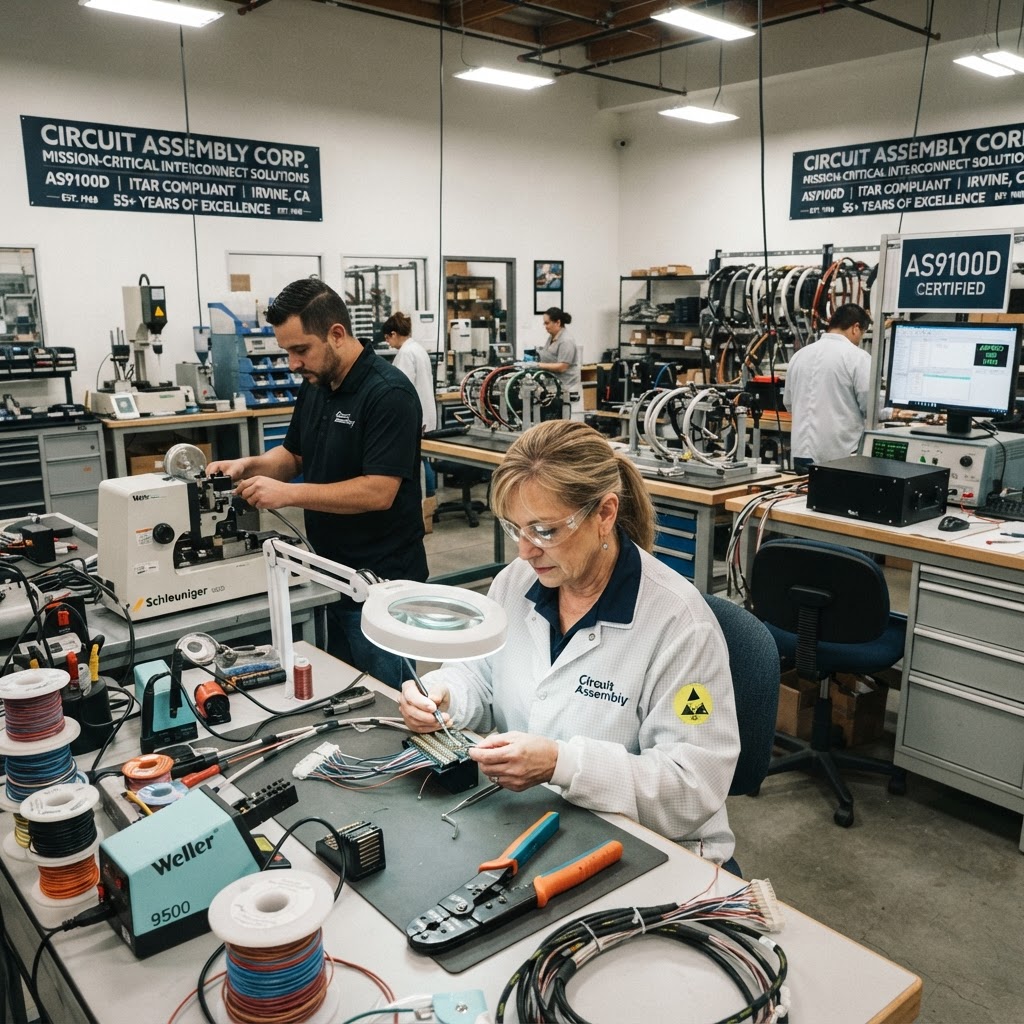


Inside Circuit Assembly: A Contract Manufacturing and Assembly Shop Built on Precision and Pride
The smell hits you first — solder flux and clean room air, the particular mix you find in shops where people are doing real work on real deadlines. Walk the floor at Circuit Assembly in Irvine, California, and you see technicians bent over workbenches, hands moving with the unhurried confidence that only comes from years of repetition. A wire harness destined for an aerospace application is taking shape under a set of fingers that have routed thousands of them. The routing board is pinned exactly right. The labels are straight. Nothing is rushed, and nothing is guessed. This is what 50-plus years of doing one thing well looks like.
Founded in 1969, Circuit Assembly is not a company that needs to reinvent itself every few years to stay relevant. It found its lane early — precision cable assemblies, wire harnesses, connectors, and complex box builds for industries where failure is not an option — and it has stayed in that lane with the kind of focused discipline that most shops only talk about.
A Family Business That Outlasted the Trends
A lot of contract manufacturers born in the late 1960s are gone now. The ones that survived either grew into massive facilities chasing volume, or they stayed sharp and stayed specific. Circuit Assembly did the latter. Still family-founded at its core, the company operates out of Irvine in Orange County — a region that has long served as a hub for aerospace and defense supply chains feeding into nearby primes and program offices throughout Southern California.
Fifty-plus years in operation is not a marketing line. It is a record. It means the company has navigated material shortages, defense drawdowns, commercial market swings, and the wholesale offshoring of American manufacturing — and came out the other side still building product in California. That matters to procurement teams who have learned the hard way what it costs when a supplier disappears mid-program.
What They Build and Who They Build It For
Circuit Assembly's core output covers the full range of interconnect and electromechanical assembly work that demanding programs require:
- Custom cable assemblies — from simple two-conductor runs to complex multi-branch configurations built to customer specifications
- Wire harnesses — routed, labeled, tested, and documented for aerospace, defense, medical, and industrial applications
- Connector manufacturing — including crimp, solder, and specialty terminations across a wide range of connector families
- Box builds — complete electromechanical assemblies integrating cables, harnesses, connectors, brackets, and enclosures into finished or semi-finished units ready for integration
The customer base reflects the geography and the pedigree. Aerospace and defense make up a significant portion of the work — the kind of programs where AS9100D certification is a baseline requirement, not a differentiator. Medical device and industrial customers round out the portfolio, industries that share the same intolerance for assembly defects and documentation gaps that defense primes have always demanded.
The Quality System Behind the Work
Circuit Assembly operates under an AS9100D-certified quality management system, which is the aerospace and defense industry's extension of ISO 9001. Getting that certification is one thing. Maintaining it across a shop doing custom work — where every job is different and every traveler requires fresh attention — is another thing entirely.
What the certification signals to a sourcing engineer or a program manager is this: the processes are documented, the controls are in place, and there is a system — not just individual craftsmanship — behind every assembly that ships. In practice at a shop like Circuit Assembly, it means full traceability from prototype through production. You can pull a record on a harness that shipped two years ago and find out who built it, what materials went into it, and what tests it passed before it left the building. For aerospace and defense customers managing configuration control across long program lifecycles, that traceability is not optional.

What will it take to turn demand into delivered output?
Explore The Capacity Imperative, our report on U.S. advanced manufacturing and the priorities shaping 2027.
Prototype capability matters too. A shop that can only run production quantities is useful, but a shop that can take a new design from first article through production with consistent processes and consistent documentation is the one that program managers return to. Circuit Assembly has been doing both for a long time.
What Makes This Shop Different
The contract manufacturing market is crowded. There are hundreds of shops that can crimp a terminal and route a harness. What separates Circuit Assembly from the commodity end of that market comes down to a few things that don't show up in a capability statement.
First, longevity creates institutional knowledge. A shop that has been building aerospace and defense assemblies since 1969 has seen more connector families, more customer drawing formats, more unusual specifications, and more edge cases than most. That experience lives in the workforce and the management — and it shows up when a new program brings a drawing that has a tolerance that seems off or a termination requirement that conflicts with the hardware. Experienced shops catch those things. New shops ship them.
Second, size matters in this market — and not always in the direction people assume. A 50-to-200-person operation is large enough to handle real production volumes, support multiple programs simultaneously, and maintain a serious quality infrastructure. It is small enough that program managers can reach the people actually making decisions and that customer programs don't get lost in a queue behind higher-revenue accounts. That middle-market position is exactly where a lot of serious aerospace and defense subassembly work gets done.
Third, California-based manufacturing for California-based programs is a logistical advantage that procurement teams sometimes undervalue until they need a fast turn, a quick engineering conversation, or an in-person source inspection. Being in Irvine puts Circuit Assembly within range of a significant concentration of aerospace and defense prime contractors and system integrators.
Procurement and sourcing teams evaluating interconnect assembly suppliers can review capabilities and contact information directly at Visit Circuit Assembly.
About Circuit Assembly
| | | |---|---| | Founded | 1969 | | Location | Irvine, California | | Employees | 50–200 | | Certifications | AS9100D | | Core Capabilities | Cable assemblies, wire harnesses, connector manufacturing, box builds | | Markets Served | Aerospace, defense, medical, industrial | | Company Type | Family-founded, contract manufacturer |
Where to Find Them
Circuit Assembly is located in Irvine, California, serving aerospace, defense, medical, and industrial customers across the United States. Engineering teams, program managers, and procurement professionals looking for a proven interconnect and electromechanical assembly partner can learn more and make contact at:
For shops doing this kind of work at this level of documentation and certification, the record speaks before the sales pitch does. Fifty-plus years of keeping defense and aerospace programs supplied with assemblies that work — that is not something you fake, and it is not something you build overnight.

