
Why Aerospace Supply Chains Are Going Vertical in 2026 — September 2026
When Lockheed Martin absorbed Martin Marietta in 1995, the defense industry drew a clear lesson: scale insulates. What took three decades to fully absorb is now being relearned at the subcontractor level, as primes and their top-tier suppliers alike conclude that owning your inputs is no longer a strategic luxury — it is a survival condition.
Vertical integration in aerospace supply chains has moved from boardroom theory to procurement reality in 2026. The convergence of persistent delivery failures on the F-35 Joint Strike Fighter program, accelerating USAF requirements under the Next Generation Air Dominance initiative, and a DoD industrial base policy framework that now explicitly rewards supply chain ownership — all of it is pushing aerospace manufacturers toward a structural model that eliminates dependency wherever the math allows.
The Supply Chain Failures That Made Vertical Integration Inevitable
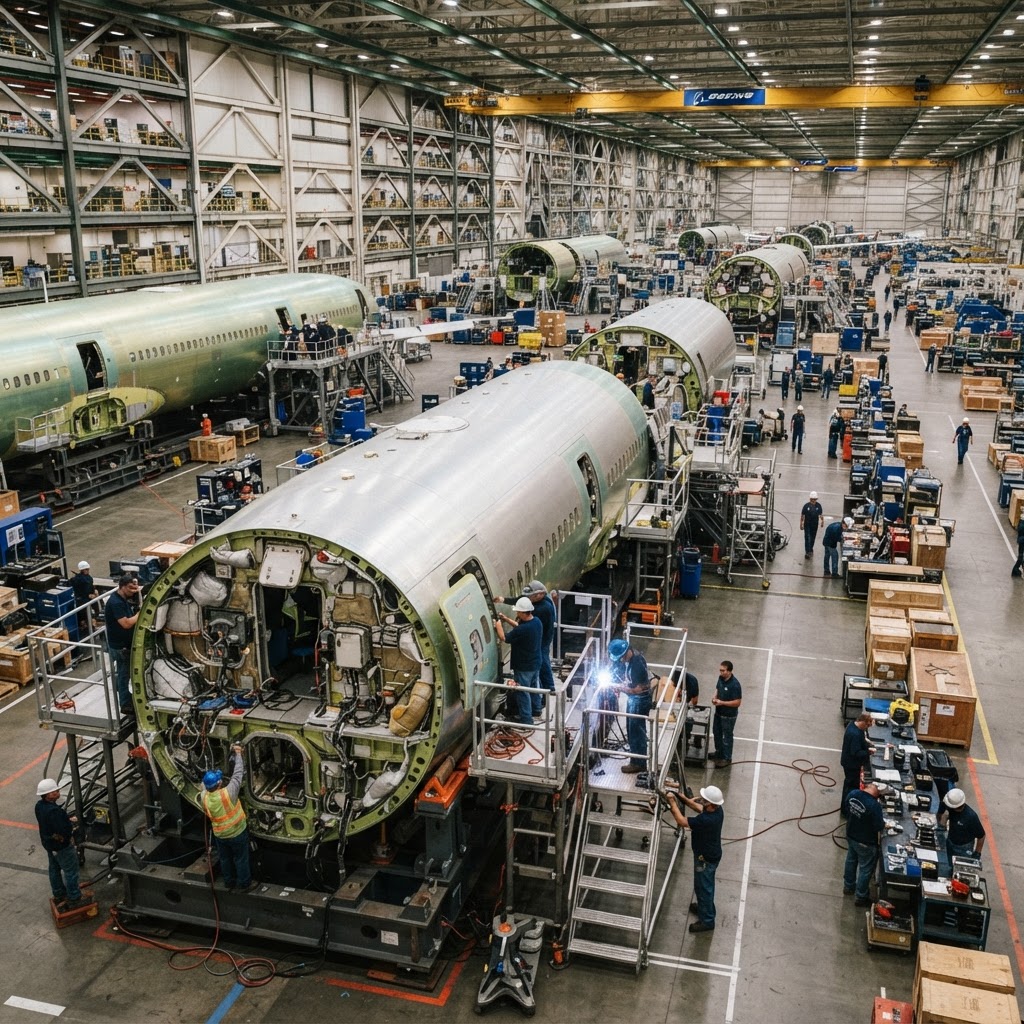
The aerospace industry spent the better part of the 2010s optimizing for cost efficiency through outsourcing. The 737 MAX program at Boeing became the canonical case study in what happens when critical manufacturing knowledge migrates outside the prime's walls. Spirit AeroSystems, spun off from Boeing in 2005 to reduce fixed costs, became the single-source provider for 737 fuselages — and when quality and delivery problems metastasized, Boeing had neither the in-house capacity nor the institutional knowledge to absorb the work quickly. Boeing's announced reacquisition of key Spirit AeroSystems assets in 2024 formalized what the supply chain community already understood: the outsourcing experiment had reached its structural limits.
The F-35 program told a parallel story at the tier 2 and tier 3 levels. Subcontractors supplying specialized forgings, titanium structural components, and advanced composite subassemblies repeatedly surfaced as program schedule constraints. Pratt & Whitney's F135 engine sustainment issues — rooted partly in a supplier base that had consolidated to dangerous single-source concentration — contributed directly to fleet availability shortfalls that drew congressional scrutiny and formal Government Accountability Office reporting. The GAO's 2025 assessment of F-35 sustainment costs reinforced what procurement leads on the program had been logging internally for years: supplier fragility is program fragility.
What Vertical Integration Actually Looks Like in 2026
The term gets used loosely, so precision matters here. Aerospace vertical integration in 2026 is not uniformly about primes building greenfield factories. It operates across at least three distinct models:
- Prime repatriation — Boeing's Spirit reacquisition is the clearest example. A prime recovers a previously divested capability because single-source dependency created unacceptable program risk.
- Tier 1 forward integration — Suppliers acquiring downstream fabrication and assembly capabilities to move closer to the prime's bill of materials. TransDigm Group, long understood as the aerospace supply chain's most aggressive consolidator, has continued bolt-on acquisitions that give it proprietary position across hydraulic, actuation, and power distribution systems — components that now appear on virtually every major DoD platform.
- Technology-driven captive capability — Primes and tier 1 suppliers investing in in-house additive manufacturing, automated composite layup, and precision CNC capacity that replaces what was previously sourced externally. GE Aerospace has expanded its internal additive manufacturing capability for LEAP and GE9X engine components specifically to reduce exposure to a machining supplier base that proved inconsistent during post-COVID ramp cycles.
The dry observation worth registering here: an industry that spent two decades publishing white papers on the virtues of lean, outsourced supply networks is now spending capital at pace to undo precisely that architecture. Consultants who sold the original model are, by most accounts, still billing.
"Supplier fragility is program fragility — and the DoD has stopped pretending otherwise."
Defense Policy Is Accelerating the Shift, Not Just Reacting to It
The DoD's Industrial Base Policy office has been explicit in its 2025–2026 guidance: programs that demonstrate multi-source or captive supply arrangements for critical materials and components will receive favorable treatment in source selections. This is not informal preference — it is codified into recent Other Transaction Authority agreements and reflected in contract language on several DARPA development programs.
The CHIPS and Science Act created a template that defense manufacturing advocates immediately pointed to as a model for aerospace: if the federal government is willing to pay for semiconductor supply chain repatriation, the argument for similar industrial policy in airframe and propulsion manufacturing becomes harder to dismiss. Congressional language in the FY2026 National Defense Authorization Act included provisions directing the Air Force and Navy to report on single-source concentration risks across their top 20 procurement programs by dollar value — a reporting requirement that functions as a quiet audit of every tier 1 supplier's exposure.
Northrop Grumman, managing the B-21 Raider program under a cost-plus-incentive-fee contract structure, has been particularly pointed in its public statements about supply chain architecture. The company has made no secret of its preference for suppliers who can demonstrate captive manufacturing capacity rather than relying on their own sub-tier networks — a preference that carries real weight when Northrop controls a program with an estimated procurement value exceeding $100 billion over its full production run.
AI and Automation Are Making Vertical Integration Economically Viable
The prior argument against vertical integration was always economic: owning the manufacturing is expensive, fixed-cost-heavy, and operationally demanding. That calculus has shifted materially as AI-driven quality inspection, robotic fabrication cells, and digital thread technologies reduce the labor intensity and management overhead of running captive manufacturing operations.
AI vision systems capable of inspecting composite layups, weld seams, and machined tolerance features at production speed — without the variability of human inspection — mean that a prime or tier 1 supplier can operate a high-mix, low-volume aerospace manufacturing cell with substantially less skilled labor than the same cell required five years ago. The economics of keeping that cell in-house improve accordingly. This is not theoretical: several production programs under USAF contract have qualified AI-assisted inspection systems to MIL-SPEC standards within the last 18 months, reducing inspection cycle times and defect escape rates simultaneously.
The integration of manufacturing execution systems with program digital threads — particularly on platforms like Siemens' Xcelerator and comparable platforms — means that a captive manufacturing cell can be managed with visibility and traceability that a third-party supplier often cannot match. For programs where DCSA compliance, export control, and classified manufacturing requirements apply, that traceability is not optional.
What This Means for Tier 2 and Tier 3 Suppliers
The vertical integration trend is not uniformly threatening to the supplier base — but it requires an unsentimental read of where each supplier sits in the new architecture.
- Single-source suppliers in commodity categories face the highest displacement risk. If you are the sole source for a standard machined bracket, a standard forging, or a non-proprietary composite panel, your customer is actively evaluating whether to bring that capability in-house or qualify a second source. The time to address this is before the requalification conversation starts, not after.
- Suppliers with proprietary process knowledge retain leverage. TransDigm's model works because its components carry switching costs that a prime cannot easily absorb. Tier 2 and tier 3 suppliers who have invested in process certifications, NADCAP accreditation, and documented capability that cannot be quickly replicated are in a structurally different position than those competing on price alone.
- Investment in automation and AI inspection is now a supplier qualification criterion, not a differentiator. Primes under cost pressure and schedule scrutiny are asking tier 2 suppliers about their inspection defect escape rates, their capacity to provide digital thread-compatible quality data, and their ability to flex production volume without proportional labor increases. Shops that cannot answer those questions credibly are losing position in source selections.
- Vertical integration creates acquisition opportunity for capable tier 2 shops. Primes and tier 1 suppliers looking to bring capabilities in-house are acquiring rather than building where speed is a constraint. A well-run, NADCAP-certified fabrication shop with clean financial records and documented capacity is a more attractive acquisition target in 2026 than at any point in the last decade.
- Geographic clustering near prime facilities will matter more. As primes consolidate supply chains and emphasize rapid iteration and in-person collaboration for critical path components, suppliers located within practical logistics distance of major production sites — Palmdale, Fort Worth, St. Augustine, Ridley Park — will have structural advantages over equivalent shops located remotely.
The fundamental dynamic is straightforward: aerospace supply chains are compressing, ownership is consolidating, and the suppliers who will navigate this successfully are those who invest now in the process capabilities, certifications, and digital infrastructure that make them either acquisition targets or indispensable partners. The ones who wait for the consolidation to finish before responding will find the decision has already been made without them.
Sources: Government Accountability Office — F-35 Sustainment · DoD Industrial Base Policy · DARPA Official Site · Air Force Next Generation Air Dominance · NIST — CHIPS and Science Act

