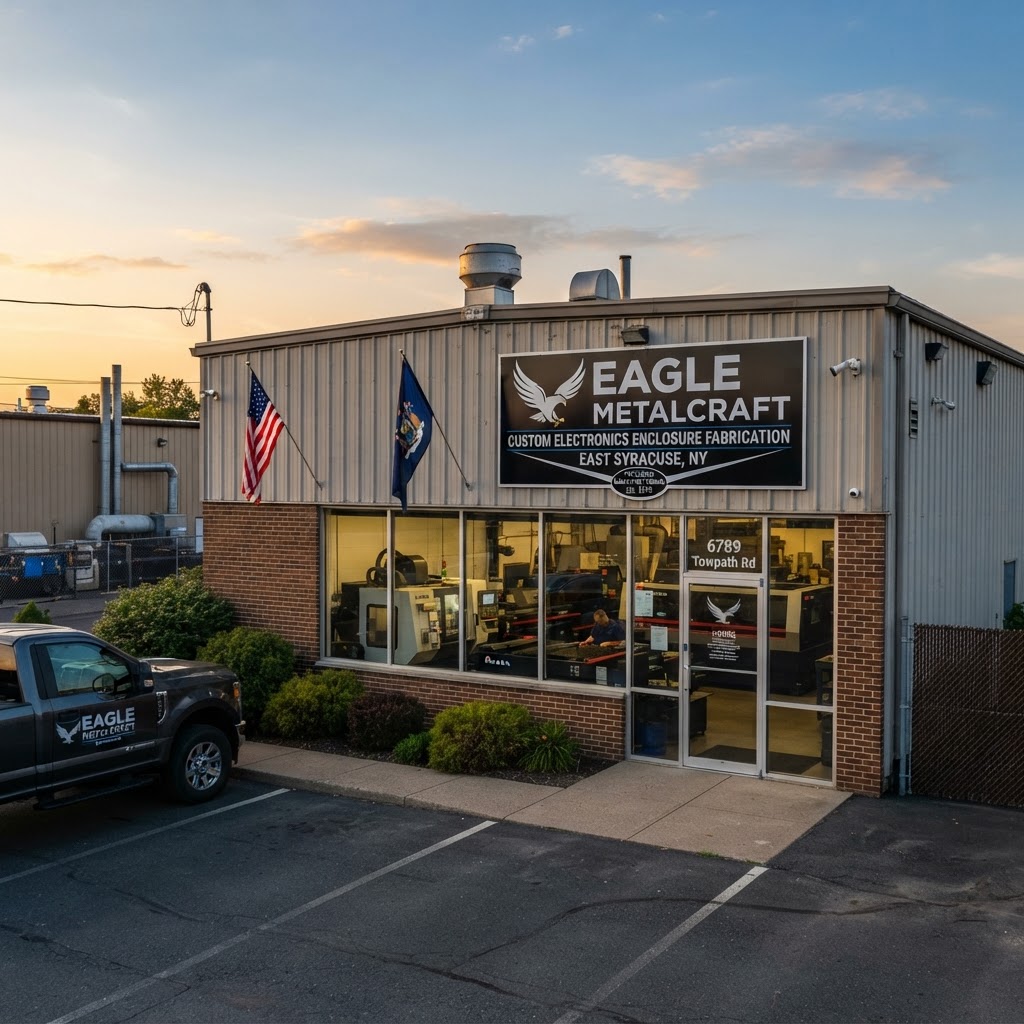


Inside Eagle Metalcraft: A Custom Electronics Enclosure Fabricator Built on Precision and Pride
The hum of a CNC punch press is a particular kind of sound — rhythmic, purposeful, each stroke removing exactly what doesn't belong. Walk the floor at Eagle Metalcraft in East Syracuse, New York, and that sound is part of the background score of a shop that has been doing this work since 1946. Flat sheet goes in one end. A precision-engineered metal enclosure, chassis, or mechanical assembly comes out the other. In between, there's a lot of hard-won knowledge applied at every station.
Eagle Metalcraft doesn't make consumer goods. They don't stamp out commodity parts by the millions. What they do — and have done for over 75 years — is build the metal housings that protect sensitive electronics in environments where failure is not an acceptable outcome. That's a different kind of work, and it demands a different kind of shop.
What They Build and Who They Build It For
Eagle Metalcraft's core product line centers on custom electronic enclosures, electronic chassis, and complex mechanical assemblies — the structural and protective hardware that surrounds circuit boards, power supplies, control systems, and other sensitive electronics deployed in demanding field environments.
Their customer base is made up of electronic OEMs — original equipment manufacturers who need precision sheet metal components that integrate cleanly with their own engineered systems. These are companies building instrumentation, defense electronics, industrial control equipment, communications hardware, and similar products where dimensional accuracy isn't a preference — it's a specification.
For those customers, Eagle functions less like a job shop and more like a manufacturing partner. They're not just bending metal to a print. They're often engaged earlier in the product development cycle, working through design decisions that will affect how a finished enclosure performs once it's housing live electronics in the field.
The Design-for-Performance Philosophy
What separates Eagle Metalcraft from a generalist sheet metal shop is what they call a design-for-performance approach. This means their engineering focus extends beyond dimensional conformance to the functional behavior of the finished assembly.
Two areas get particular attention: thermal management and tolerance stacking.
Thermal management matters because electronics generate heat, and enclosures either help dissipate that heat or trap it — and a trapped-heat problem inside a sealed metal housing is a product reliability problem. Eagle's team thinks about vent placement, material selection, and geometry with heat dissipation in mind from the beginning of a design engagement.
Tolerance stacking is the other discipline that separates experienced enclosure fabricators from everyone else. When you're assembling a chassis with multiple panels, brackets, cutouts, and mating surfaces, individual part tolerances compound. A hole that's two thousandths off on one panel, combined with a bend that's two thousandths off on another, can mean an assembly that doesn't close cleanly — or worse, one that looks fine on the bench but causes problems in the field. Eagle's fabrication process is designed to control those stack-ups from the first operation to the last.
This is the kind of engineering discipline that procurement managers and design engineers should be asking about when they're qualifying a new sheet metal fabricator for electronic assemblies. It's not glamorous, but it's the difference between a supplier that ships parts and a partner that ships solutions.
The Technology Behind the Work
Eagle Metalcraft runs a modern fabrication floor built around the equipment that precision electronics enclosure work demands.

What will it take to turn demand into delivered output?
Explore The Capacity Imperative, our report on U.S. advanced manufacturing and the priorities shaping 2027.
CNC punching handles high-accuracy hole patterns, louvers, knockouts, and formed features across a range of material gauges. Punching is fast and repeatable, and for enclosures with complex perforation patterns — ventilation arrays, connector cutouts, mounting grids — it delivers consistency that manual methods can't match.
Laser cutting brings the capability to handle complex profiles, tight-radius cuts, and materials or thicknesses where punching isn't the right tool. Laser-cut edges are clean, which matters when mating surfaces need to seal or when finished appearance is part of the specification.
Precision bending is where flat blanks become three-dimensional geometry. For electronic chassis work, bend accuracy is critical — flange angles, return dimensions, and corner geometry all affect how assemblies come together. Eagle's press brake operations are set up for the kind of close-tolerance bending that enclosure work requires.
Robotic welding rounds out the fabrication capability. For assemblies that need welded joints — whether for structural integrity, EMI shielding, or environmental sealing — robotic welding delivers consistent penetration and repeatable geometry that manual welding can't reliably achieve at production volumes.
Taken together, this equipment stack covers the full fabrication sequence for complex electronic enclosures without subcontracting the critical operations out. That matters for lead time, quality control, and communication. When everything happens under one roof, problems get caught and corrected faster.
What Makes This Shop Different
Eagle Metalcraft has been operating continuously since 1946. That's not a marketing point — it's a fact that carries real meaning for sourcing and procurement teams evaluating long-term supply relationships.
A shop that has survived for over seven decades in precision sheet metal fabrication has done so by solving hard problems for demanding customers, adapting its equipment and processes as technology evolved, and maintaining the kind of quality reputation that keeps OEM customers coming back. In the electronics manufacturing supply chain, that kind of track record is genuinely rare.
The shop operates at a 50–100 employee scale — large enough to run multiple shifts and handle meaningful production volumes, but small enough that experienced people are hands-on with the work. In a shop this size, the people quoting your job and the people running your job are not strangers to each other. That organizational coherence shows up in execution.
For engineering and procurement teams who want to dig deeper into capabilities, tolerances, and materials before making contact, Eagle Metalcraft's website provides a clear picture of their services and approach. It's a practical starting point for any sourcing evaluation.
About Eagle Metalcraft
- Founded: 1946
- Location: East Syracuse, New York
- Employees: 50–100
- Specialties: Custom Electronic Enclosures, Electronic Chassis, Precision Sheet Metal Fabrication
- Key Technologies: CNC Punching, Laser Cutting, Precision Bending, Robotic Welding
- Primary Customer Base: Electronic OEMs
- Engineering Focus: Design-for-performance, thermal management, tolerance stacking
- Website: eaglemetalcraft.com
Where to Find Them
Eagle Metalcraft is located in East Syracuse, New York, positioned in the heart of a region with deep manufacturing roots and strong access to the Northeast and Mid-Atlantic electronics OEM base.
Procurement managers, design engineers, and operations leaders evaluating precision electronic enclosure fabricators can find capability details, service information, and contact options directly at Visit Eagle Metalcraft.
For companies building electronics that have to perform in the real world, this is a shop worth knowing.
Sponsored by Manufacturing Ultra
This Manufacturer Spotlight is brought to you by Manufacturing Ultra — a zero-upfront-cost website development and digital growth program built exclusively for American manufacturers. Whether you need a modern website, SEO, or digital marketing, Manufacturing Ultra delivers without the upfront cost. Visit manufacturingultra.com to learn how they help shops like Eagle Metalcraft grow their digital presence.

