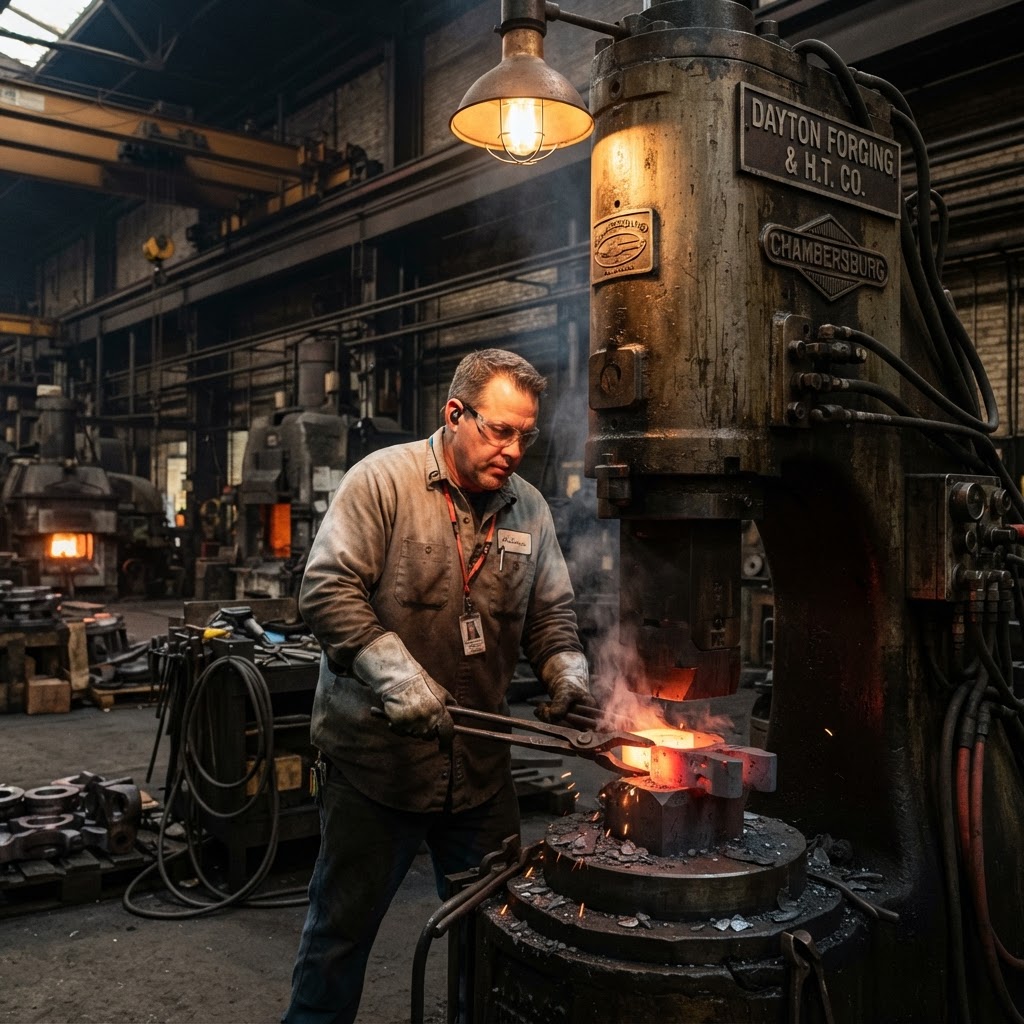


Inside The Dayton Forging & Heat Treating Co.: A forging and heat treatment Shop Built on Precision and Pride
The hammer comes down with a sound you feel before you hear it. Steel billet, heated to a precise orange glow, gets pressed into a closed die with the kind of force that reshapes metal at the molecular level. Watch it happen a few times and you start to understand why forging — real forging, done right — produces parts that cast or machined components simply cannot match for grain structure, strength, and long-term reliability. At The Dayton Forging & Heat Treating Co. in Dayton, Ohio, that process has been repeating itself, day in and day out, for more than ninety years. The equipment has evolved. The metallurgical understanding has deepened. But the core commitment — turn raw steel into something stronger than what you started with — has never changed.
A Century of Heat and Hammer in the Heart of Ohio
Dayton has always been a working city. It sits in the southwestern corner of Ohio, surrounded by manufacturing infrastructure that stretches back to the industrial buildout of the early twentieth century. The Dayton Forging & Heat Treating Co. was founded in that era, sometime in the 1920s, when American manufacturing was still figuring out how to feed a growing industrial economy with reliable, high-strength components. The company took root in that environment and never left.
Ninety-plus years later, the shop is still standing — and still forging. That kind of longevity in American manufacturing is not accidental. It requires consistent quality, the ability to adapt to changing customer demands, and a workforce that actually knows what they're doing. With approximately 75 employees operating across a facility that puts 300,000 square feet under roof, Dayton Forging has the scale to handle serious production volume while staying nimble enough to work closely with customers on custom requirements.
What They Do: Closed-Die Forging, Heat Treatment, and Rough Machining
The core of the business is closed-die forging — a process where heated steel is pressed between two shaped dies to produce a near-net-shape component with tight tolerances and superior mechanical properties. Closed-die forgings carry internal grain flow that follows the contour of the part, which is why forged components consistently outperform alternatives in fatigue life and impact resistance. For industrial applications where failure is not an option, this matters.
But forging alone is only part of the picture. What separates Dayton Forging from a shop that just runs hammers is the integrated heat treatment capability under the same roof. Heat treating — whether that means normalizing, annealing, quench-and-temper, or stress relieving — is what brings a forged component to its final mechanical specification. The ability to forge a part and then move it directly into a controlled heat-treat cycle, without shipping it across town to a third-party processor, compresses lead times and eliminates a significant source of variability in the supply chain.
Round out the offering with rough machining capabilities and you have a genuine one-stop shop for steel components from raw billet to a near-finished part ready for final machining or assembly. For procurement managers who have lived through the logistics headache of coordinating multiple vendors across a single part's production journey, that integration has real dollar value.

What will it take to turn demand into delivered output?
Explore The Capacity Imperative, our report on U.S. advanced manufacturing and the priorities shaping 2027.
The Facility: 300,000 Square Feet of Working Infrastructure
Three hundred thousand square feet is a serious footprint. That kind of space doesn't exist to impress visitors — it exists because forging and heat treating require room to operate safely and efficiently. Forge presses and hammers need floor space and ceiling clearance. Heat treat furnaces need room for loading equipment, quench tanks, and controlled cooling areas. Raw material storage — and steel arrives here in bulk — needs its own dedicated space.
The facility supports the full workflow from incoming billet through finished forging and heat-treated part. For sourcing teams evaluating a potential supplier, a large, purpose-built facility is a signal that the operation was designed for this work, not adapted from something else.
What Makes This Shop Different
There are forging shops scattered across the Midwest and beyond. Most of them do competent work. What distinguishes The Dayton Forging & Heat Treating Co. is the combination of things it does under one roof — and the depth of institutional knowledge built up over a century of doing it.
When a shop has been forging and heat treating steel since the 1920s, the knowledge embedded in that workforce is not documented in a manual somewhere. It lives in the hands and judgment of people who have run these processes through every variation of steel chemistry, part geometry, and customer specification you can imagine. That accumulated experience is genuinely difficult to replicate, and it's the kind of capability that matters when a customer brings an unusual alloy, a tight tolerance requirement, or a difficult part geometry to the table.
The one-stop-shop model also carries supply chain advantages that are increasingly relevant in a manufacturing environment where lead time and logistics reliability are competitive differentiators. Fewer handoffs mean fewer opportunities for delays, miscommunications, and quality escapes. Procurement and operations teams evaluating supply chain risk should weigh that integration seriously.
For sourcing engineers and procurement managers who want to understand the full scope of Dayton Forging's capabilities before making contact, the company maintains a website at Visit The Dayton Forging & Heat Treating Co. that provides an overview of their services and a point of contact for quoting inquiries.
Who They Serve
Dayton Forging produces forged steel components for a range of industrial markets. The specifics of their customer base span the kinds of industries that depend on high-strength steel parts — heavy equipment, agricultural machinery, energy, defense-adjacent industrial supply, and general industrial manufacturing. If your application involves load-bearing, high-stress, or impact-critical steel components, closed-die forgings from a shop with integrated heat treat capability belong on your approved vendor list.
About The Dayton Forging & Heat Treating Co.
- Founded: 1920s
- Location: Dayton, Ohio
- Employees: Approximately 75
- Facility: 300,000 square feet under roof
- Core Capabilities: Closed-die forging, heat treatment, rough machining
- Materials: Steel
- Markets Served: Industrial manufacturing across multiple sectors
- Business Model: Integrated one-stop shop — forging, heat treating, and rough machining under one roof
- Years in Operation: 90+
- Website: www.daytonforging.com
Where to Find Them
The Dayton Forging & Heat Treating Co. is located in Dayton, Ohio — a well-connected manufacturing hub in the Midwest with strong logistics access to customers across the industrial heartland and beyond. For procurement teams, sourcing engineers, and operations executives looking to qualify a forging and heat treat supplier with a proven track record, this shop deserves a serious look.
Start your evaluation at Visit The Dayton Forging & Heat Treating Co..
Sponsored by Manufacturing Ultra
This Manufacturer Spotlight is brought to you by Manufacturing Ultra — a zero-upfront-cost website development and digital growth program built exclusively for American manufacturers. Whether you need a modern website, SEO, or digital marketing, Manufacturing Ultra delivers without the upfront cost. Visit manufacturingultra.com to learn how they help shops like The Dayton Forging & Heat Treating Co. grow their digital presence.

