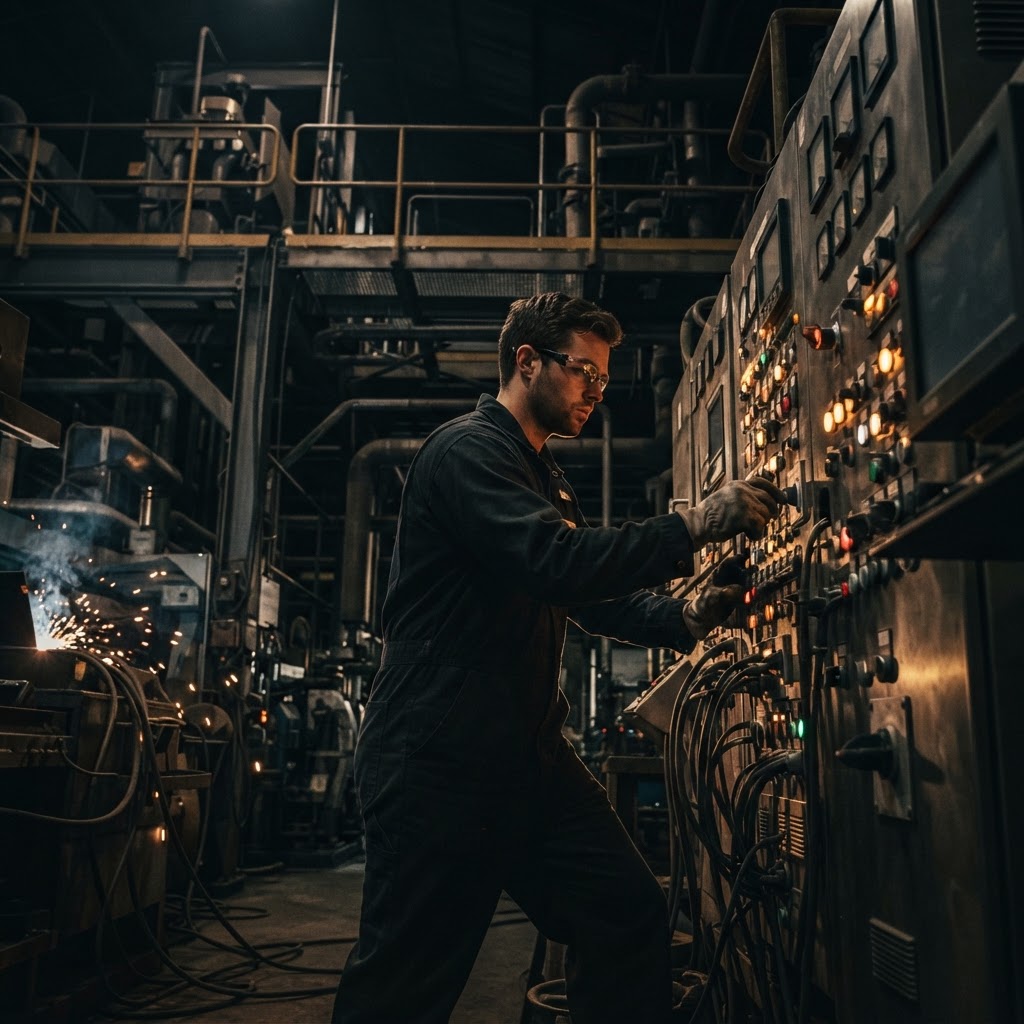

From PLC to AI: The Controller Evolution Reshaping Process Manufacturing — October 2026
By mid-2026, more than 40% of new automation deployments in North American process manufacturing are specifying AI-native controllers alongside — or instead of — traditional PLCs, a structural shift that legacy control architectures were never designed to absorb.
The PLC Model Served Its Purpose — Now It's a Bottleneck
The programmable logic controller dominated factory floors for five decades because it did one thing exceptionally well: deterministic, ladder-logic-driven control at millisecond cycle times. Rockwell Automation's ControlLogix platform and Siemens' SIMATIC S7 series defined that standard. Hardened, reliable, and simple to maintain — PLCs were the backbone of discrete and process manufacturing alike.
But process manufacturing in 2026 demands something PLCs structurally cannot deliver:
- Real-time adaptive setpoint adjustment based on upstream sensor fusion
- Predictive compensation for feedstock variability without operator intervention
- Cross-system optimization across multiple process loops simultaneously
- Edge inference for quality decisions at sub-100ms latency
These are not incremental feature requests. They represent a different computational paradigm — one that legacy scan-cycle architecture fundamentally cannot support at scale.
AI-Native Controllers Are Not Upgraded PLCs — They're a Different Tool Class
The industry is converging on a specific architecture: edge-deployed AI inference engines running in parallel with — or replacing — traditional scan-cycle controllers. The distinction matters operationally.
Emerson's DeltaV Automation Controller with embedded AI modules processes live historian data and model-predictive control outputs in the same chassis. Honeywell's Experion platform has integrated its Forge AI layer directly into distributed control system (DCS) architecture, enabling process optimization loops that close without routing through cloud infrastructure.
On the pure-play AI controller side:
- Aveva has deployed its System Platform with AI-assisted alarming and dynamic process modeling at refinery and chemical plant scales
- AspenTech continues expanding its Aspen DMC3 model-predictive control deployments, which now handle nonlinear process dynamics that rule-based PLC logic cannot approximate
- Rockwell Automation is midway through integrating its Plex AI capabilities into FactoryTalk Optix, targeting mid-market process facilities
"The scan cycle is a 1970s constraint. The plants winning in 2026 are the ones that stopped designing around it."
The Sensor-to-Decision Stack Has Compressed Dramatically
What's accelerating the PLC-to-AI transition isn't just controller hardware — it's the full stack compression happening underneath it. Modern process automation now operates across a tighter, faster loop:

What will it take to turn demand into delivered output?
Explore The Capacity Imperative, our report on U.S. advanced manufacturing and the priorities shaping 2027.
- Edge sensors — wireless HART, IO-Link, and smart transmitters feeding data at 10-100x legacy sample rates
- Edge compute nodes — NVIDIA Jetson-class hardware running inference models directly on the plant floor
- AI controllers — closed-loop optimization without cloud round-trips
- Digital twins — process simulation environments from Ansys and Dassault Systèmes validating control decisions before deployment
- MES integration — bidirectional data flow into manufacturing execution systems for traceability and compliance
This stack compresses the time between a process deviation and a corrective control action from minutes — in a traditional PLC-SCADA architecture — to seconds or sub-seconds. For continuous process manufacturers running tight yield targets, that compression is the margin.
Integration Complexity Is the Real Barrier — Not Cost
Plant managers surveyed at the 2026 Automation Fair consistently cited integration complexity as the primary obstacle, not capital expenditure. The installed base problem is real:
- Most process facilities run heterogeneous control environments spanning 15-30 years of hardware generations
- OPC-UA and MQTT protocol adoption is still uneven across legacy field devices
- Workforce retraining from ladder logic to Python-adjacent AI toolchains is a genuine operational risk
System integrators are absorbing much of this complexity. Burns & McDonnell, Grantek, and Polytron have all scaled dedicated AI controller integration practices in 2025-2026, offering phased migration frameworks that protect uptime during transitions. The playbook typically runs in three stages: parallel operation, shadow mode validation, then live control handoff — a sequence that typically spans 90 to 180 days depending on process criticality.
What This Means for Your Floor
If you're an operations director or plant manager evaluating your control architecture in Q4 2026, the decision framework has changed. This is not a rip-and-replace conversation — it's a parallel architecture conversation.
Immediate actions worth prioritizing:
- Audit your existing PLC firmware versions and communication protocol support — OPC-UA compatibility is your gateway drug into AI controller integration
- Identify two or three high-variability process loops where adaptive control would have the clearest yield or energy impact — start the business case there
- Engage your DCS vendor directly on their AI roadmap timelines; Emerson, Honeywell, and Rockwell all have documented 2027 feature commitments that affect procurement timing
- Evaluate edge compute infrastructure separately from controller software — the NVIDIA and Intel hardware layer is often procured on different budget cycles than automation software
- Do not wait for a greenfield project; the most successful AI controller deployments in 2026 are brownfield integrations running alongside existing PLCs
The manufacturers gaining ground right now are not the ones who replaced everything. They're the ones who added inference capability to existing infrastructure and let it prove ROI before committing to broader migration. That's the model worth replicating.
The PLC isn't dead — but it is no longer the ceiling. In process manufacturing, the ceiling is now defined by how fast your control architecture can learn.
Sources: Rockwell Automation — FactoryTalk Optix · Emerson DeltaV AI · AspenTech DMC3 · Honeywell Experion PKS · Aveva System Platform

