
The 500,000 Worker Shortage That Nobody Talks About — September 2026
American manufacturing is short roughly 500,000 skilled workers right now — and the silence around this crisis is almost as damaging as the gap itself.
A Tuesday Morning in Youngstown Tells the Whole Story
Maria Delgado has been running a CNC lathe — a computer-controlled cutting machine that shapes metal parts with precision — at a mid-sized fabrication shop outside Youngstown, Ohio for eleven years. She knows the machine the way a musician knows an instrument. Last spring, her plant manager offered her a lead technician role. She wanted it. But the promotion would have pulled her off the floor, and the shop had nobody ready to replace her at the lathe. The promotion sat on the table for four months while the manager quietly panicked about coverage.
That story — a skilled worker frozen in place because there is no one behind her — is playing out across thousands of shops, plants, and factories this September. The bottleneck is not ambition. It is pipeline.
The Numbers Behind the Quiet Crisis
The Bureau of Labor Statistics reported in its most recent Job Openings and Labor Turnover Survey that manufacturing job openings remain elevated well above pre-pandemic baselines, with skilled trades and precision production roles accounting for the most persistent vacancies. The Manufacturing Institute, the workforce development arm of the National Association of Manufacturers, has projected that the domestic skills gap could leave 2.1 million manufacturing jobs unfilled by 2030 — and that the steepest shortfall arrives in the middle of this decade.
We are in that window right now.
The specific roles hardest to fill include:
- CNC machinists and operators
- Industrial maintenance technicians
- Welders certified for structural and pressure applications
- Robotics and automation technicians — a category that barely existed at scale a decade ago
- Quality control inspectors who can work alongside AI-assisted vision systems
That last category matters more than most executives realize. As Cognex and other machine vision companies expand AI-assisted inspection tools across the floor, plants need workers who understand both the old craft standards and the new software interfaces. Finding one person who holds both skill sets is genuinely difficult in most regional labor markets.
Why This Shortage Gets Underreported
Part of the answer is optics. When a factory automates a line and reduces headcount, that story travels. When the same factory cannot hire a qualified maintenance tech to keep that automated line running, it rarely makes news. The narrative of automation displacing workers has crowded out the quieter, more complicated story of automation creating worker demand that the current pipeline cannot meet.

What will it take to turn demand into delivered output?
Explore The Capacity Imperative, our report on U.S. advanced manufacturing and the priorities shaping 2027.
Operators feel this acutely. A plant manager at a tier-two automotive supplier in the Midwest — who asked not to be named because her company is mid-negotiation on a training partnership — put it plainly: "We bought the robots. We cannot find the people to maintain them."
"We bought the robots. We cannot find the people to maintain them."
This is not an argument against automation. It is an argument for treating workforce development as infrastructure — not a human resources line item.
What Is Actually Working on the Ground
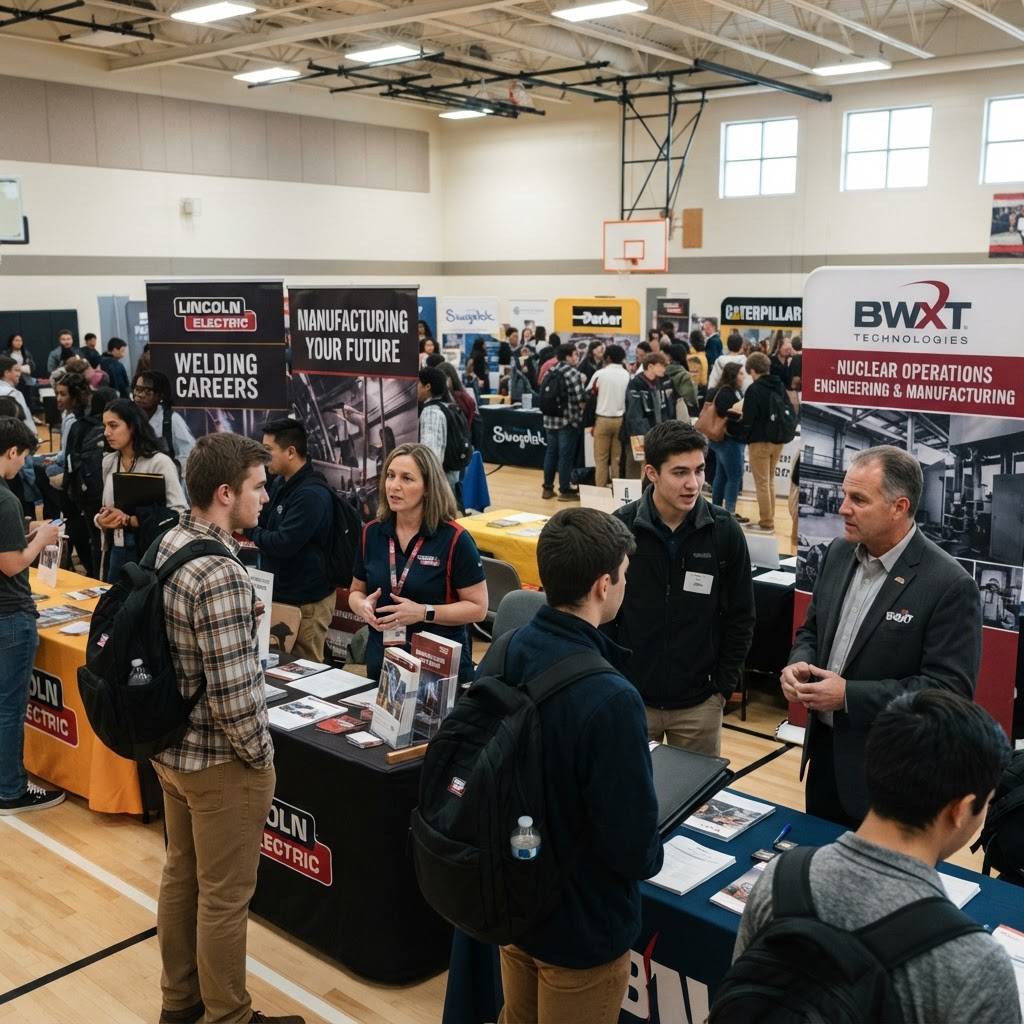
The programs generating real results share a few common traits: they are employer-connected from day one, they are shorter than a four-year degree, and they treat the worker's time as valuable.
Tooling U-SME, the training division of the Society of Manufacturing Engineers, has built a library of over 500 online courses specifically calibrated to manufacturing skill gaps, and their apprenticeship-readiness programs have shown measurable improvement in first-year retention rates for enrolled workers. Retention matters as much as recruitment — losing a trained technician in year one is expensive in ways that never show up cleanly on a balance sheet.
Ivy Tech Community College in Indiana has become something of a national model for its Advanced Manufacturing programs, with direct employer partnerships that effectively guarantee interviews upon completion. Their dual-credit pathways, which let high school students earn college credit on a shop floor, are filling the front of the pipeline in ways that traditional recruitment cannot.
At the federal level, the Department of Labor's Registered Apprenticeship framework has seen manufacturing enrollments grow steadily, though advocates argue the program needs faster onboarding for small and mid-sized manufacturers who lack dedicated HR staff to navigate the paperwork.
For workers like Maria Delgado, the solution is not more brochures about manufacturing careers. It is a trainee standing next to her for six months, learning the machine, so she can move up without leaving the shop exposed. That is a mentorship and succession model, and it requires employers to invest time before they see return.
September 2026 and the Road Ahead
The 500,000-worker gap will not close through any single program or policy. What is more likely — and more honest to say — is that it closes incrementally, shop by shop, through a combination of community college partnerships, registered apprenticeships, and employers willing to pay training wages for workers who are not yet fully productive.
Maria eventually got her promotion. The shop hired a recent graduate from a local technical college to take her seat at the lathe. It took seven months and two failed hires to get there. That timeline is too long for most operations running lean.
The workforce is there. The pathways need to be shorter, better marked, and better funded. That is not optimism. That is a project with a known scope — and enough people who want to work on it.
Sources: Bureau of Labor Statistics — JOLTS · The Manufacturing Institute — Skills Gap Research · Apprenticeship.gov · Tooling U-SME · Ivy Tech Community College Advanced Manufacturing

