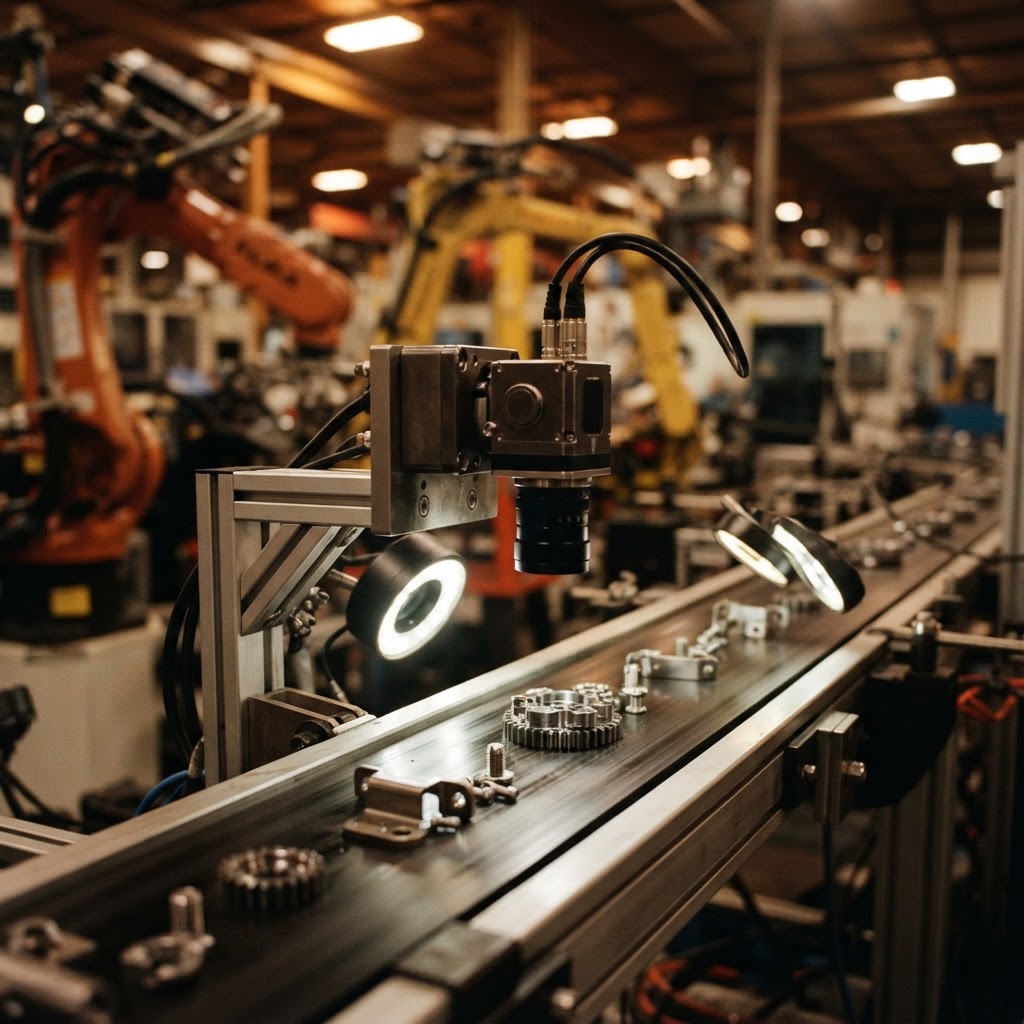

AI Vision Systems Are Outperforming Human Quality Inspectors — September 2026
In high-volume discrete manufacturing, AI vision systems are now catching defects at rates that exceed trained human inspectors by measurable margins — and the September 2026 deployment data from automotive and electronics lines is making the case impossible to ignore.
The Performance Gap Is No Longer Marginal
The conversation shifted from "can AI vision match humans" to "by how much does it beat them" sometime in early 2025. By mid-2026, that gap has widened into operational doctrine. Facilities running Cognex In-Sight 3D-L4000 systems alongside legacy human inspection stations are reporting defect escape rates dropping by 60 to 80 percent on surface-finish and dimensional checks. That is not incremental improvement — that is a process redesign trigger.
Human inspectors face irreducible biological constraints:
- Attention degrades after 20 minutes of repetitive visual tasks
- Lighting variation and fatigue introduce inconsistency across shifts
- Subjectivity in borderline accept/reject decisions creates audit variance
- Throughput caps at roughly 400 to 600 parts per hour on complex visual checks
AI vision does not share any of those constraints. A properly trained model running on NVIDIA Jetson AGX Orin edge compute evaluates 1,200 to 2,000 parts per hour with sub-millisecond latency and zero drift across a 24-hour production window.
What September 2026 Deployments Are Actually Showing
Three deployment patterns are dominating the case-study pipeline right now.
Automotive stamping and body panels: Tier 1 suppliers integrating FANUC R-2000iC robots with mounted vision payloads from Keyence are running 100 percent inline inspection on Class A surfaces. The economic argument is straightforward — one vision-equipped robot arm replaces two to three inspection technicians per shift while increasing throughput and producing a full digital audit trail per part.
PCB and semiconductor packaging: Electronics manufacturers are deploying Cognex ViDi deep learning tools for solder joint inspection and component placement verification. The critical advantage here is that deep learning models trained on known-good and known-bad image sets generalize to novel defect types that rule-based machine vision would miss entirely.
Precision machined components: Hexagon Manufacturing Intelligence is pairing structured-light scanning with AI classification to flag dimensional deviations on CNC-turned parts before they reach CMM queues. The result is a dramatic reduction in CMM bottlenecks — parts that pass the inline AI check skip the queue entirely.
"The shift is not about replacing eyes on the floor — it is about replacing the inconsistency those eyes inevitably introduce into your process data."
The Integration Stack That Makes This Work
Deploying AI vision is not a camera swap. It is a systems integration project with four distinct layers:
- Imaging hardware: High-resolution 2D, 3D structured light, or hyperspectral sensors matched to defect type. Teledyne DALSA and Basler dominate the sensor tier.
- Edge compute: Inference must run at line speed. NVIDIA Jetson platforms and Intel-based vision PCs from Advantech handle the workload without cloud latency dependency.
- AI model layer: Deep learning frameworks — either proprietary tools from Cognex or Keyence, or open-architecture platforms like Landing AI LandingLens — require structured training data and ongoing retraining pipelines as product variants change.
- MES and SCADA integration: Defect data must feed Rockwell Automation FactoryTalk or Siemens Opcenter in real time. Isolated vision systems that generate data nobody reads are a common and expensive failure mode.

What will it take to turn demand into delivered output?
Explore The Capacity Imperative, our report on U.S. advanced manufacturing and the priorities shaping 2027.
System integrators are the linchpin. Firms like Integra Systems and JMP Engineering are handling the full-stack deployment — from fixture design and lighting engineering to model training and historian integration — because most plants do not carry that expertise internally.
Human Inspectors Are Not Disappearing — They Are Repositioning
The workforce displacement narrative oversimplifies what is actually happening on the floor. The plants deploying AI vision at scale are not eliminating QC headcount outright — they are reallocating it.
Inspectors are moving into three higher-value roles:
- Model validation and exception review: AI systems escalate borderline cases. Trained humans review flagged parts and provide feedback that retrains the model — a closed-loop improvement process.
- Root cause analysis: With full defect imaging and classification data flowing into the MES, QC personnel can run statistical process control with precision that manual tally sheets never allowed.
- Supplier quality management: Outbound inspection resources freed by inline automation are being redirected to incoming material audits and supplier development — a function that still requires human judgment and relationship management.
The net effect is a quality organization that is smaller in total headcount but operating at a substantially higher analytical level.
What This Means for Your Floor
If you are an operations director or plant manager evaluating AI vision in Q4 2026, here is the decision framework that matters:
- Start with your highest-escape-rate defect category. Do not build a universal inspection system first. Solve the single most expensive quality failure point and prove ROI before scaling.
- Budget for integration, not just hardware. Camera and compute costs are a fraction of total project cost. Lighting, fixturing, model training, and MES integration typically represent 60 to 70 percent of deployment spend.
- Demand retraining architecture upfront. Any vendor that cannot explain how the model updates when your product mix changes is selling you a static tool that will degrade over time.
- Align with your quality data strategy. AI vision generates high-density defect data. If your MES cannot consume and contextualize it, you are leaving the primary business value on the table.
- Evaluate total cost against fully-loaded inspection labor. When you include benefits, turnover, training, and shift differential, inspection labor costs are frequently underestimated by 30 to 40 percent in capital justification models.
The facilities pulling ahead in 2026 are not the ones that deployed the most sophisticated vision system — they are the ones that integrated it deepest into their process control architecture.
Sources: Cognex Corporation · NVIDIA Manufacturing · Rockwell Automation FactoryTalk · Hexagon Manufacturing Intelligence · Landing AI LandingLens

