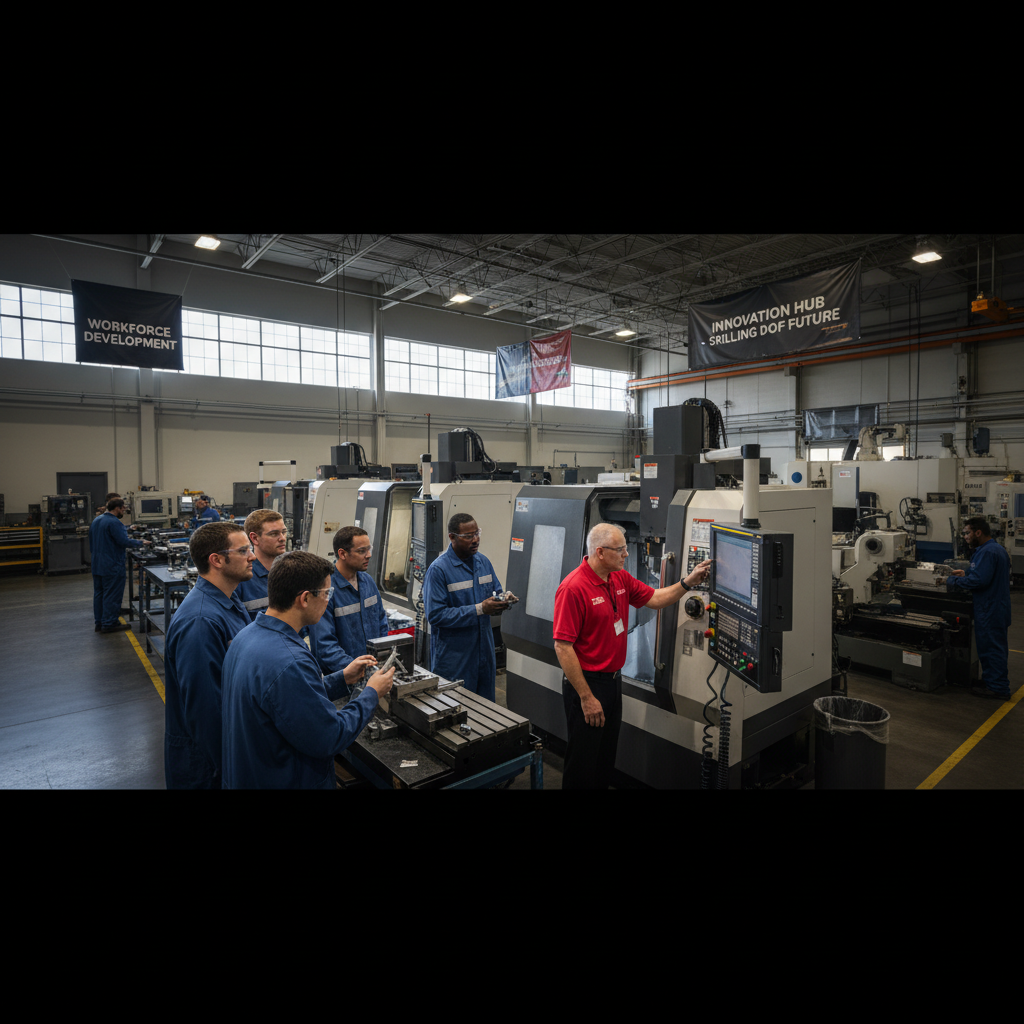

The 500,000 Worker Shortage That Nobody Talks About
She has been running the same CNC mill for eleven years. She knows the machine's sounds the way a parent knows a child's cough - which vibration is normal, which one means something is about to go wrong. Next spring, she retires. And the plant manager in Rockford, Illinois has no one to replace her.
Multiply that scene a few thousand times across American shop floors, and you begin to understand what the skilled trades gap actually feels like from the inside. Not as a statistic. As a daily operational emergency.
The National Association of Manufacturers has flagged for years that the industry could face a shortage of hundreds of thousands of workers over the coming decade - a figure shaped by simultaneous pressures: the retirement of the Baby Boomer generation, a decades-long cultural pivot that steered young people toward four-year degrees, and a reshore-driven surge in domestic manufacturing demand that nobody fully anticipated when those guidance counselors were handing out college brochures.
We talk endlessly about automation, reshoring, and supply chain resilience. We talk far less about the human infrastructure required to make any of it real.
The Problem Isn't a Lack of Jobs
Let's be precise about what kind of shortage this actually is. Manufacturers are not primarily struggling to fill entry-level assembly positions. The acute pain point is mid-skill, high-knowledge work - CNC machinists, industrial electricians, welders certified for structural or pipe work, mechatronics technicians, and tool-and-die makers. These are roles that typically require two to four years of training, strong spatial reasoning, and the kind of tacit knowledge that only comes from years on the floor.
Boeing, Siemens, and Caterpillar have all expanded apprenticeship and workforce development partnerships in recent years - not because it's good PR, but because the pipeline problem is existential. Siemens USA's apprenticeship program, modeled partly on the German Ausbildung system, has been widely cited as one of the more rigorous domestic examples of earn-while-you-learn manufacturing training. The fact that these programs are still considered noteworthy tells you how underdeveloped the broader ecosystem remains.
Meanwhile, community colleges - which should be the backbone of trades training - are often under-resourced, running equipment a decade behind what students will actually encounter in a modern facility. The credential they earn and the machine they'll touch on day one of the job can feel like two different eras of manufacturing.

What will it take to turn demand into delivered output?
Explore The Capacity Imperative, our report on U.S. advanced manufacturing and the priorities shaping 2027.
Why the Conversation Gets Drowned Out
Here's what I think is actually happening: the workforce crisis doesn't generate the same narrative electricity as AI or robotics. It's slower. It's structural. It doesn't make for a clean product launch or a ribbon-cutting ceremony.
But consider the operational math. When a skilled maintenance technician leaves and isn't replaced, mean time to repair creeps up. Unplanned downtime increases. You run your remaining technicians harder, accelerating burnout and turnover. The problem compounds before it announces itself.
This isn't hypothetical. Manufacturers across the Midwest and Southeast regularly report that maintenance and skilled trades vacancies are their most difficult positions to fill - harder, often, than engineering roles. A plant that can't maintain its equipment doesn't benefit much from its capital investments in new machinery.
What a Real Response Looks Like
The manufacturers gaining ground on this problem share a few characteristics worth naming:
- They treat workforce development as a capital investment, not an HR cost. They fund apprenticeships, pay for community college partnerships, and build internal training infrastructure with the same seriousness they apply to equipment procurement.
- They engage before the hire. Companies like Nucor have built reputations in their local labor markets through years of visible community presence - in schools, at career fairs, with local governments - not just when they have openings.
- They focus on retention as hard as recruitment. Starting wages matter. So does shift flexibility, internal advancement pathways, and basic cultural respect for trades expertise. The skilled worker who feels like a number leaves. The one who feels like a craftsperson stays.
- They advocate for policy, not just workforce. Federal programs like the Workforce Innovation and Opportunity Act (WIOA) and the Department of Labor's apprenticeship expansion initiatives exist, but they require active industry engagement to be effective. The manufacturers who show up at those tables shape the outcomes.
The Stakes Are Operational, Not Abstract
I want to be direct with the operations directors and plant managers reading this: the workforce gap is not a background concern. It is a throughput constraint. It is a quality risk. It is, in some facilities, already the binding limitation on what can be produced.
The woman running that CNC mill in Rockford retires in spring. She represents knowledge - hard-won, irreplaceable, and entirely preventable to lose if someone had started planning two years ago. The question for every plant on this continent is simple and uncomfortable: who is your version of her, and what have you actually done about it?
The shortage doesn't wait for a better quarter to start mattering. It's already on your floor.

