
Strategic Expansions, Acquisitions, and Domestic Investments Drive US Manufacturing Sector: What Manufacturing Leaders Need to Know This Week
By Marcus D. Holloway, Editor in Chief, Strata Intelligence | July 2, 2026
The United States manufacturing sector is undergoing a structural reconfiguration in real time — and this week's cluster of capital deployments, strategic acquisitions, and legal skirmishes makes that transformation impossible to ignore. From a $20 billion semiconductor investment in Arizona to record steel shipments driven by tariff discipline, the industrial backbone of American production is being rebuilt with deliberate, high-stakes urgency.
TSMC's $20 Billion Arizona Commitment Rewrites the Logic of Domestic Chip Supply
TSMC has received approval from Taiwan's Ministry of Economic Affairs for a $20 billion capital injection into its U.S. subsidiary, TSMC Arizona. The funds are earmarked for two specific infrastructure projects: a 12-inch wafer fabrication facility and an advanced packaging plant. This is not incremental investment. This is a sovereign-level commitment to embedding the world's most advanced semiconductor manufacturing capability into American soil.
For U.S. manufacturers, the downstream implications are immediate and compounding:
- Supply chain proximity: Advanced node chips — the processors and logic semiconductors that power everything from defense systems to consumer electronics — will be produced within domestic jurisdiction, reducing exposure to Taiwan Strait geopolitical risk.
- Advanced packaging onshoring: The packaging plant is a critical and often overlooked piece of the semiconductor supply chain. Packaging determines final chip performance, power efficiency, and form factor. Domestic advanced packaging capability removes a foreign dependency that has quietly persisted even as fab investments grew.
- Supplier ecosystem development: A facility of this scale requires a dense local ecosystem of chemical suppliers, equipment maintenance firms, specialty gas providers, and logistics operators. Arizona-based industrial suppliers should be actively positioning for long-term service contracts.
- Workforce pipeline pressure: The skills gap in semiconductor manufacturing is documented and acute. Plant operators and procurement directors in the region need to engage technical colleges and workforce development programs now — not when construction completes.
The U.S. CHIPS and Science Act framework created the incentive architecture that made this investment economically rational. TSMC's $20 billion commitment is, in part, a validation that federal industrial policy can move private capital at scale. C-suite leaders in adjacent manufacturing sectors should study this dynamic carefully.
"The world's most advanced semiconductor manufacturer is not hedging on America — it is betting on it, and every domestic manufacturer dependent on chip supply should understand exactly what that means for their sourcing strategy over the next decade."
Micron and General Motors Formalize the Memory-Automotive Supply Chain Alliance
Micron Technology and General Motors announced a Strategic Customer Agreement on July 1, establishing a long-term supply arrangement for memory and storage platforms to support GM's vehicle production pipeline. The agreement is specifically oriented toward next-generation connected and autonomous vehicles.
This deal matters beyond its two signatories. It represents a new model for how automakers and semiconductor suppliers must structure relationships in a post-shortage environment. The 2020–2023 semiconductor shortage cost the global automotive industry an estimated tens of billions of dollars in lost production. OEMs that relied on spot-market chip procurement paid the price in idled assembly lines and lost revenue. The Micron-GM agreement is a direct institutional response to that failure mode.
Key implications for automotive supply chain professionals:
- Tier 1 and Tier 2 suppliers servicing GM's vehicle programs need to align their own memory and storage sourcing strategies with the specifications and timelines embedded in this agreement. Misalignment at the component level can create integration bottlenecks even when OEM supply is secured.
- Inventory strategy shifts: Long-term agreements of this kind typically come with volume commitments and delivery schedules that alter just-in-time inventory assumptions. Procurement directors should reassess safety stock calculations for memory-dependent components.
- Autonomous vehicle readiness: The storage requirements for autonomous vehicle sensor fusion and real-time processing are orders of magnitude greater than conventional infotainment systems. Micron's role in this architecture is not peripheral — it is foundational.
This agreement also signals that domestic memory manufacturing capacity, supported in part by Micron's own CHIPS Act-backed fab expansions, is becoming a competitive differentiator for U.S. automakers seeking supply chain resilience.
ON Semiconductor's $7 Billion Acquisition of Synaptics Reshapes the Intelligent Edge
ON Semiconductor (onsemi) announced a definitive all-stock agreement to acquire Synaptics Incorporated in a transaction valued at approximately $7 billion. The strategic rationale centers on expanding onsemi's capabilities in human-machine interface (HMI) technology and edge computing — two domains that are rapidly becoming central to automotive cockpit systems, industrial automation, and smart infrastructure.
This is the most consequential semiconductor M&A event of the first half of 2026, and its implications for domestic industrial customers are significant:
- Consolidated intelligent systems offering: Onsemi has historically excelled in power semiconductors and sensing — the components that manage energy conversion and detect physical-world inputs. Synaptics brings sophisticated HMI silicon and software intelligence. The combined entity can now offer automotive and industrial OEMs a more integrated, single-vendor solution from power management through user interface.
- Edge AI acceleration: Synaptics has invested heavily in edge AI inference capabilities. Combined with onsemi's existing sensor portfolio, this acquisition positions the merged company to compete aggressively in the industrial IoT and smart manufacturing segments — markets where domestic manufacturers are actively upgrading facilities.
- Supply chain consolidation risk: Any major acquisition introduces integration complexity. Procurement directors at automotive and industrial firms that source from either company should request formal supply continuity assurances and monitor part number transitions carefully over the next 18 months.
- Competitive market reshaping: This deal compresses the competitive landscape. Rivals including Texas Instruments and Renesas will face a more capable onsemi across multiple product categories simultaneously.

What will it take to turn demand into delivered output?
Explore The Capacity Imperative, our report on U.S. advanced manufacturing and the priorities shaping 2027.
Texas Instruments vs. GlobalFoundries: The IP War Heating Up Domestic Semiconductor Competition
On June 29, Texas Instruments filed a lawsuit in the Texas Business Court against a former employee and competitor GlobalFoundries, alleging the theft of proprietary trade secrets. The suit resulted in a temporary injunction hearing — a legally significant early development that signals TI's intent to pursue the case aggressively.
This litigation is not a sidebar story. It is a signal about the competitive dynamics now defining domestic semiconductor manufacturing.
Three structural realities this lawsuit illuminates:
- Talent mobility as a strategic risk vector: As the United States builds out its domestic semiconductor manufacturing base, the movement of highly skilled engineers between competing firms accelerates. Each transition carries the risk — and, as TI alleges, the reality — of proprietary knowledge transfer. HR, legal, and operational leadership at semiconductor firms must treat IP protection as a continuous operational discipline, not a post-incident response.
- The CHIPS Act talent surge creates friction: Federal investment has dramatically increased hiring velocity across the sector. Rapid workforce expansion, particularly through lateral hiring from competitors, heightens trade secret exposure for every firm in the ecosystem.
- Downstream customer exposure: Manufacturers that source from both TI and GlobalFoundries — or from any firm that may be drawn into the litigation — should assess whether product roadmap delays or supply disruptions could result from prolonged legal proceedings.
The Texas Business Court, established to handle complex commercial disputes, represents an evolving judicial infrastructure for exactly these types of high-stakes industrial IP conflicts. Its rulings in this case will be watched closely across the sector.
U.S. Steel and Nucor Anchor the Domestic Steel Supply Chain from Two Directions
Two developments in the domestic steel sector this week, taken together, present a coherent picture of a supply chain consolidating around American production.
U.S. Steel announced a $475 million investment to install a new Quench and Tempering line at its Fairfield Tubular Operations in Alabama. Full production is targeted for Q2 2029. Quench and Tempering is a heat treatment process that produces high-strength, dimensionally precise steel pipe — the specification-grade material required by the U.S. oil and gas sector for demanding downhole and pipeline applications.
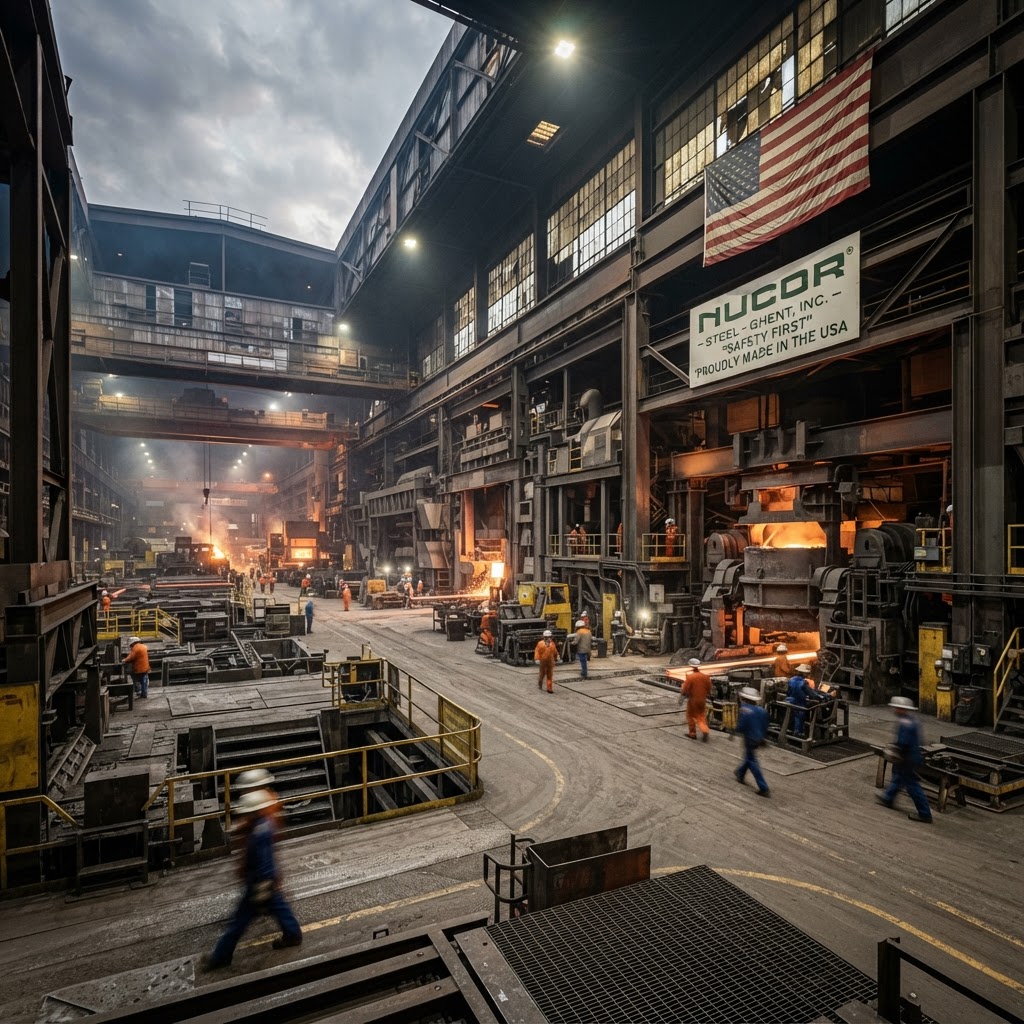
Simultaneously, Nucor Corporation lifted its financial outlook following record steel mill shipments, drawing broad analyst upgrades. The company attributed its performance to tight domestic steel supply conditions and the impact of recently tightened U.S. steel tariffs.
For downstream manufacturers and procurement professionals, these two developments carry distinct but complementary implications:
- Oil and gas supply chain planners should take note of the Fairfield timeline. The Q2 2029 production start is a planning anchor — sourcing teams managing tubular steel procurement for multi-year capital projects should factor this domestic capacity expansion into long-range contract strategies.
- Structural steel buyers in construction, infrastructure, and industrial manufacturing are operating in a market where Nucor's record shipments and improved guidance signal sustained tight supply. Spot pricing assumptions made in 2024 or 2025 may no longer hold.
- Trade policy dependency: Nucor's outperformance is explicitly linked to tariff protection. Procurement directors at firms that import steel inputs should treat current tariff structures as a scenario variable, not a fixed assumption, and maintain contingency sourcing models accordingly.
- Capital expenditure signaling: U.S. Steel's $475 million commitment signals long-term confidence in domestic demand for energy-sector steel. This is a meaningful data point for any supplier or service provider operating in the industrial Alabama corridor.
Editor's Take: Marcus D. Holloway's 90-Day Outlook
What this week's events collectively describe is not a series of isolated corporate decisions. They describe the architecture of a deliberate industrial reconfiguration — one driven by the convergence of federal policy incentives, geopolitical supply chain anxiety, and a domestic manufacturing sector that is finally moving from reactive posture to proactive investment.
In the next 90 days, I expect the following dynamics to intensify:
-
Semiconductor M&A acceleration: The onsemi-Synaptics deal will not be the last major transaction in this cycle. As CHIPS Act facilities come online and the competitive landscape consolidates, mid-tier semiconductor firms with specialized capabilities in power, sensing, and edge AI will become acquisition targets. Procurement directors should audit their critical component supply base for ownership changes before they happen.
-
IP litigation as competitive strategy: The TI-GlobalFoundries case will embolden other semiconductor firms to pursue aggressive trade secret enforcement. Legal costs and distraction are real operational risks. Firms should conduct proactive IP audits of their own onboarding and offboarding protocols for technical talent.
-
Automotive-semiconductor direct agreements proliferating: The Micron-GM model will be replicated. Expect at least two additional major OEM-semiconductor direct supply agreements before year-end. Tier 1 suppliers that do not have their own bilateral agreements in place are increasingly exposed to supply allocation risk as OEMs secure priority access.
-
Steel tariff scrutiny: Nucor's record performance will draw renewed political and trade partner attention to U.S. steel tariff structures. Downstream manufacturers using steel inputs — particularly in automotive, construction, and energy — should monitor U.S. Trade Representative activity and prepare for potential tariff adjustment scenarios in Q3 and Q4.
-
TSMC Arizona ecosystem formation: The $20 billion capital injection approval will trigger a cascade of supplier qualification and workforce development activity in Arizona. Regional manufacturers, logistics providers, and specialty chemical firms should be in active discussions with TSMC's procurement organization now.
The structural forces reshaping U.S. manufacturing are no longer theoretical. They are capitalized, litigated, and producing record shipments. The leaders who act on this intelligence today will be the ones setting the agenda in 2027.
Sources: TSMC Investor Relations · U.S. Department of Commerce CHIPS Program Office · Micron Technology Newsroom · Nucor Corporation Investor Relations · U.S. Trade Representative

