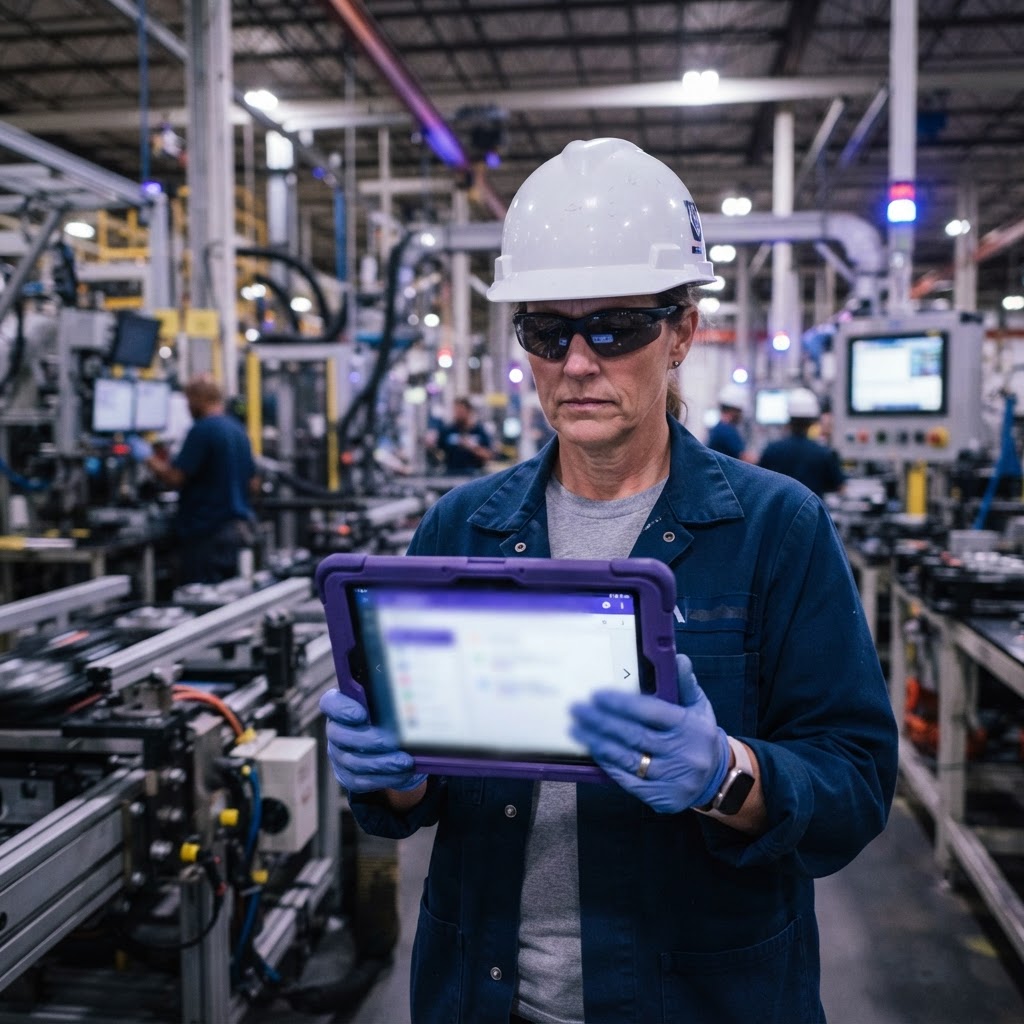

Inside Manufacturing GPT: Why This AI Actually Understands the Factory Floor
Most AI assistants were built for offices. Manufacturing GPT was built for the plant floor — and that distinction changes everything about how it performs when the stakes are real.
The Problem Every Plant Manager Knows
It's 6:45 a.m. A line supervisor walks into the morning standup with a question nobody can answer cleanly: a key resin supplier just flagged a 30-day delay, a new Section 232 tariff is hitting aluminum inputs, and the customer wants confirmation on delivery by end of week. The plant manager pulls up a general-purpose AI assistant and asks what to do. The answer comes back confident, fluent — and completely disconnected from the plant's actual capacity, contracted lead times, or current supplier relationships.
This is the failure mode that Manufacturing GPT was designed to eliminate.
General AI tools like ChatGPT and Google Gemini are impressive. They are also fundamentally built for generalist use cases. They hallucinate. They lack access to live operational data. They don't know what your facility runs, what your throughput looks like, or what policy changes came out of Washington last week that directly affect your cost structure. Manufacturing GPT does.
Why It Matters
The manufacturing sector is operating under compounding pressure. Reshoring Initiative data points to accelerating domestic production investment, but that growth comes with complexity — tighter labor markets, volatile input costs, shifting federal policy, and supply chains that are still recovering from structural disruptions.
In that environment, bad information is expensive. A wrong assumption about tariff exposure, a miscalculated make-vs-buy scenario, or a delayed response to a supplier risk event can cost a mid-sized manufacturer tens of thousands of dollars — or a customer relationship.
"Most AI gives you an answer. Manufacturing GPT gives you the right answer for your operation — grounded in real data, not a language model's best guess."
The AI tools that actually help manufacturers need three things that general models almost never have:
- Anti-hallucination architecture — outputs grounded in verified, sourced data rather than probabilistic text generation
- Manufacturing-specific context — understanding of production terminology, supply chain dynamics, and operational decision frameworks
- Live data integration — access to current policy, tariff, and market information that changes faster than any static training set
Manufacturing GPT is built around all three. It connects directly to Strata Ultra's Government Insights layer, which aggregates live federal manufacturing data, tariff schedules, and policy updates from sources including the U.S. International Trade Commission and the Bureau of Industry and Security. When you ask a question about cost exposure, you get an answer informed by what's actually happening in policy — not what was true eighteen months ago.

What will it take to turn demand into delivered output?
Explore The Capacity Imperative, our report on U.S. advanced manufacturing and the priorities shaping 2027.
How It Works
Manufacturing GPT lives inside the Capability Center on Strata Ultra — the same hub that houses voice reporting, the Scenario Planner, and specialized AI utilities built for shop floor and executive use. Here is what makes it function differently from a general-purpose assistant:
- Grounded responses: Every output is tied to real, sourced data. When the model does not have verified information, it tells you — rather than inventing a plausible-sounding answer.
- Platform-integrated context: Manufacturing GPT can pull from your activity across Strata Ultra, including supplier profiles in the Manufacturing Exchange, job postings in Strata Jobs, and scenario modeling from the Scenario Planner.
- Policy and tariff awareness: Through the Government Insights feed, the AI stays current on federal programs, ITC rulings, CHIPS Act implementation updates, and tariff schedule changes that affect manufacturing inputs.
- Operational language: Ask about cycle time, SMED, OEE, capacity utilization, or supplier lead times — Manufacturing GPT understands the vocabulary and the operational logic behind it, not just the dictionary definitions.
- Decision-ready outputs: Responses are structured to support real decisions — comparisons, tradeoffs, scenario framing — not just information retrieval.
The anti-hallucination design is the feature that matters most at scale. MIT research on large language model reliability has consistently shown that hallucination rates in generalist models remain high enough to make them risky in high-stakes professional environments. Manufacturing GPT addresses this by constraining outputs to verified source material and flagging uncertainty rather than papering over it.
Who It's For
Manufacturing GPT is built for the people who make consequential decisions under time pressure with incomplete information. Specifically:
Plant Managers and Operations Leaders who need fast, accurate answers about capacity, supplier risk, and production tradeoffs without waiting for a report to be built.
Procurement and Supply Chain Managers navigating tariff exposure, supplier qualification, and sourcing alternatives in a market where the rules keep changing.
Executives and Ownership who need to understand policy shifts, cost structure changes, and market dynamics quickly — and who cannot afford to act on bad AI-generated information.
Engineering and Process Teams using it alongside the Scenario Planner to model make-vs-buy decisions, capacity investments, and cost shock scenarios with a conversational interface that accelerates the analysis.
This is not a chatbot bolted onto a platform. It is a purpose-built AI assistant that reflects how manufacturing professionals actually think and what they actually need to know when they are making decisions that affect production, people, and margin.
Get Inside the Capability Center
Manufacturing GPT is live inside the Capability Center at strataUltra.app. If you are already on the platform, open the Capability Center from your dashboard and start with a real question — something you actually need answered today. The difference from what you have used before will be immediate.
If you are not yet on Strata Ultra, this is the feature that makes the case for getting there.
Sources: U.S. International Trade Commission · Bureau of Industry and Security · Reshoring Initiative · MIT News — LLM Reliability Research · NIST CHIPS Act Program

