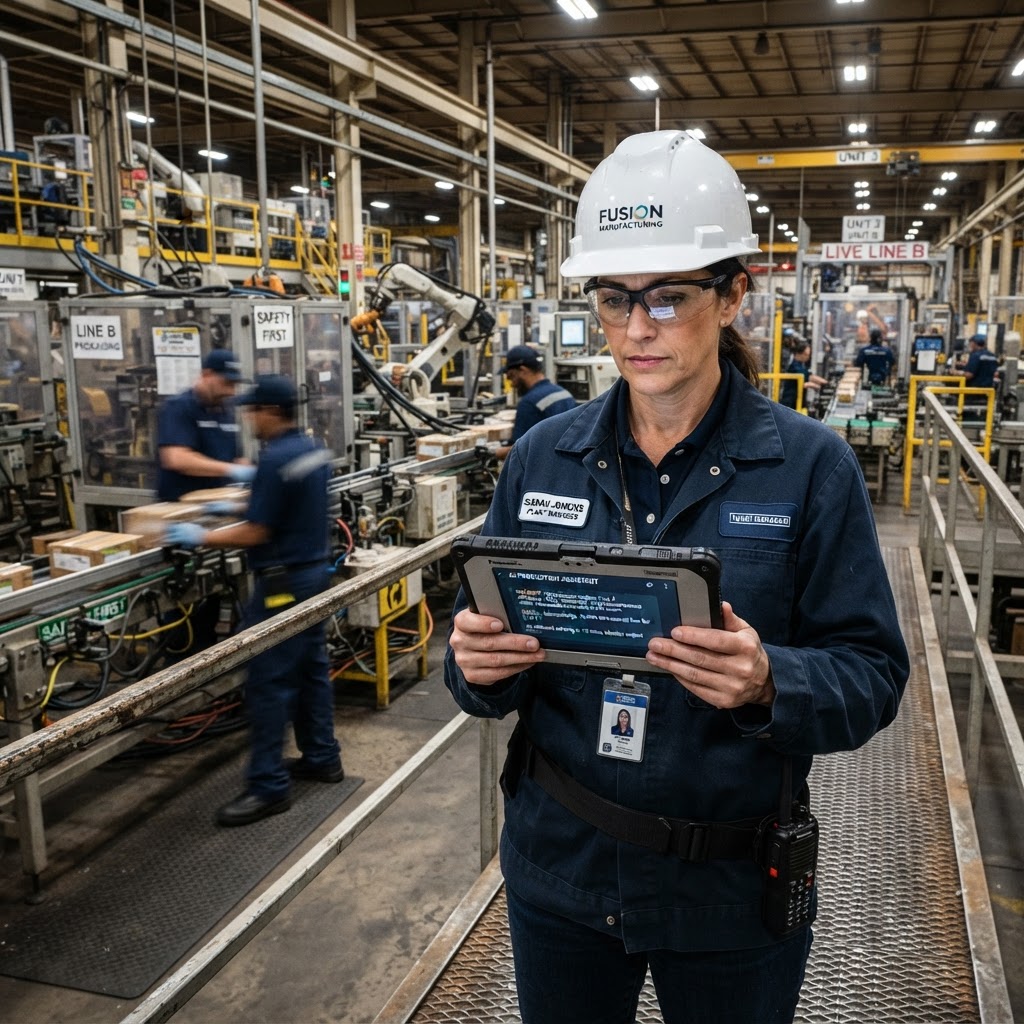

Inside Manufacturing GPT: Why This AI Actually Understands the Factory Floor
Most AI assistants will confidently give you the wrong answer. Manufacturing GPT was built so that never happens on the plant floor, in the boardroom, or anywhere in between.
The Problem Every Plant Manager Already Knows
It's 6:45 a.m. A capacity crunch is developing on Line 3. Your procurement lead needs to know whether to accelerate a supplier order or absorb the delay. Someone pulls up a general-purpose AI tool, asks a question about lead times and throughput tradeoffs, and gets back a response that sounds authoritative — and is completely disconnected from your actual operation.
This is the quiet failure mode that general AI creates in manufacturing environments. Tools like ChatGPT and Google Gemini were built for broad audiences. They're impressive. They're also not trained on your production data, your supplier relationships, your cost structure, or the operational realities of discrete or process manufacturing. They hallucinate. And in a factory context, a hallucinated answer about capacity or tariff exposure isn't just wrong — it's expensive.
Manufacturing GPT on Strata Ultra was built specifically to solve this.
Why It Matters
The manufacturing sector is under more simultaneous pressure right now than at almost any point in recent memory. U.S. tariff policy is shifting supply chain calculus in real time. The CHIPS and Science Act and Inflation Reduction Act incentives are reshaping domestic investment decisions. Workforce shortages tracked by the Bureau of Labor Statistics are forcing operations leaders to do more with leaner teams.
In that environment, the margin for bad information is zero.
"General AI gives you confident answers. Manufacturing GPT gives you correct ones — grounded in the data that actually runs your operation."
What manufacturers need is an AI that:
- Understands the vocabulary of the shop floor — cycle times, OEE, make-vs-buy, capacity utilization
- Pulls from real, verified data rather than generating plausible-sounding responses
- Connects to the live policy and market intelligence that affects manufacturing decisions today
- Doesn't require a data science team to operate
Manufacturing GPT delivers on all four. It's the difference between having a knowledgeable analyst at your side and rolling the dice on a general-purpose chatbot.
How It Works
Manufacturing GPT is embedded directly inside the Strata Ultra platform, which means it operates with context that generic AI tools simply don't have access to.
Here's what sets the architecture apart:
-
Anti-hallucination grounding. The model is constrained to respond based on verified data inputs — platform intelligence, your operational context, and live sourced information. It won't invent a supplier lead time or fabricate a regulatory threshold.
-
Integration with Government Insights. Manufacturing GPT connects to Strata Ultra's Government Insights layer, which aggregates live tariff data, federal policy updates, and manufacturing-relevant regulatory changes. When you ask about cost exposure on imported components, the answer reflects actual current policy — not a training snapshot from 18 months ago.
-
Scenario-aware intelligence. Manufacturing GPT works in coordination with the platform's Scenario Planner, Strata Ultra's AI-powered what-if modeling tool for supply chain shocks, capacity planning, and make-vs-buy analysis. Ask a follow-up question about a scenario you've already modeled and the AI has context — it's not starting from scratch.
-
Plain-language interface. No prompt engineering required. Operations leaders and executives ask questions in normal language and get structured, actionable responses. The system is designed for people running factories, not people running AI experiments.
-
Capability Center access. Manufacturing GPT lives inside the Capability Center, Strata Ultra's hub for shop floor tools — alongside voice reporting and specialized AI utilities — so it's always one click from wherever you're working on the platform.
Who It's For
Manufacturing GPT was designed for three core user types, and each one uses it differently:
Plant Managers and Operations Leaders Day-to-day questions about throughput, downtime patterns, supplier alternatives, and workforce deployment. Fast answers that don't require pulling a report or waiting on an analyst.
Executives and Strategic Decision-Makers Higher-level questions about market exposure, policy risk, capital allocation, and competitive positioning. Manufacturing GPT can synthesize across data layers that would otherwise require multiple team members and tools to compile.
Procurement Managers Supplier risk, tariff exposure, component sourcing alternatives, and cost modeling. In a period when global supply chain disruption remains a persistent operational reality, having an AI that understands procurement context — not just general business context — is a material advantage.
If you're operating in any of these roles and you're still using generic AI tools for manufacturing questions, you're carrying unnecessary risk. The specificity of Manufacturing GPT isn't a feature add-on. It's the entire point.
Get Inside the Tool
Manufacturing GPT is available now on Strata Ultra. Log in, navigate to the Capability Center, and start with the question you've been meaning to get a straight answer on. You'll notice the difference immediately — not because it sounds smarter, but because it actually knows what it's talking about.
Sources: OpenAI ChatGPT · U.S. Trade & Tariff Information · NIST CHIPS Act · DOE Inflation Reduction Act · BLS Manufacturing Employment

