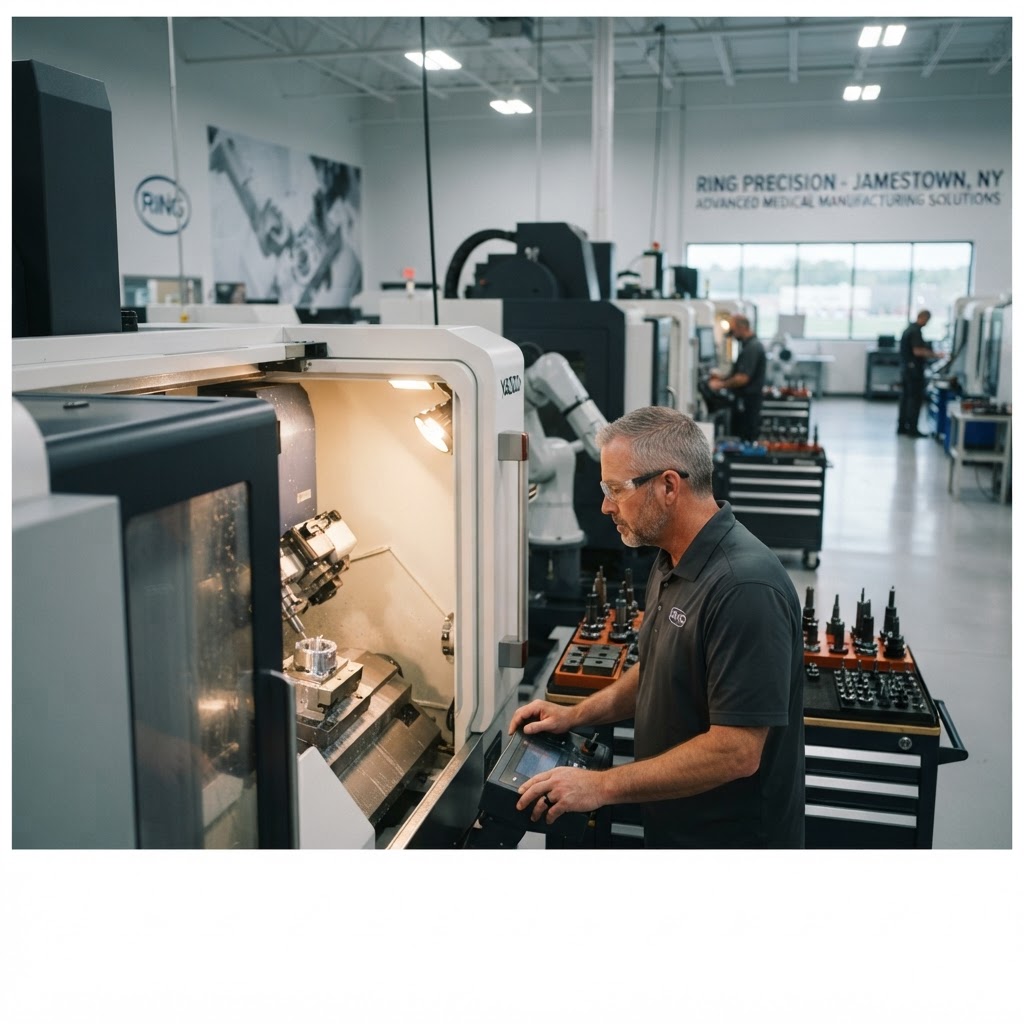


Inside Ring Precision: A Medical Device Precision Machining Built on Precision and Pride
The floor of a shop that makes injection mold tooling for medical devices doesn't look dramatic at first glance. No sparks flying, no massive castings being moved by crane. What you find instead is quiet intensity — a Swiss turn machine cycling through a program while a machinist checks a core pin under a comparator, measuring a feature that has to land within a tenth or it goes in the scrap bin. Tolerances that tight don't leave room for distraction. They require a culture, built over decades, where doing it right the first time isn't a slogan — it's the only option.
That's the world Ring Precision has occupied since the 1950s, working out of Jamestown, New York, a small city in the western part of the state with a long manufacturing history. What started as a precision grinding operation has evolved into a focused, capable shop serving some of the most demanding end markets in American industry: medical devices, life sciences, and veterinary applications.
Precision Grinding and Swiss Turning — The Core of the Operation
Ring Precision's capabilities center on two disciplines that complement each other well for the work they do. Precision grinding is where the shop has its deepest roots. They specialize in grinding complex square and round core pins — the tooling components that form the internal geometry of injection molded parts. If you've ever held a molded plastic medical device and noticed the small holes, channels, or internal features, there's a good chance a core pin made by someone like Ring Precision helped create that geometry.
Grinding complex profiles on small, hardened tool steel components is one of those capabilities that looks simple on paper and is genuinely difficult in practice. The tolerances demanded by injection mold tooling — particularly for medical device applications where part geometry directly affects function and regulatory compliance — are unforgiving. Surface finish, concentricity, and feature geometry all have to hit spec consistently, across a production run, not just on a first article.
The second pillar is CNC Swiss turning, a machining process well-suited to long, slender, complex components produced in volume with tight dimensional control. Swiss-type lathes guide bar stock through a guide bushing, keeping the workpiece supported close to the cutting tool and enabling precision on parts that would flex and chatter on a conventional lathe. For ejector pins, ejector sleeves, and bushings — all components Ring Precision produces — Swiss turning is the right tool for the job.
Together, these two process strengths give the shop a coherent, deep capability set for injection mold tooling components rather than a scattered menu of services.
What They Actually Make
The product list at Ring Precision is specific and intentional. They make injection mold replacement cores, core pins in both square and round configurations, ejector pins, ejector sleeves, bushings, and custom injection mold tooling components — primarily for medical and veterinary applications.
For procurement managers sourcing mold tooling components, that specificity matters. A shop that does a little of everything and happens to grind a core pin when asked is a different supplier than one that has built its entire operation around this category of work. Ring Precision is the latter. When a medical device manufacturer needs replacement cores for an aging mold, or a veterinary equipment company needs custom ejector pins to a print, Ring Precision is built for exactly that conversation.

What will it take to turn demand into delivered output?
Explore The Capacity Imperative, our report on U.S. advanced manufacturing and the priorities shaping 2027.
The medical device and life sciences focus also carries regulatory implications. Customers in these markets often require traceability, material certifications, and quality documentation that goes beyond what a general job shop typically manages. A shop that has served this space for decades understands those requirements as standard operating procedure, not as a special accommodation.
What Makes This Shop Different
A few things stand out when you look at Ring Precision's positioning in the market.
First, depth in a narrow discipline. They haven't tried to be all things to all customers. They've built genuine expertise in grinding and Swiss turning precision mold tooling components, and they've applied that expertise almost exclusively to demanding, quality-sensitive end markets. That kind of focus tends to produce shops that are genuinely good at what they do, because every dollar invested in equipment, tooling, and training goes into the same core capabilities.
Second, geographic durability. Jamestown, New York is not a manufacturing hub that shows up on many trend pieces, but it has a real industrial history, and Ring Precision has been part of it since the 1950s. Shops that survive for that long in a mid-sized American city do so because they deliver consistent value to their customers. Longevity in precision machining isn't accidental.
Third, the Culper Capital Partners connection. Ring Precision operates within the portfolio of Culper Capital Partners, a private equity firm that invests in American manufacturing businesses. For customers evaluating suppliers, that structure typically indicates professional management, investment in the business, and a commitment to continuity — factors that matter when you're qualifying a supplier for medical device tooling and you need confidence in their long-term stability.
For sourcing teams evaluating precision mold tooling suppliers, the combination of focused capability, industry experience, and operational backing is worth serious consideration. Their website at ringprecision.com provides direct access to capability details and contact information for procurement and engineering inquiries.
About Ring Precision
- Founded: 1950s
- Location: Jamestown, New York
- Employees: 50–200
- Core Capabilities: Precision grinding, CNC Swiss turning
- Primary Products: Injection mold replacement cores, square and round core pins, ejector pins, ejector sleeves, bushings, custom injection mold tooling
- Markets Served: Medical devices, life sciences, veterinary applications
- Ownership: Culper Capital Partners portfolio company
- Website: Visit Ring Precision
The Broader Case for American Mold Tooling Suppliers
Over the past several years, supply chain disruptions and reshoring pressures have pushed more medical device manufacturers to scrutinize their tooling supply chains. Replacement cores, ejector pins, and custom mold components sourced from overseas suppliers can carry lead time risk that shows up at the worst possible moments — when a mold is down and a production line is waiting.
Domestic suppliers like Ring Precision offer a different calculus: faster response, easier technical communication, shorter lead times for replacement components, and no customs complications on time-sensitive tooling. For operations managers and procurement teams managing mold maintenance programs, having a qualified domestic source for precision mold components is a supply chain risk management decision as much as a sourcing one.
Where to Find Them
Ring Precision is located in Jamestown, New York, serving medical device manufacturers, life sciences companies, and veterinary equipment producers across the United States.
Procurement managers, tooling engineers, and operations teams sourcing precision injection mold components can find full capability information, product details, and contact information at:
Strata Intelligence covers American manufacturers across every region and every discipline. If your shop has a story worth telling, we want to hear it.
Sponsored by Manufacturing Ultra
This Manufacturer Spotlight is brought to you by Manufacturing Ultra — a zero-upfront-cost website development and digital growth program built exclusively for American manufacturers. Whether you need a modern website, SEO, or digital marketing, Manufacturing Ultra delivers without the upfront cost. Visit manufacturingultra.com to learn how they help shops like Ring Precision grow their digital presence.

