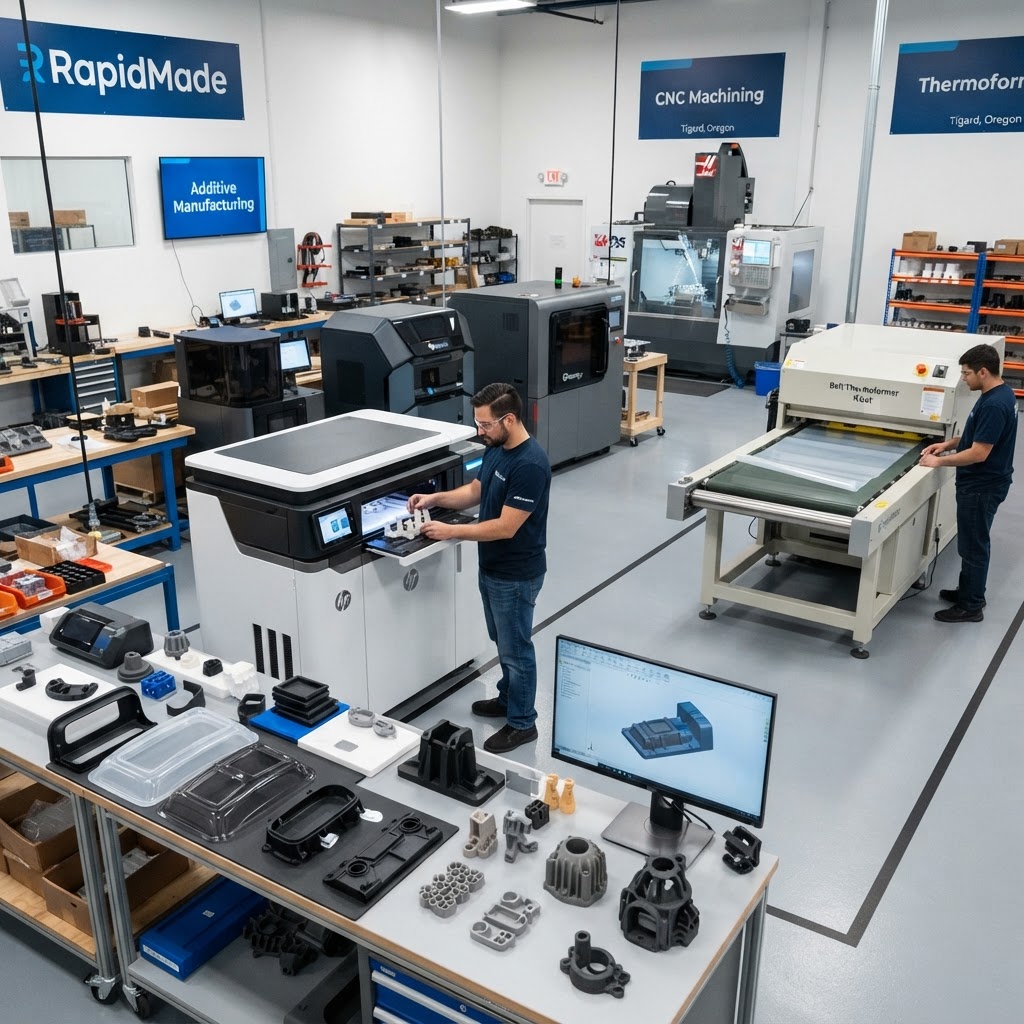


Inside RapidMade: An Industrial Plastics and Thermoforming Shop Built on Precision and Pride
The sheet hits the clamp frame at around 400 degrees, soft and cooperative, and a technician guides it down over the mold with the practiced patience of someone who has done this ten thousand times. The vacuum pulls. The material conforms. Seconds later, a large industrial enclosure panel — the kind that will eventually house electronics on a factory floor somewhere in America — comes off the tool clean and true. No warping. No second-guessing. Just a part that matches the print.
This is a Tuesday morning at RapidMade, tucked into Tigard, Oregon, a suburb southwest of Portland that has quietly become home to one of the more capable industrial plastics shops on the West Coast. The facility is not loud about itself. There is no flashy lobby, no oversized signage. What there is, instead, is a shop floor organized around doing difficult thermoforming work accurately, repeatably, and at a pace that the big OEM procurement teams have come to count on.
What They Do
RapidMade's core business is heavy-gauge thermoforming and vacuum forming — the process of heating thermoplastic sheet stock and forming it over a mold under vacuum pressure to produce large, complex parts. It sounds simple enough, but at the industrial scale RapidMade operates, the variables multiply fast. Sheet thickness, material selection, mold geometry, draw depth, cooling uniformity — each one has to be managed by people who understand the physics of what is happening inside that press.
The shop runs industrial vacuum and thermoforming machines with large bed sizes, which matters enormously when your customers are asking for enclosures, panels, and housings that run up to eight feet long. Most thermoformers tap out well before that. RapidMade has built its equipment list and its team around not tapping out.
After forming, parts move to 5-axis CNC plastic trimming, where complex trimmed edges, cutouts, and features are machined in with the kind of consistency that flat-bed routers simply cannot match on three-dimensional formed parts. For engineering teams specifying tight tolerances on formed components, this capability is not a luxury — it is a requirement.
The Aerolite Carbon Fiber Process
If there is one capability that stops sourcing engineers in their tracks when they dig into what RapidMade actually does, it is the Aerolite Carbon Fiber thermoforming process. The shop pioneered a specialized method that allows real carbon fiber components to be vacuum formed over a mold, dramatically compressing cycle times compared to traditional autoclave layup. The result is genuine carbon fiber parts — not carbon-look film, not carbon-infused resin — produced at a pace and cost structure that opens the material up to applications where it previously could not compete on economics.
For aerospace interiors, motorsports components, and high-end industrial housings where weight and stiffness matter, this process changes the conversation. It is the kind of process innovation that comes from a shop that thinks about manufacturing problems rather than just executing established recipes.
Tooling Done In-House, Fast

What will it take to turn demand into delivered output?
Explore The Capacity Imperative, our report on U.S. advanced manufacturing and the priorities shaping 2027.
RapidMade runs production 3D printers internally for fast tooling — a decision that pays dividends when customers need prototype tools turned around quickly or when a legacy mold needs a replacement in a hurry. The ability to print tooling in-house rather than waiting on an outside tool shop compresses the front end of the project timeline considerably. For procurement managers who have sat through too many delayed first-article inspections, this is a practical advantage that shows up on the schedule.
Finishing That Matches the Forming
A thermoformed part that comes off the tool clean still needs a finish that holds up in the field. RapidMade operates a full-service in-house paint facility capable of applying coatings to parts up to eight feet long. The finishing menu includes Sherwin-Williams Polane topcoats for durability, ESD-safe coatings for electronics applications where static discharge is an engineering concern, RFI shielding coatings, and custom automotive-grade clear coat finishes for trim and appearance components.
Having that paint capability under the same roof as the forming and trimming operations is not just a convenience — it is a quality control lever. When the same team that formed the part is also finishing it, the accountability does not get handed off and diluted. If something is not right, it gets caught and corrected before it ships.
Who They Serve
RapidMade's customer base spans aerospace, defense, automotive, and industrial OEM applications. The shop holds ISO 9001 certification and is ITAR registered, which are baseline requirements for doing serious work in aerospace and defense supply chains. Those registrations are not incidental — they reflect the documentation discipline and process control that regulated industries demand.
The parts list is broad: custom thermoformed enclosures, large industrial panels and housings, automotive body trim components, custom material-handling trays, electronics housings, and replacement plastics for legacy equipment. That last category — replacement plastics — is underappreciated as a business line. When a manufacturer needs a formed plastic component for a machine that went out of production fifteen years ago, RapidMade is the kind of shop that can reverse-engineer from a broken original and put good parts back into service.
Procurement and sourcing teams researching the shop's full capabilities will find detailed process documentation and application examples at Visit RapidMade.
What Makes This Shop Different
The honest answer is the range. Most plastics shops are good at one process tier — either they do short-run prototype thermoforming, or they do high-volume commodity forming, or they do specialty coatings. RapidMade has threaded those capabilities together in a single facility: forming, five-axis trimming, proprietary carbon fiber processing, in-house fast tooling, and a full paint line. For an OEM engineer trying to reduce the number of vendors touching a single assembly, that integration has real value.
The Aerolite carbon fiber process represents genuine process development — the kind that comes from a shop willing to invest R&D time into solving a manufacturing problem that the industry had largely left alone. That instinct to develop rather than just execute is what separates a capable job shop from a long-term manufacturing partner.
At 15 to 50 employees, RapidMade is large enough to run production programs with real capacity and small enough that the people making decisions about your parts actually know the shop floor. That combination is rarer than it should be in American manufacturing.
About RapidMade
- Founded: 2011
- Location: Tigard, Oregon
- Employees: 15–50
- Certifications: ISO 9001, ITAR Registered
- Core Capabilities: Heavy-gauge thermoforming, vacuum forming, Aerolite carbon fiber thermoforming, 5-axis CNC plastic trimming, industrial coating and paint finishing
- Markets Served: Aerospace, defense, automotive, industrial OEM
- Website: rapidmade.com
Where to Find Them
RapidMade operates out of Tigard, Oregon, serving customers across the West Coast and nationally. Engineering and procurement teams can review capabilities, request quotes, and access technical resources directly at Visit RapidMade.

