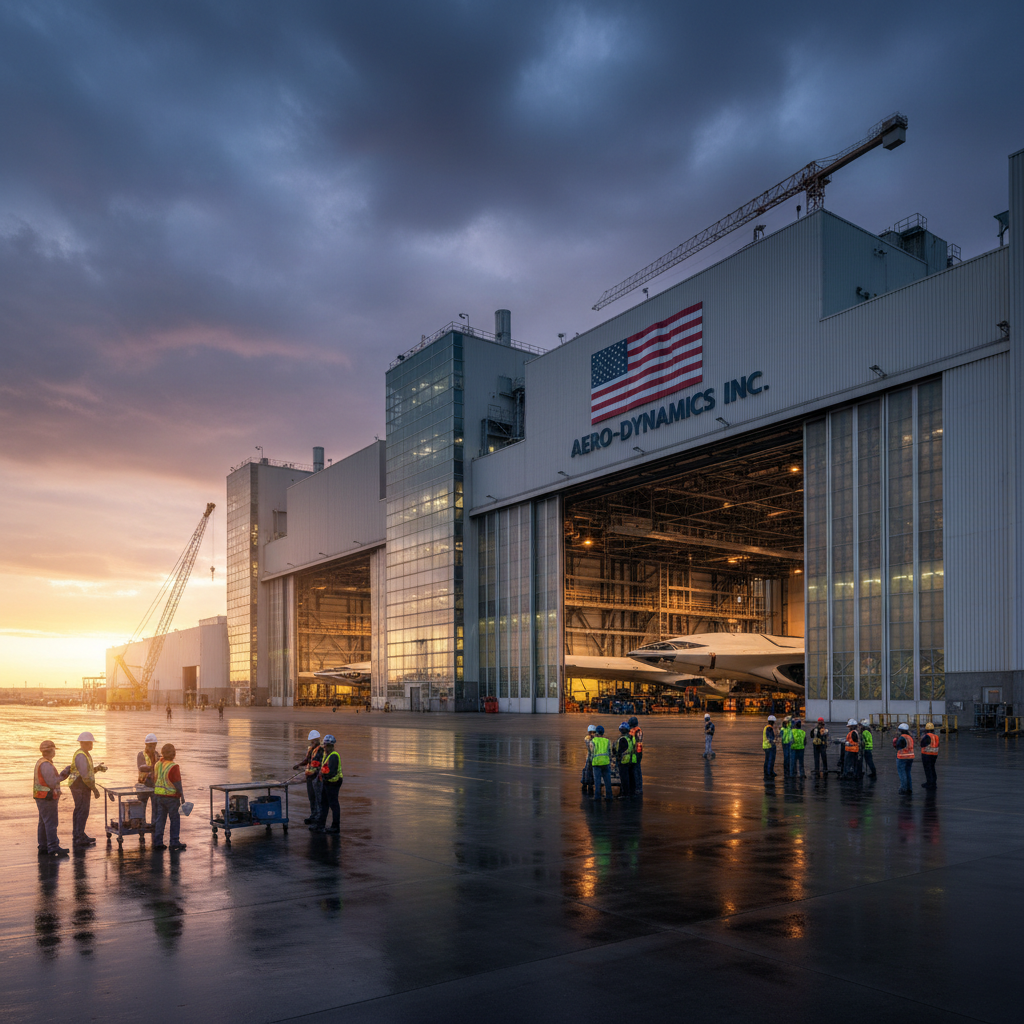

Physical AI and Strategic Partnerships Rapidly Advance Industrial Automation: What Manufacturing Leaders Need to Know This Week
By Marcus D. Holloway, Editor in Chief, Strata Intelligence | June 18, 2026
The industrial automation sector crossed a definitive threshold this week: physical AI — the fusion of machine perception, large language models, and real-world sensory data — moved from laboratory concept to factory-floor deployment across five major announcements in seventy-two hours. For C-suite executives, plant managers, and procurement directors, the window for passive observation has closed.
Executive Summary
Between June 11 and June 16, 2026, five watershed developments reshaped the competitive landscape of industrial automation:
- ABB Robotics partnered with prosthetics firm PSYONIC to harvest human-derived tactile data for robot training.
- FANUC announced a strategic collaboration with Google to embed large language models into industrial robotics systems.
- Rockwell Automation secured a major greenfield contract in Monterrey, Mexico, anchoring cloud-based manufacturing intelligence to the nearshoring wave.
- Yaskawa Electric completed proof-of-concept testing with more than one hundred companies, advancing its commercial autonomous robot deployment model built on an NVIDIA integration partnership.
- KUKA unveiled a scalable robotics-as-a-service machine tending solution co-developed with system integrator Formic Automation, targeting small and mid-size manufacturers.
Taken individually, each announcement is significant. Taken together, they represent a structural reorganization of how automation intelligence is acquired, trained, and deployed at scale.
ABB and PSYONIC: The Human Body as a Robot Training Dataset
ABB Robotics has solved one of industrial automation's most stubborn problems — and it did so by looking at the human hand. In a partnership announced June 16, ABB is mounting PSYONIC's Ability Hand, an advanced prosthetic equipped with dense sensor arrays, onto ABB's GoFa collaborative robots. The result is a continuous stream of real-world tactile and grip data generated under actual working conditions — not simulated environments.
The downstream implications for US manufacturers are immediate and profound:
- Food processing and agriculture: Robots have historically failed at handling soft, irregular, and perishable goods. Human-derived grip intelligence directly addresses the fragility problem — enabling automation in segments that have resisted it for decades.
- E-commerce and fulfillment: The explosion in SKU diversity inside distribution centers demands robotic systems capable of handling everything from fragile cosmetics to irregular produce packaging. Tactile AI bridges that gap.
- Supplier qualification: Procurement directors evaluating collaborative robot platforms should now scrutinize the quality and diversity of training data — not just cycle time and payload specifications.
The deeper strategic insight here is that PSYONIC's prosthetic hand wearers are, functionally, unpaid contributors to an industrial AI training corpus. This is a novel data acquisition model — and one that competitors will attempt to replicate. ABB has secured a meaningful lead.
"The industrial robot that can feel what it is touching is no longer a research asset — it is a competitive weapon, and the manufacturers who deploy it first will own the margin in delicate-goods automation."
FANUC and Google: When Cognitive AI Meets Industrial Scale
No single partnership announced this week carries more long-term structural weight than the collaboration between FANUC and Google. Announced June 16, the agreement focuses on embedding Google's large language model capabilities directly into FANUC's robotics systems — enabling robots to perceive their environments, interpret unstructured instructions, and make autonomous decisions on the factory floor without intensive manual programming.
This matters for three interconnected reasons:
- Programming labor costs: The single largest hidden cost of industrial robot deployment is not the hardware — it is the specialized programming and integration labor required to make robots functional. LLM-guided robots that can interpret natural-language instructions dramatically compress that cost.
- Flexibility at scale: FANUC's installed base spans tens of thousands of facilities globally. Retrofitting that base with cognitive AI capabilities — rather than requiring hardware replacement — represents an exponential multiplication of Google's AI reach into physical production environments.
- Competitive displacement: Robot OEMs that cannot offer comparable AI-native interfaces within eighteen months risk losing RFQs on new line installations to FANUC by default. Procurement directors issuing capital equipment specifications in 2026 should build AI interface capability into evaluation criteria immediately.
For plant operators specifically, the near-term implication is workforce evolution, not workforce elimination. Technicians who understand how to supervise, prompt, and audit LLM-driven robotic decisions will command significant wage premiums. Operators who do not develop those skills face structural obsolescence.
Rockwell Automation and the Nearshoring Infrastructure Imperative
The contract between Rockwell Automation and automotive supplier Zinkteknik — announced June 11 — is a data point that supply chain strategists cannot afford to dismiss. Zinkteknik selected Rockwell's cloud-based Plex Smart Manufacturing Platform for a new greenfield facility in Monterrey, Mexico, deploying a manufacturing execution system, quality management infrastructure, and real-time analytics from day one of operations.

What will it take to turn demand into delivered output?
Explore The Capacity Imperative, our report on U.S. advanced manufacturing and the priorities shaping 2027.
This contract encodes three strategic realities simultaneously:
- Nearshoring is accelerating faster than infrastructure: Greenfield facilities in Mexico's industrial corridors are being built without legacy IT debt, which means cloud-native MES platforms are winning contracts by default over on-premise legacy competitors.
- Traceability is now table stakes: Automotive OEM customer requirements — driven by US content rules under the USMCA trade framework — demand real-time quality and production traceability that only cloud-connected platforms can deliver at the speed new facilities require.
- Supplier standardization pressure: US Tier 1 and Tier 2 automotive suppliers with Mexican operations who have not standardized on a cloud-based MES will face increasing pressure from OEM customers to demonstrate equivalent data transparency. The Zinkteknik contract sets a visible benchmark.
Procurement directors managing cross-border supply chains should treat this announcement as a signal that cloud-based industrial software is no longer a modernization discussion — it is a qualification requirement.
Yaskawa and KUKA: Two Models for Scaling Physical AI to the Factory Floor
The remaining two announcements this week illuminate divergent but equally important commercialization strategies for physical AI in manufacturing.
Yaskawa Electric completed proof-of-concept testing with more than one hundred companies, validating its AI-backed autonomous robot platform developed in ongoing integration with NVIDIA. Yaskawa's approach is volume-first: proving system performance across a wide array of industrial contexts before committing to a single commercial deployment model. This breadth of validation is strategically significant.
Key implications for manufacturers evaluating Yaskawa:
- The scale of proof-of-concept testing signals that Yaskawa is building empirical performance data across diverse production environments — a due diligence asset that competitors with narrower test programs cannot yet match.
- The NVIDIA integration positions Yaskawa's motion-control expertise alongside NVIDIA's Isaac robotics platform, creating a hardware-software stack that will be difficult to dislodge once deployed.
- Labor shortage mitigation is Yaskawa's explicit commercial narrative, which aligns directly with the operational reality facing US manufacturers in food, logistics, and discrete manufacturing.
KUKA, by contrast, is attacking the adoption problem from the access side. The MairoFlex Compact 8 system — developed with system integrator Formic Automation and powered by AI vision alongside the KR Cybertech nano robot — targets CNC machine tending at smaller manufacturing facilities. The robotics-as-a-service delivery model is the critical differentiator:
- Capital expenditure barriers have historically excluded small and mid-size manufacturers from automation. A subscription or outcome-based pricing model eliminates that barrier.
- CNC machine tending is among the highest-frequency, most physically repetitive tasks in job shop and precision machining environments — the segments most acutely affected by skilled operator shortages.
- For plant managers at smaller facilities, the KUKA-Formic model represents the first credible path to automation ROI without a seven-figure capital commitment.
The contrast is instructive: Yaskawa is building depth through rigorous multi-client validation; KUKA is building reach through accessible pricing architecture. Both strategies are correct for their respective market segments, and both will gain ground in the next twelve months.
Editor's Take: Marcus D. Holloway's 90-Day Outlook
These five announcements, read together, define the next phase of industrial automation with unusual clarity. Here is what I expect to unfold between now and mid-September 2026:
1. Data provenance will become a procurement criterion. The ABB-PSYONIC model establishes that the quality of a robot's training data — not just its hardware specifications — determines its capability ceiling. Within ninety days, expect leading integrators and procurement teams to begin issuing RFQ language that requires OEMs to disclose training data sources and diversity metrics for AI-enabled systems.
2. LLM-native robot interfaces will trigger a reprogramming wave. The FANUC-Google partnership will force competitors — including Yaskawa, ABB, and KUKA — to accelerate their own LLM integration roadmaps or risk losing RFQ competitions on new line installations. Plant operators should anticipate pilot announcements from at least two additional major OEMs before Q3 closes.
3. Nearshoring will intensify cloud MES adoption. The Rockwell-Zinkteknik contract is not an outlier — it is a template. US-headquartered manufacturers standing up Mexican production capacity in the second half of 2026 will overwhelmingly select cloud-native MES platforms, further eroding on-premise legacy systems in greenfield contexts. Rockwell, Plex, and competitive platforms including Sight Machine will see accelerated pipeline activity.
4. Robotics-as-a-service will capture the SMB segment. The KUKA-Formic model will validate — or refute — subscription-based automation at commercial scale within this window. If early deployments demonstrate sub-eighteen-month payback periods, expect a wave of competing RaaS offerings from integrators and OEMs targeting the same under-automated SMB manufacturing base.
5. Physical AI certification standards will emerge. As autonomous robots make consequential decisions on factory floors without operator input, liability and insurance frameworks will begin to crystallize. Manufacturers, insurers, and industry bodies will initiate working groups on AI-driven robot decision auditing before year-end. Early movers who document their AI governance processes now will hold a competitive advantage when standards arrive.
The industrial automation sector is not approaching a tipping point. It has passed one. The manufacturers who act on this week's intelligence will be positioned to lead. Those who wait for consensus will be following.
Sources: ABB Robotics Official Site · FANUC Corporation · Rockwell Automation Plex Platform · NVIDIA Isaac Robotics · USMCA Trade Agreement — USTR

