
Inside Pacific Die Casting Corporation: A Die Casting Shop Built on Precision and Pride
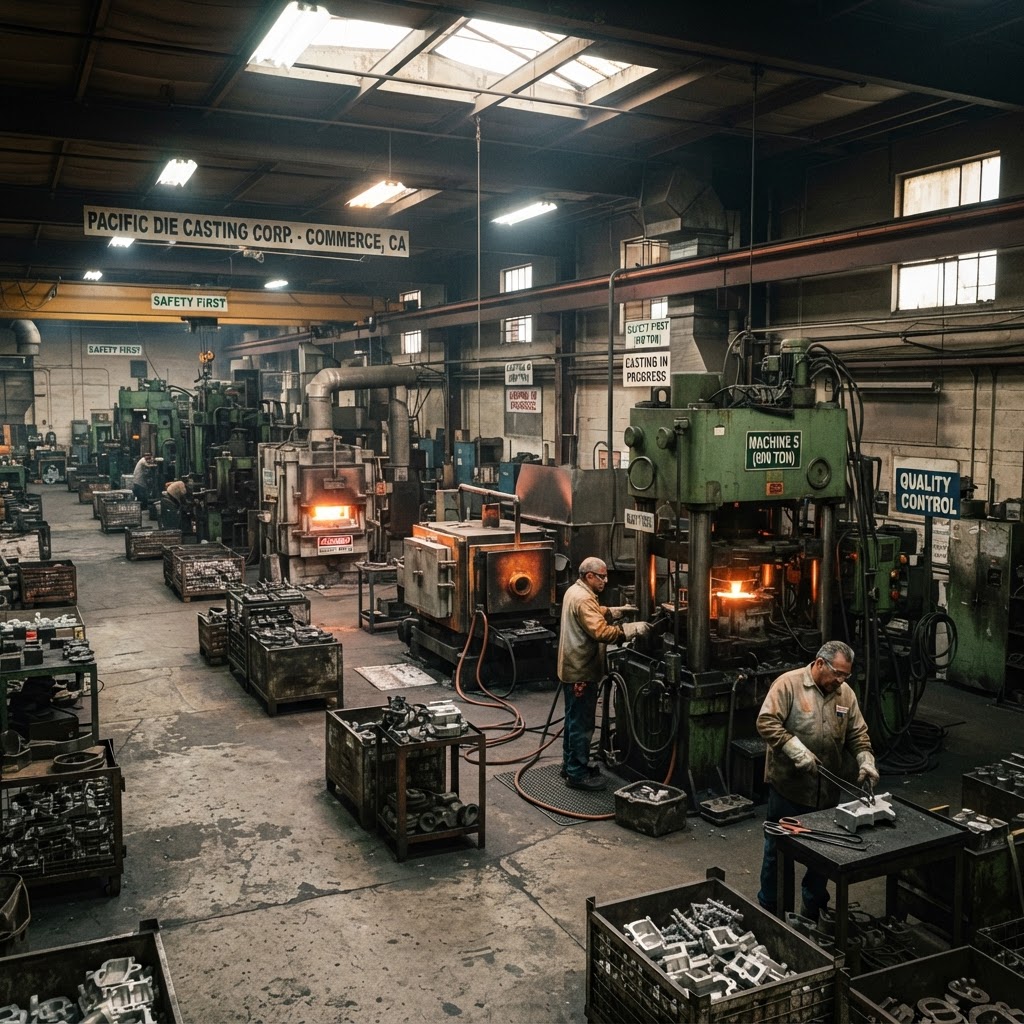
The hiss of hydraulic pressure. The clang of a trimmed casting dropping into a bin. The low hum of a CMM arm tracing a bore diameter down to the thousandth. If you've spent any time on the floor of a real die casting operation, those sounds are familiar — they're the sounds of metal being turned into something useful. At Pacific Die Casting Corporation in Commerce, California, those sounds have been part of the daily rhythm since 1953. That's not a typo. Over seven decades of running aluminum and zinc through high-pressure tooling, shipping precision components to customers across industries, and doing it all under one roof in the industrial corridor of Southern California.
This is not a flashy company. It doesn't need to be. The work speaks for itself.
A Shop With Deep Roots and Practical Range
Pacific Die Casting was founded at a time when American manufacturing was still rebuilding from the demands of the post-war era and the industrial appetite of the country was enormous. The shop planted itself in Commerce — a city whose name is, frankly, appropriate — and it has stayed there ever since. What started as a focused die casting operation has grown into a turn-key production house capable of taking a part from mold concept to finished, inspected component without ever leaving the building.
That kind of vertical integration is rarer than it used to be. A lot of shops shed secondary operations over the years to cut overhead or focus on core competencies. Pacific Die Casting went the other direction — adding in-house tooling, CNC machining, vibratory deburring, and precision CMM inspection to the casting core. For procurement managers trying to reduce their supplier count and compress lead times, that matters. You're not coordinating between a casting house, a machine shop, and a finishing vendor. You're making one call.
What They Cast and How They Cast It
The shop runs both high-pressure cold chamber machines for aluminum and hot chamber machines for zinc, covering a meaningful range of tonnage that allows them to handle components from small intricate housings to larger structural parts. High-pressure die casting is not a forgiving process — it requires tight control over metal temperature, injection speed, die temperature, and cycle timing. When those variables are managed well, you get net-near-shape parts with excellent surface finish and dimensional consistency. When they aren't, you get porosity, cold shuts, and scrap.
Seven decades of process knowledge is not nothing. The institutional memory in a shop like this — in the toolroom, on the casting floor, in the quality department — represents a kind of competitive advantage that doesn't show up on a spec sheet.
On the aluminum side, Pacific Die Casting produces components including electronic enclosures, structural housings, automotive brackets, lighting fixtures, and industrial valve components. Zinc work covers commercial hardware and smaller precision components where the material's superior fluidity allows for finer detail and tighter walls than aluminum can reliably achieve. Customers across automotive, electronics, lighting, and industrial sectors have sourced from this shop — and the breadth of that customer base is a reasonable signal that the shop can adapt to varying design requirements and quality standards.

What will it take to turn demand into delivered output?
Explore The Capacity Imperative, our report on U.S. advanced manufacturing and the priorities shaping 2027.
In-House Tooling: Where the Work Really Starts
Any experienced engineer will tell you that a die casting job lives or dies in the tooling. A poorly designed die — bad gating, inadequate venting, wrong draft angles — will generate problems on the casting floor that no amount of process adjustment can fully fix. Pacific Die Casting's in-house tooling capability means their toolmakers and process engineers are working from the same building, talking to the same people who will run the die in production. That feedback loop is genuinely valuable.
For customers bringing new parts to cast, it also means faster iteration. Design changes don't have to travel to an outside tool shop and back. Modifications get made and tested on a timeline that keeps projects moving.
Secondary Operations and Quality Control
After casting and trimming, parts flow through CNC milling and turning centers for any machined features — drilled and tapped holes, bored fits, faced surfaces — that the casting process can't hold to tolerance on its own. Vibratory deburring handles edge cleanup and surface prep. Then coordinate measuring machine (CMM) inspection provides dimensional verification against print.
For engineering teams and quality managers, a shop running CMM inspection in-house means you're getting documented dimensional data, not just a visual check. For critical fits and assemblies, that documentation trail is worth something — both in production confidence and in supplier audit conversations.
What Makes This Shop Different
There are a lot of die casting shops in the United States. Some are massive, running dozens of machines on three shifts for high-volume automotive programs. Some are small jobbers doing short runs of commodity parts. Pacific Die Casting occupies a particular middle ground that serves a specific kind of customer well.
As a family-owned operation, the shop hasn't been through a private equity rollup, hasn't been acquired and restructured, and hasn't had its institutional knowledge walked out the door in a series of cost-cutting layoffs. The people there have been doing this work, many of them, for a long time. For customers who've experienced the pain of a supplier transition mid-program — new ownership, new management, new priorities — that stability carries real weight.
The turn-key model is the other differentiator. Tooling, casting, machining, finishing, and assembly under one roof at 5000 East Sheila Street, Commerce, California is a supply chain simplification that procurement teams increasingly need. Fewer purchase orders. Fewer quality escapes at handoff points. Shorter lead times. Cleaner accountability.
Manufacturing engineers and sourcing managers evaluating Pacific Die Casting as a potential supplier would do well to review their full capabilities at pacdiecast.com, where technical details and contact information are available for organizations ready to engage on new programs.
About Pacific Die Casting Corporation
- Founded: 1953
- Location: Commerce, California
- Employees: 51–200
- Processes: High-Pressure Aluminum Die Casting, Zinc Die Casting, In-House Tooling, CNC Machining, Vibratory Deburring, CMM Inspection
- Markets Served: Automotive, Electronics, Lighting, Industrial, Commercial Hardware
- Ownership: Family-owned
- Website: pacdiecast.com
Where to Find Them
Pacific Die Casting Corporation operates out of Commerce, California, in the heart of Southern California's industrial manufacturing corridor — well-positioned to serve customers throughout the Western United States and beyond.
For procurement teams, program managers, or engineers looking to source precision aluminum or zinc die cast components with full secondary capabilities, their team can be reached through their website.

