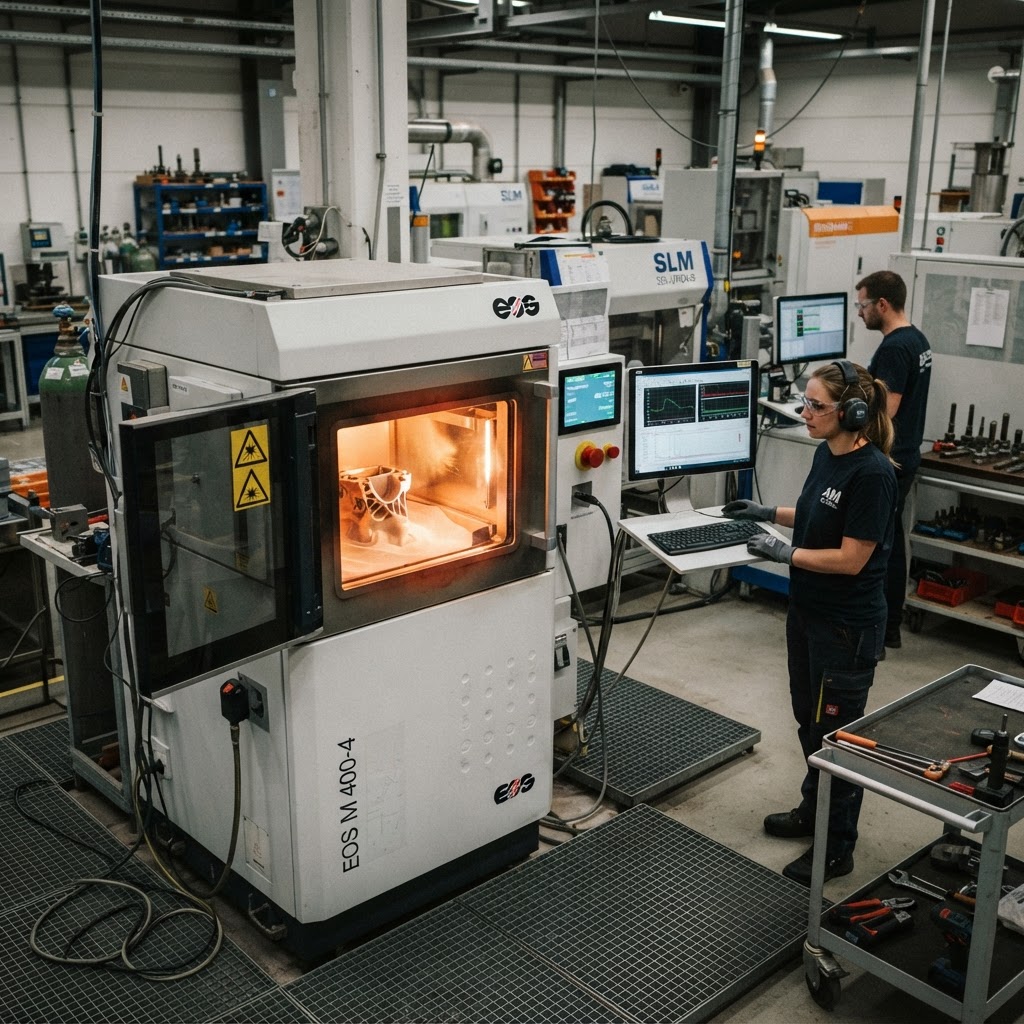

Metal Additive Manufacturing Has Crossed the Production Threshold — September 2026
When the F-117 Nighthawk entered service in 1983, its airframe required fabrication tolerances that pushed conventional machining to its absolute limits — tolerances achieved through years of iterative tooling investment and a supply chain built on institutional knowledge accumulated over decades. The parallel moment for metal additive manufacturing arrived quietly but unmistakably in the summer of 2026, not with a single program announcement but with a convergence of qualification decisions, production contract awards, and congressional appropriations language that collectively signal something the industry has long anticipated: metal AM is no longer a prototyping discipline. It is a production method.
The Qualification Wall Has Finally Been Breached
For the better part of a decade, the central obstacle to metal additive manufacturing in defense and aerospace production was not machine capability — it was qualification. The Department of Defense and its prime contractors spent years developing frameworks to certify additively manufactured flight-critical components, and that process was neither fast nor inexpensive. DARPA's Open Manufacturing program, launched years prior, laid the groundwork for qualification methodologies that could compress the certification timeline without sacrificing the structural integrity data that FAA and DCSA demand.
By mid-2026, several inflection points had stacked on top of one another:
- GE Aerospace confirmed full-rate production of additively manufactured fuel nozzle assemblies across multiple engine platforms, with component counts per engine now exceeding what was considered feasible in 2020
- Raytheon Technologies received DCMA approval for AM-produced structural brackets on the F135 engine sustainment program
- Honeywell Aerospace expanded its Torrance facility's powder-bed fusion capacity specifically to support Navy rotorcraft sustainment contracts
- The Air Force Research Laboratory published updated qualification guidance under its Airworthiness certification framework that explicitly accommodates directed energy deposition components in non-primary structure
The qualification wall did not crumble — it was methodically disassembled, program by program, agency by agency. That distinction matters to anyone still waiting for a single regulatory event to unlock the market. There will not be one.
Why This Production Cycle Is Different from the Last Three
The defense manufacturing community has endured several previous cycles of additive enthusiasm that did not survive contact with procurement reality. The 2012-2015 wave generated considerable conference programming and very few production parts. The 2018-2020 cycle produced more serious investment but stalled against qualification friction and material certification backlogs. This cycle is structurally different for three reasons that operations and procurement executives should internalize.
First, the machine reliability data now exists at scale. EOS, 3D Systems, and Velo3D have accumulated enough production-environment runtime data across aerospace customers to provide meaningful MTBF figures and process consistency documentation — the kind of data that procurement officers and DCMA auditors require before approving a manufacturing process for a long-term contract.
Second, raw material supply chains for aerospace-grade titanium and nickel superalloy powders have matured. AP&C, Carpenter Technology, and Höganäs have each expanded powder atomization capacity, reducing the single-source risk that quietly killed several early AM production programs when powder lot inconsistencies introduced unacceptable variability into mechanical properties.
Third — and this is the factor that tends to get underweighted — congressional appropriations language has changed. The FY2026 National Defense Authorization Act included provisions directing the services to develop additive manufacturing insertion plans for sustainment programs with identified long-lead casting and forging dependencies. That is not a suggestion. That is direction with budget authority behind it, and it changes the calculus for program managers who previously had every incentive to wait.

What will it take to turn demand into delivered output?
Explore The Capacity Imperative, our report on U.S. advanced manufacturing and the priorities shaping 2027.
"The qualification wall did not crumble — it was methodically disassembled, program by program, agency by agency. That distinction matters to anyone still waiting for a single regulatory event to unlock the market."
Where Production Volume Is Actually Accumulating
The popular narrative around defense AM focuses on exotic applications — hypersonic vehicle components, satellite structures, next-generation fighter airframes. That narrative is not wrong, but it is incomplete in ways that obscure where actual production volume is building right now.
The largest near-term volume is in sustainment, not new production. The B-52 Commercial Engine Replacement Program, legacy rotorcraft fleets, and aging naval surface combatant propulsion systems all share a common problem: original equipment manufacturers no longer produce many of the castings and forgings those platforms require, and the tooling to produce them conventionally no longer exists. Additive manufacturing does not require that tooling. For a bracket, a duct fitting, a non-flight-critical housing that would otherwise require a $400,000 casting tool with an 18-month lead time, a qualified AM process is not just cost-competitive — it is the only viable path that does not involve a multi-year re-qualification of a rebuilt conventional process.
Lockheed Martin's Skunk Works division has been explicit about AM's role in the F-22 Raptor sustainment supply chain, where obsolescence is a chronic and accelerating problem. Boeing Defense has made similar moves on CH-47 Chinook sustainment. These are not pilot programs. They are structural responses to a supply chain reality that conventional manufacturing cannot solve at acceptable cost or schedule.
The dry observation worth making here: the defense industrial base spent twenty years building the case for additive manufacturing on the strength of its design freedom, and it turns out the killer application is replacing parts that should have been redesigned forty years ago.
What This Means for Tier 2 and Tier 3 Suppliers
The production threshold crossing is not uniformly good news for the existing supply chain. It creates specific pressures and specific opportunities that smaller manufacturers need to assess with clarity, not optimism.
Immediate pressures:
- Tier 1 primes are accelerating insourcing of AM production for components previously sourced to job shops. If your shop produces small-to-medium castings or investment cast components for defense sustainment programs, your order book faces structural erosion within 24-36 months, not because you performed poorly but because the geometry can now be printed faster and without tooling amortization
- AS9100 Rev D certification is now effectively table stakes for any Tier 2 or Tier 3 shop seeking AM defense work — not a differentiator, a floor requirement. Shops without it are not in the conversation
- Nadcap accreditation for AM processes, specifically the AC7110/14 additive manufacturing checklist, is moving from optional to required on an increasing share of defense solicitations
Actionable opportunities:
- Small shops with existing five-axis CNC capability and metrology infrastructure are better positioned than they typically recognize. Post-processing — machining, surface finishing, non-destructive inspection of AM components — is a genuine bottleneck that primes are actively seeking to solve through qualified subcontractors rather than capital investment
- AFWERX and the DoD's Defense Innovation Unit continue to issue SBIR and OTA solicitations specifically targeting AM process development and qualification for sustainment applications — these are accessible to shops under 500 employees and represent legitimate contract vehicles, not grant money with strings
- Powder management and material traceability services are an emerging specialty with low competition and high demand. Primes need documented powder lot genealogy for qualification packages, and many lack internal capability to manage it at the volume AM production requires
The suppliers who treat this transition as a threat to be survived will find that assessment accurate. Those who treat it as a capabilities gap to be filled — in post-processing, inspection, material logistics, or process development — will find the demand is already there. The production threshold has been crossed. The question now is which shops are on the right side of it.
Sources: GE Aerospace · Air Force Research Laboratory · Defense Innovation Unit · AFWERX · eAuditNet / Nadcap

