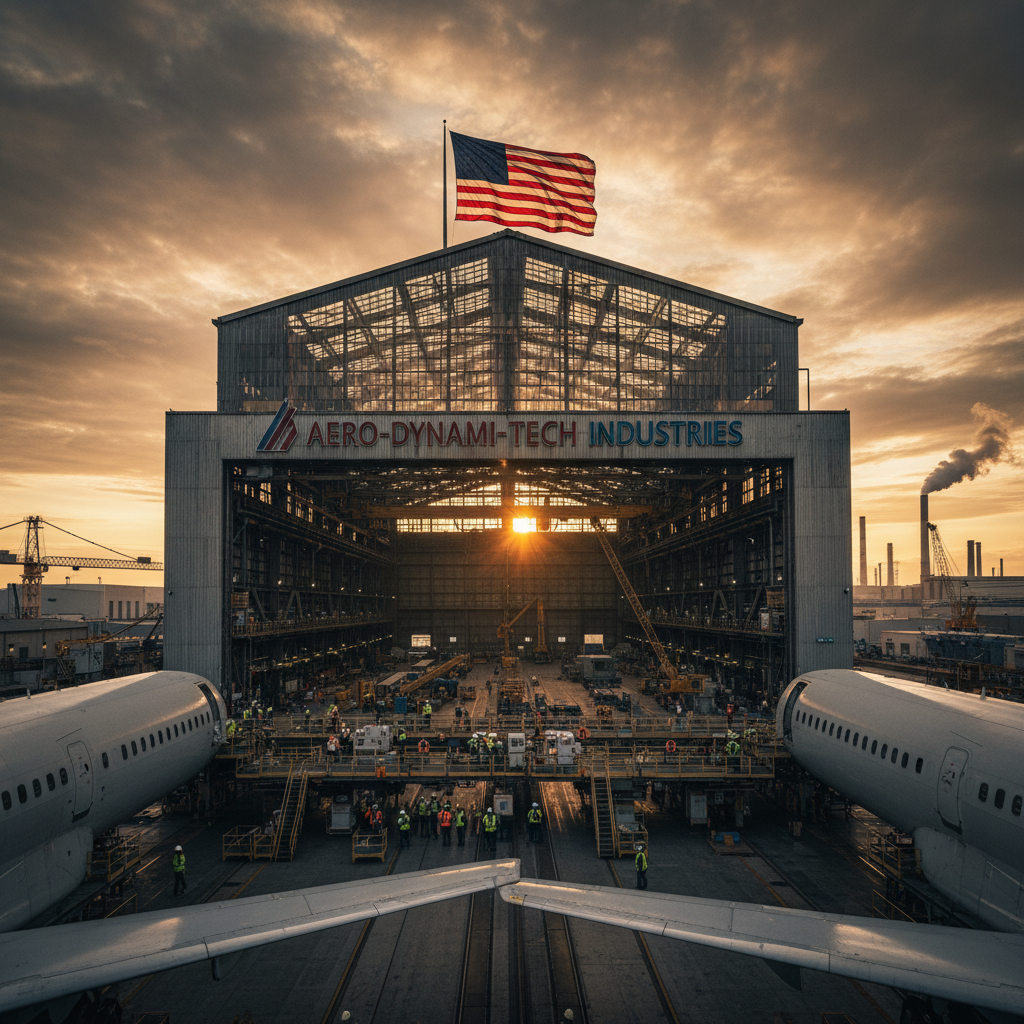

Manufacturers Advance Autonomous Driving and Aerospace Tech Amid Legal Battles: What Manufacturing Leaders Need to Know This Week
By Marcus D. Holloway, Editor in Chief, Strata Intelligence | June 23, 2026
The week of June 16–20, 2026 delivered four developments that collectively redraw the competitive map for US manufacturers: autonomous vehicle platforms are accelerating toward mass deployment, GPS-denied navigation is being solved at scale, and a landmark fraud lawsuit is forcing the legal industry's role in manufacturing costs into the open. The leaders who internalize these signals now will be ahead of the decisions their competitors are still forming.
Executive Summary
This week's four stories are not isolated events. They are data points on the same trend line: the industrialization of autonomy, the hardening of navigation infrastructure against electronic warfare, and the growing urgency for manufacturers to protect operational margins from forces outside the factory floor.
Key takeaways for C-suite, plant managers, and procurement directors:
- Navigation reliability is now a procurement criterion for any drone or UAS program - not an afterthought.
- Tesla's Cybercab has moved from speculation to stockpile. Robotaxi supply chains are real and forming now.
- Rivian's autonomous push signals that full self-driving software is no longer a Tesla-exclusive moat - supplier ecosystems must adapt accordingly.
- Ford's $25 million lawsuit is a bellwether. Manufacturers operating in California's lemon law environment face systemic billing exposure that legal operations teams can no longer treat as routine cost of business.
Honeywell's Kestrel Solves the GPS Problem That Has Stalled Military and Commercial Drone Programs
Honeywell Aerospace launched Kestrel, a compact navigation system engineered specifically to sustain reliable autonomous operations in GPS-contested and GPS-denied environments. According to reporting by AIN Online, the system delivers an 80 percent improvement in navigation accuracy under conditions where GPS signals are actively jammed or spoofed - environments that have become standard operating conditions in both military theaters and certain commercial corridors.
This is a tier-one development for US defense contractors and commercial drone manufacturers alike. The implications break down across three layers:
Immediate operational implications:
- Military drone programs that have historically required GPS-clear airspace now have a viable path to contested-zone deployment.
- Commercial operators in urban or infrastructure-dense environments gain a redundancy layer against spoofing attacks, which have increased alongside broader electronic warfare proliferation.
- OEM integration timelines will compress because Kestrel's compact form factor is designed for retrofit and new-build applications without major airframe redesign.
Downstream supplier implications:
- Navigation sensor suppliers and inertial measurement unit (IMU) manufacturers will face substitution pressure unless they can match Kestrel's accuracy margins.
- Defense integrators building UAS platforms for programs under the US Department of Defense's rearmament and autonomous systems initiatives will need to evaluate Kestrel against their current nav stack within the next procurement cycle.
- Procurement directors sourcing drone components for commercial inspection, logistics, or infrastructure monitoring applications should include GPS-resilience specifications in all RFPs issued after Q3 2026.
The electronic warfare threat environment is not moderating. It is expanding. Honeywell's move positions the company as an infrastructure-layer provider in the autonomous systems stack - a role that carries long-term margin advantages as platform competition intensifies. For plant operators running autonomous ground or aerial vehicles in industrial environments, the Kestrel benchmark now sets the floor for what navigation reliability should look like.
Tesla's Cybercab Moves from Announcement to Assembly: What the EPA Filing Reveals About Robotaxi Supply Chains
Tesla crossed a threshold this week that separates concept vehicles from manufacturing programs. EPA certification documents - the kind that precede mass production - confirmed the first detailed specifications for the Cybercab robotaxi: a 48 kWh battery pack, a 219-horsepower front motor, and a 3,113-pound curb weight. Simultaneously, large fleets of the two-seat autonomous vehicle were spotted outside Gigafactory Texas, as reported by Teslarati.
EPA certification is not a publicity exercise. It is a regulatory prerequisite for commercial sale in the United States. The combination of a filed certification and visible production inventory is the clearest signal yet that Tesla intends to begin Cybercab deliveries - not in years, but in quarters.
What the specifications tell supply chain professionals:
- The 48 kWh battery is notably smaller than Tesla's passenger vehicle packs, reflecting a purpose-built efficiency optimization for urban, short-range ride-hailing cycles. This creates a distinct battery cell demand profile that tier-one cell suppliers - including Panasonic Energy - will need to accommodate separately from Model Y and Cybertruck production schedules.
- The 219-horsepower single motor confirms a cost-reduction architecture. Cybercab is not a performance vehicle. It is a fleet asset. This has direct implications for motor supplier volumes and per-unit pricing expectations.
- The 3,113-pound curb weight sits meaningfully below comparable ICE taxis and ride-share vehicles, which will generate downstream advantages in tire wear cycles, brake component demand, and infrastructure load calculations for fleet operators.
For manufacturers in the automotive supply chain, the message is direct: the robotaxi segment is no longer a future-state planning exercise. Suppliers who have not yet engaged with Tesla's procurement teams on Cybercab component specifications are already behind the qualification curve. Fleet operators evaluating autonomous ride-hailing infrastructure should begin scenario planning around Cybercab availability in the 12-to-18-month window.

What will it take to turn demand into delivered output?
Explore The Capacity Imperative, our report on U.S. advanced manufacturing and the priorities shaping 2027.
Rivian Enters the Autonomous Software Race, Expanding the Competitive Field Beyond Tesla
Rivian CEO RJ Scaringe confirmed this week that the automaker will deploy a supervised, point-to-point autonomous driving system later in 2026 for its Gen 2 vehicles and the upcoming R2 platform. The announcement, covered by Road & Track, positions Rivian as a direct challenger to Tesla's Full Self-Driving software - a capability that has, until now, been the primary software differentiator in the premium EV segment.
"The autonomous vehicle software race is no longer a two-company contest - it is becoming an industry-wide infrastructure competition, and the suppliers who treat it otherwise will be disintermediated."
The strategic logic for Rivian is straightforward: software-defined vehicles generate recurring revenue streams that hardware margins alone cannot sustain. By developing autonomous capability in-house rather than licensing from a third party, Rivian retains the full economic value of that software layer across its growing installed base. The R2, positioned as a mass-market entry, amplifies this dynamic considerably - higher unit volumes mean higher software attach rates.
Implications for manufacturers, suppliers, and plant operators:
- Sensor and compute suppliers must now manage qualification relationships with multiple AV software developers simultaneously. The assumption that Tesla's FSD ecosystem is the only integration target is operationally dangerous.
- Insurance and fleet management vendors serving commercial EV fleets will need to develop risk models for Rivian's supervised autonomy system distinct from those built around Tesla's architecture.
- Plant operators evaluating autonomous vehicles for intralogistics or last-mile delivery programs should add Rivian's Gen 2 platform to their 2027 procurement horizon assessments.
- OEM software teams at traditional automakers - who have lagged on in-house AV development - face increased urgency. When a capital-constrained startup like Rivian fields a competing FSD product, the competitive bar has demonstrably lowered. The cost of continued delay is no longer defensible.
Rivian's announcement also raises a structural question for the broader industry: as autonomous software becomes a standard feature rather than a premium differentiator, where does the pricing power migrate? The answer, increasingly, is to the data infrastructure and mapping layers - a space dominated by a different set of players entirely.
Ford's $25 Million Fraud Lawsuit Is a Warning Shot for Every Manufacturer Paying Outside Legal Counsel
Ford Motor Company filed a $25 million federal lawsuit against Los Angeles-based firm Quill & Arrow LLP, alleging that the firm systematically inflated legal fees across thousands of California Lemon Law cases by deploying overseas virtual assistants and non-lawyers to perform work billed at attorney rates, as reported by the Daily Journal.
This is not a dispute between a corporation and a law firm. It is a systemic indictment of how fee-shifting mechanisms in California's Song-Beverly Consumer Warranty Act - the statute underlying most California lemon law litigation - have created financial incentives for high-volume legal operations to maximize billable activity irrespective of actual legal work performed.
The operational reality for manufacturers:
- California's lemon law fee-shifting structure requires manufacturers to pay prevailing plaintiffs' attorney fees, creating a litigation model where the fee recovery, not the client's damages, is the primary revenue driver for certain plaintiff firms.
- The use of offshore virtual assistants for work billed as domestic attorney time is not unique to Quill & Arrow. Ford's decision to litigate rather than settle signals a strategic shift: the company intends to use this case to establish legal precedent and deter similar conduct across its broader outside counsel network.
- Procurement and legal operations directors at any manufacturer with a California lemon law exposure - which includes virtually every automaker selling vehicles in the state - should conduct immediate audits of outside counsel billing records for the patterns Ford has alleged.
Downstream implications:
- If Ford prevails, the precedent will enable manufacturers to pursue clawback litigation against other high-volume plaintiff firms using similar billing models.
- State bar associations in California may face pressure to clarify unauthorized-practice-of-law standards as applied to AI-assisted and offshore-assisted legal work - a regulatory gap that has existed since the advent of legal process outsourcing.
- Manufacturers' legal operations teams should build AI-assisted billing review capabilities into their outside counsel management systems now, before litigation exposure accumulates.
Ford's action is, at its core, a margin-protection strategy executed through legal channels. For manufacturing executives, it is a reminder that operational cost discipline extends beyond the plant floor and into every vendor relationship - including the law firms that are supposed to be on your side.
Editor's Take: Marcus D. Holloway's 90-Day Outlook
The four events this week form a single coherent thesis: the autonomous and aerospace manufacturing ecosystem is entering a hardening phase, where early-stage technology transitions into hardened, certifiable, mass-producible infrastructure - and the operational and legal frameworks surrounding it are hardening in parallel.
In the next 90 days, here is what I expect manufacturing leaders will be managing:
Navigation and UAS: Honeywell's Kestrel will generate rapid competitive responses from Northrop Grumman, L3Harris, and European navigation system suppliers. Procurement teams at defense prime contractors should expect unsolicited briefings from at least three competing vendors within the quarter. Use that competition to drive performance benchmarking into your RFP language now.
Tesla Cybercab: The EPA certification is the last major regulatory hurdle before commercial deployment at scale. Expect Tesla to announce a formal commercial launch timeline before the end of Q3 2026. Tier-two suppliers who have not yet received component qualification inquiries should treat that silence as a warning - not a reprieve.
Rivian autonomy: The late-2026 deployment window for Rivian's supervised driving system means software validation and safety certification work is either complete or in final stages today. Watch for Rivian to leverage this capability aggressively in R2 pre-order marketing beginning in Q3, which will accelerate competitive pressure on legacy automakers' AV timelines.
Ford's legal action: The 90-day horizon here is about discovery. As Ford's legal team begins depositions and document production, the scope of the alleged scheme will become public record. That public record will become a roadmap for other manufacturers' internal audits. If your legal operations team is not already pulling outside counsel billing data for California lemon law matters, that review needs to begin this week - not after the verdict.
The autonomous economy is not arriving. It is being manufactured, certified, and deployed. The manufacturers who recognize that this week's news is not background noise - but operational intelligence - are the ones who will hold margin when the transition completes.
Sources: AIN Online · Daily Journal · Teslarati · Road & Track · Ford Motor Company Investor Relations

