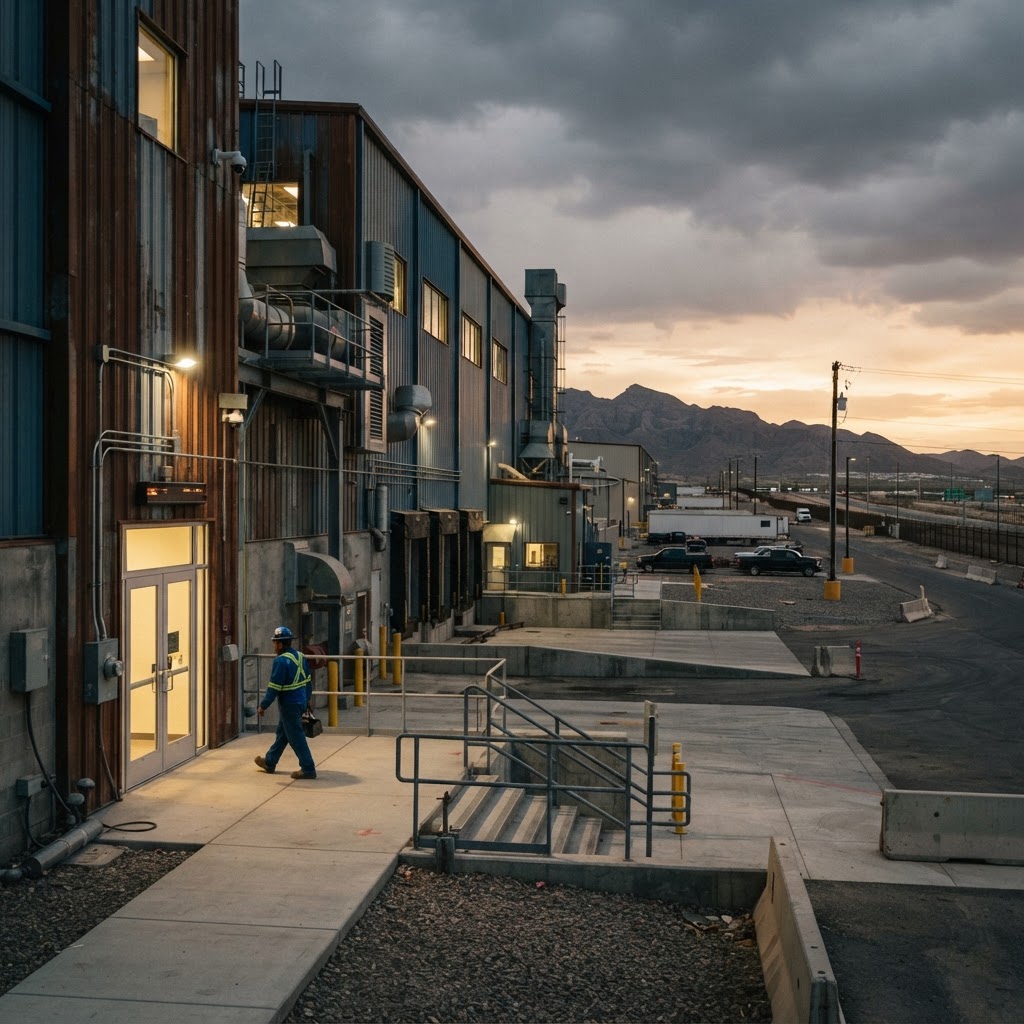

How Mexico's Monterrey Became America's Most Important Manufacturing Corridor — September 2026
U.S. manufacturers spent the last three years reshoring rhetoric. The ones actually moving product built plants in Monterrey.
The Tariff Shock Exposed a Single-Source Problem
Problem: When Section 301 tariffs on Chinese goods hit 45%+ across electronics, auto parts, and industrial components, procurement leads faced a brutal math problem. Reshoring to Ohio or Tennessee added 18–24 months of lead time and 35–60% cost premiums. Doing nothing meant margin compression that killed competitiveness.
Insight: Monterrey absorbed that displacement faster than any U.S. metro. The city now hosts over 900 industrial facilities across aerospace, automotive, electronics, and medical devices. Labor costs run $4.80–$6.20/hour for skilled assembly — roughly 22% of comparable U.S. rates — while proximity to the Texas border keeps inbound logistics under 48 hours to most Midwest distribution hubs.
Recommendation: If your supplier map still routes through Shenzhen for mid-complexity fabricated parts, run a landed cost comparison against a Monterrey-based tier-two. The delta is no longer marginal.
USMCA Is the Structural Engine, Not a Bonus
Problem: Most procurement teams treat USMCA as a compliance checkbox. That's a missed optimization. Manufacturers leaving 8–12% in recoverable duty savings on the table because their legal teams haven't mapped regional value content thresholds.
Insight: USMCA's regional value content rules — requiring 75% North American content for auto parts to qualify for zero-tariff status — are actively reshaping supplier networks around Monterrey's industrial parks. Nemak, Rassini, and Vitro have all expanded Monterrey footprints specifically to serve Tier 1 OEM compliance requirements. The corridor is becoming a USMCA compliance engine, not just a cheap labor play.
Recommendation: Audit your bill of materials for USMCA origin content quarterly. Suppliers in Monterrey's FINSA industrial parks can often be structured to push a product from non-qualifying to fully qualifying status — converting a tariff liability into a zero-rate advantage.
"Monterrey isn't a nearshoring destination. It's a tariff arbitrage platform with a skilled labor surplus — and most U.S. manufacturers are still underusing it."
Automation Is Closing the Quality Gap Skeptics Cited
Problem: Quality variability was the legitimate knock on Mexico manufacturing through 2022. Scrap rates, rework loops, and inspection failures were real — and costly. That argument is now outdated and operationally dangerous to repeat unchecked.

What will it take to turn demand into delivered output?
Explore The Capacity Imperative, our report on U.S. advanced manufacturing and the priorities shaping 2027.
Insight: Monterrey's largest facilities are deploying AI vision inspection systems at a rate that outpaces many U.S. plants. Cognex vision systems, FANUC robotic cells, and Rockwell Automation control platforms are standard spec in new greenfield builds. Defect detection rates in automated Monterrey lines are tracking at sub-0.3% — competitive with best-in-class U.S. facilities.
Mobile autonomous robots are also reducing internal logistics cycle times by 25–40% in distribution-linked manufacturing cells — a direct parallel to the warehouse automation gains driving traffic on this publication.
Recommendation: Require prospective Monterrey suppliers to provide OEE data, scrap rate history, and their automation investment roadmap before signing. Suppliers investing in vision and robotics capex are de-risking your quality exposure — not just their own.
Infrastructure Investment Is Compounding the Advantage
Problem: Logistics bottlenecks — specifically cross-border truck wait times at Laredo — created real friction in 2023–2024. That constraint suppressed Monterrey's throughput ceiling and gave skeptics ammunition.
Insight: U.S. CBP's Unified Cargo Processing expansion at the Colombia Solidarity Bridge, combined with Mexico's federal investment in Highway 85D corridor upgrades, has cut average commercial crossing times by 31% since Q1 2025. Laredo remains the highest-volume land port in the U.S., processing over $300 billion in annual trade — and its throughput infrastructure is finally catching up to that volume.
Kansas City Southern's CPKC rail merger created a single-line network from Monterrey to Chicago — cutting intermodal transit from 6–8 days to 3–4 days for manufacturers willing to structure around rail rather than over-the-road.
Recommendation: Map your freight lanes before committing to a Monterrey supplier. Companies 300+ miles from the Texas border should model CPKC intermodal seriously — the transit time and cost structure frequently beats truckload for high-volume, medium-weight components.
Tactical Recommendations
- Run a landed cost model now — not a rough estimate. Include tariff classification, USMCA content eligibility, cross-border logistics, and duty drawback recovery. The real number almost always favors Monterrey over China for mid-complexity parts.
- Require automation disclosure from suppliers — ask specifically about vision inspection systems, robotic cell density, and OEE benchmarks. Automation investment predicts quality trajectory.
- Engage a FINSA or Vesta industrial park directly — their development teams map available capacity, labor pools, and proximity to existing Tier 1 clusters faster than brokers do.
- Model CPKC intermodal for every lane over 500 miles — the Monterrey-to-Midwest corridor is structurally underutilized by U.S. manufacturers still defaulting to over-the-road.
- Audit USMCA compliance quarterly — supplier network shifts in 2025–2026 mean your regional value content calculations from 18 months ago are likely stale and potentially non-compliant.
Sources: USTR — USMCA Overview · U.S. CBP — Laredo Port Operations · CPKC Rail Network · Rockwell Automation — Manufacturing Intelligence · FINSA Industrial Parks Mexico

