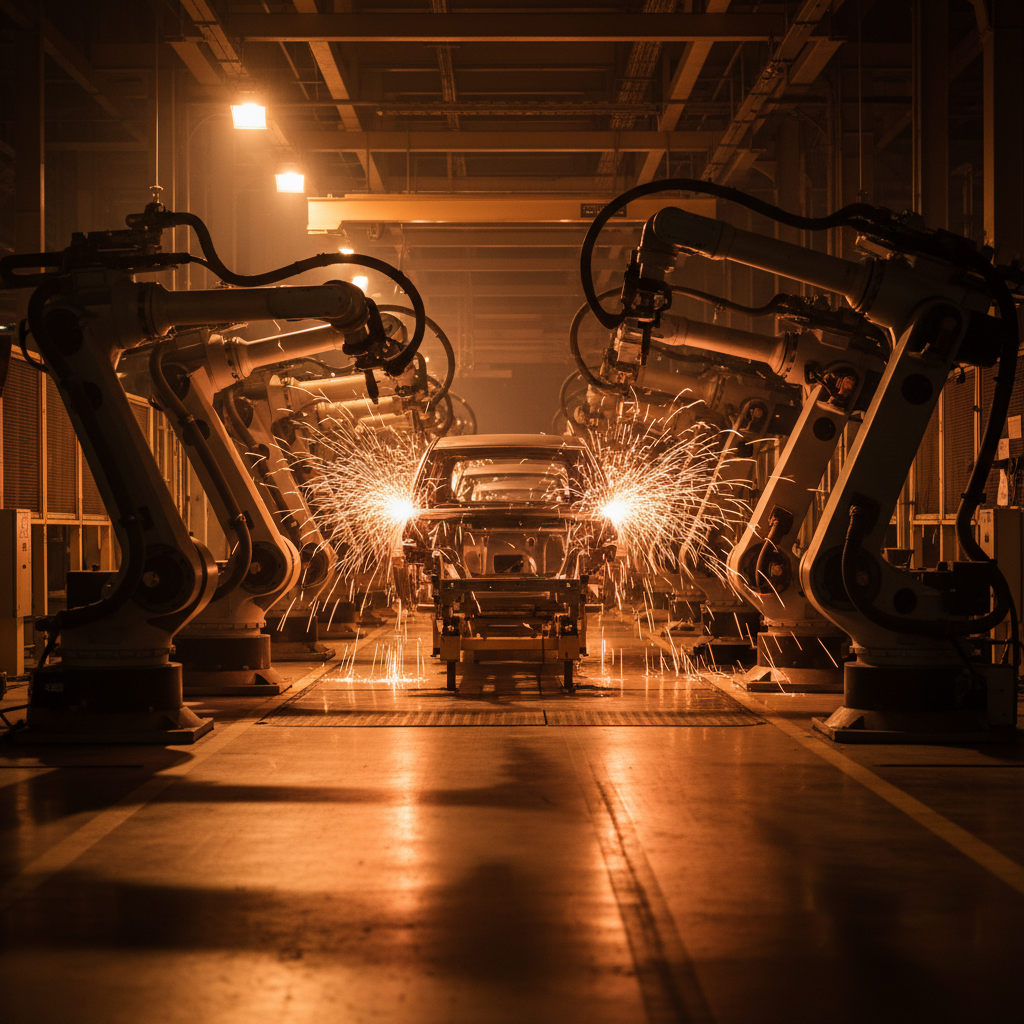

How Hyperautomation Is Rewiring the Modern Factory Floor - June 2026
Rockwell Automation's latest Connect partner ecosystem now integrates with over 300 discrete software platforms - a signal that hyperautomation has crossed from buzzword to infrastructure reality.
Hyperautomation Is Not a Single Technology - It's a Stack
Stop thinking of hyperautomation as a product you purchase. It's an architecture: robotic process automation (RPA) layered with AI-driven decision engines, computer vision, collaborative robotics, and industrial IoT telemetry - all stitched together through a unified orchestration layer. The goal isn't automating one task. It's automating the handoffs between tasks, between systems, and between humans and machines.
The practical stack currently running in high-performing U.S. facilities looks like this:
- Physical execution layer: AMRs from Zebra Technologies (Fetch Robotics), autonomous forklifts from Seegrid, and articulated arms from FANUC, KUKA, and Universal Robots
- Process orchestration: UiPath and Automation Anywhere for RPA workflows tied directly into ERP systems (SAP S/4HANA, Oracle Manufacturing Cloud)
- AI inference layer: Machine vision from Cognex and Keyence detecting defects, verifying assembly steps, reading barcodes at line speed
- Data backbone: PTC ThingWorx, Siemens MindSphere, and Rockwell's FactoryTalk pulling sensor data into actionable dashboards
- Integration middleware: MuleSoft and Boomi bridging legacy PLCs with cloud analytics platforms
When these layers communicate without human intervention, you get hyperautomation. When they don't, you get expensive islands of automation that still require a coordinator with a clipboard.
AI Is Finally Earning Its Place at the Machine Level
For three years, plant managers watched AI get pitched as a strategic planning tool - forecasting, scheduling, demand sensing. That positioning is shifting hard. AI is moving down the stack, directly into the control loop.
Siemens' Industrial Copilot, deployed across select automotive and electronics facilities, is now interpreting PLC fault codes and recommending corrective actions in under 90 seconds. Rockwell's Plex Smart Manufacturing Platform uses machine learning to detect process drift before it triggers a quality escape. These aren't dashboard analytics - they're closed-loop interventions.
System integrators like Accenture Industry X and Wipro's manufacturing practice are deploying edge AI nodes - small inference computers mounted at the cell level - that run vision models locally without cloud latency. Latency matters when a press cycle runs in 400 milliseconds.
What this means operationally:
- Defect detection rates improving sharply on lines where camera-based AI replaced manual inspection gates
- Predictive maintenance moving from scheduled downtime models to condition-based triggers with meaningful OEE impact
- Dynamic routing of AMR fleets adjusting in real time to production prioritization changes - no re-programming required
The Integration Layer Is Where Implementations Succeed or Die
Every failed hyperautomation deployment shares a common cause: the integration layer was underbuilt. Vendors sell robots. Vendors sell software. Almost nobody leads with integration architecture - and that gap is where projects stall.

What will it take to turn demand into delivered output?
Explore The Capacity Imperative, our report on U.S. advanced manufacturing and the priorities shaping 2027.
Consider a mid-size Tier 2 automotive supplier deploying a hyperautomation initiative across three cells. They purchase FANUC CRX collaborative robots, a Zebra AMR fleet, and a UiPath RPA layer for order processing. Each system works. The robots pick reliably. The AMRs navigate. The RPA bots process paperwork. But if the WMS doesn't push real-time inventory signals to the AMR fleet manager, and the AMR fleet manager doesn't trigger the RPA workflow when a part shortage is detected, you haven't automated a process - you've automated three disconnected tasks.
Integrators doing this right - Plex Systems, Dematic, and Honeywell Intelligrated on the material handling side - are leading with data architecture before a single robot is scoped. That sequence is not optional.
Key integration checkpoints before any deployment:
- ERP-to-MES connectivity: Bidirectional, real-time, not batch-synced overnight
- OT/IT convergence: Legacy PLCs must be wrapped with data-collection agents (Kepware, Ignition by Inductive Automation) before AI layers can read them
- Cybersecurity segmentation: Purdue model or zero-trust architecture applied before connecting edge nodes to cloud platforms
- API governance: Every vendor integration documented, versioned, and owned by a named system owner internally
Workforce Architecture Is Being Redrawn, Not Eliminated
The headline risk that hyperautomation eliminates jobs is incomplete. The accurate picture: it eliminates task categories while creating new role structures. The plants running hyperautomation most effectively are doing deliberate workforce redesign in parallel.
Siemens' U.S. manufacturing facilities have reported shifting significant portions of their floor workforce toward automation oversight, exception handling, and continuous improvement roles. Rockwell's own internal facilities have documented similar transitions. The operational title "Automation Technician" is increasingly a hybrid - part PLC programmer, part data analyst, part robot maintenance specialist.
Community colleges partnering with FANUC America's CERT program and Universal Robots' UR Academy are producing entry-level technicians who can deploy, maintain, and modify cobot applications. That pipeline is accelerating, not keeping pace.
For procurement leads and ops directors: budget for workforce transition explicitly. Treat it as a capital line item alongside hardware, not an HR afterthought.
What This Means for Your Floor
If you're in the planning or early deployment phase, here's the operational takeaway:
- Audit integration architecture first. Before purchasing another robot or software license, map every system that will need to communicate. Gaps here kill ROI.
- Demand orchestration capability from your integrator. Not just installation. Ask Accenture, Rockwell, Dematic, or whoever you're working with how they handle cross-system workflow logic. If they can't answer it specifically, escalate.
- Move AI to the cell level, not just the dashboard. Edge inference from vendors like NVIDIA (Jetson platform) and Intel (OpenVINO) is mature enough for production deployment. Latency-sensitive inspection and detection tasks belong at the edge.
- Phase AMR and fixed automation together. Seegrid, Zebra, and Vecna Robotics all offer fleet management APIs that can be tied to production scheduling systems. Dynamic routing tied to live WMS data eliminates the "AMR traffic jam" problem that plagues first-generation deployments.
- Lock cybersecurity before connectivity. Every OT node you bring online is an attack surface. Claroty and Dragos both offer OT-specific threat monitoring platforms built for manufacturing environments. This is not optional infrastructure.
- Redefine roles before you deploy. Hyperautomation fails operationally when floor personnel don't understand how to work alongside it. Change management is technical, not soft.
The Competitive Window Is Compressing
The facilities that deployed early hyperautomation pilots in 2023 and 2024 are now on second-generation deployments - refining orchestration logic, expanding into new cells, and widening the operational gap over competitors still running disconnected automation point solutions.
This is not a future consideration. The stack is mature, the integrators are experienced, and the ROI cases are documented. Operations leaders who defer are not being cautious - they're ceding ground.

