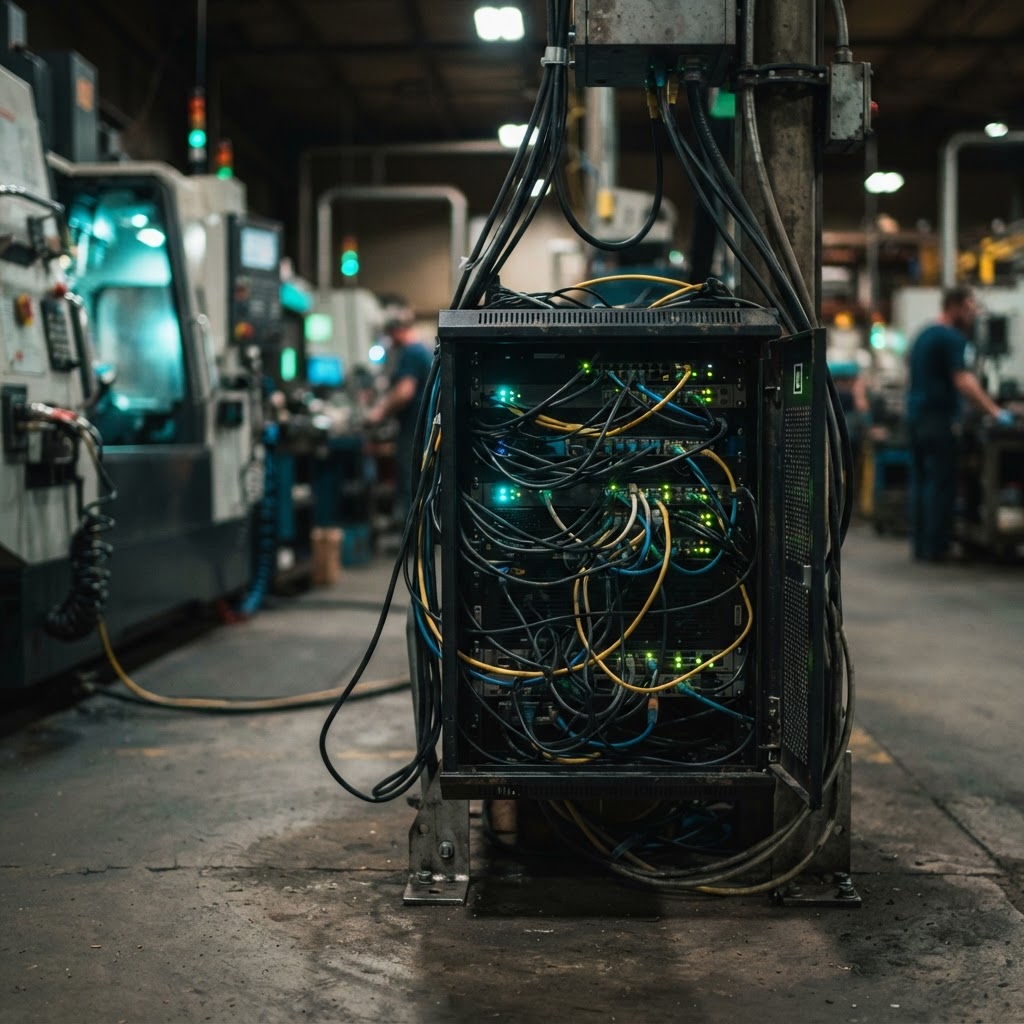

Edge Computing Is Transforming How Factories Process Real-Time Data — October 2026
Cloud latency is costing manufacturers millions in scrap, downtime, and missed yield windows. Edge computing eliminates that gap — and plants that haven't deployed it are already falling behind on cycle time and defect response.
Cloud-First Architecture Is Breaking Down on the Shop Floor
Problem: Sending raw sensor data to the cloud and waiting for a response takes 80–200 milliseconds on a good day. On a press line running 400 cycles per minute, that latency window is longer than the entire forming event.
Insight: Siemens published operational data in Q1 2026 showing that cloud-dependent quality inspection loops missed defect windows in 12% of high-speed stamping cycles — failures that edge-local inference caught in under 5ms. The physics of manufacturing do not wait for a round-trip to AWS.
Recommendation: Audit every sensor-to-decision loop in your facility. Any process running above 200 cycles per minute with a quality or safety dependency needs local compute — not a cloud SLA promise.
Sensor Density Is Outpacing Network Bandwidth — Fast
Problem: The average mid-size automotive supplier now runs between 2,000 and 8,000 connected sensors per facility. Streaming all of that raw data off-site consumes bandwidth, inflates cloud storage costs, and creates a single point of failure when WAN connectivity drops.
Insight: Rockwell Automation estimates that edge preprocessing — filtering, aggregating, and compressing data at the machine level — reduces raw data transmission volumes by 60–85% before anything hits the cloud. That's not a marginal efficiency gain. That's a fundamental shift in how plant infrastructure gets designed.
Edge nodes running inference locally can flag anomalies, trigger alarms, and adjust process parameters in real time — sending only exception events and compressed summaries upstream.
Recommendation: Deploy edge nodes with local inference capability at every high-output asset. Use cloud infrastructure for historical trend analysis and model retraining — not live process control.
"The plants winning on quality in 2026 aren't sending more data to the cloud — they're making faster decisions without it."
The Hardware Stack Is Finally Ready for Plant-Floor Conditions
Problem: Early edge compute hardware wasn't built for manufacturing environments. Vibration, heat, particulate, and EMI killed consumer-grade hardware within months, and industrial-rated solutions carried price points that only Tier 1 suppliers could absorb.
Insight: That ceiling has dropped significantly. NVIDIA Jetson-class modules now run vision and inference workloads at under $800 per node with IP67 enclosure options. Dell Technologies and HPE both ship hardened edge servers rated for continuous operation at 50°C with MTBF figures exceeding 100,000 hours.

What will it take to turn demand into delivered output?
Explore The Capacity Imperative, our report on U.S. advanced manufacturing and the priorities shaping 2027.
The capital barrier to entry for a 10-node edge deployment now runs $15,000–$40,000 depending on compute requirements — a number most plant capex budgets can absorb without a major approval cycle.
Recommendation: Spec edge hardware to your actual environment. Prioritize thermal rating and vibration tolerance over raw compute specs. A slower node that runs continuously beats a fast node that fails in month three.
Integration With AI Vision Is Where the Real ROI Surfaces
Problem: Deploying edge compute as a standalone infrastructure project delivers limited returns. The payoff comes when local compute powers AI vision systems — the same class of technology covered in Strata's August 2026 analysis — enabling sub-10ms defect detection without cloud dependency.
Insight: Cognex and Keyence both ship vision systems with onboard inference engines that push detection decisions in under 8ms. Paired with edge nodes running ONNX-format models, plants are achieving first-pass yield improvements of 3–7 percentage points — recoverable margin that goes directly to the bottom line.
One Midwest stamping operation running 18 press lines reported a $2.1M annual reduction in scrap after deploying edge-connected vision across its blanking and forming cells in early 2026.
Recommendation: Prioritize edge-vision integration at your highest-scrap process steps first. Model the ROI on first-pass yield improvement, not just infrastructure cost savings — the business case accelerates significantly.
Tactical Recommendations for Operations Leaders
- Map latency requirements by process. Any decision loop under 20ms needs local compute. Build that threshold into your sensor architecture specs now.
- Standardize on one edge platform. Mixed hardware environments create maintenance overhead and security gaps. Pick a platform — Siemens, Rockwell, or Dell — and build around it.
- Run edge nodes in redundant pairs at critical assets. Single-node deployments create downtime exposure. Budget for failover from the start.
- Retrain models at the edge quarterly. Production drift is real. Models trained on last year's material or tooling conditions degrade. Build a retraining cadence into your maintenance schedule.
- Negotiate data ownership terms with platform vendors upfront. Several edge-as-a-service platforms retain rights to anonymized process data. Understand what you're signing before deployment.
Sources: Siemens Edge Computing · Rockwell Automation Connected Enterprise · NVIDIA Jetson Platform · ONNX Open Standard · HPE Edge Computing Solutions

