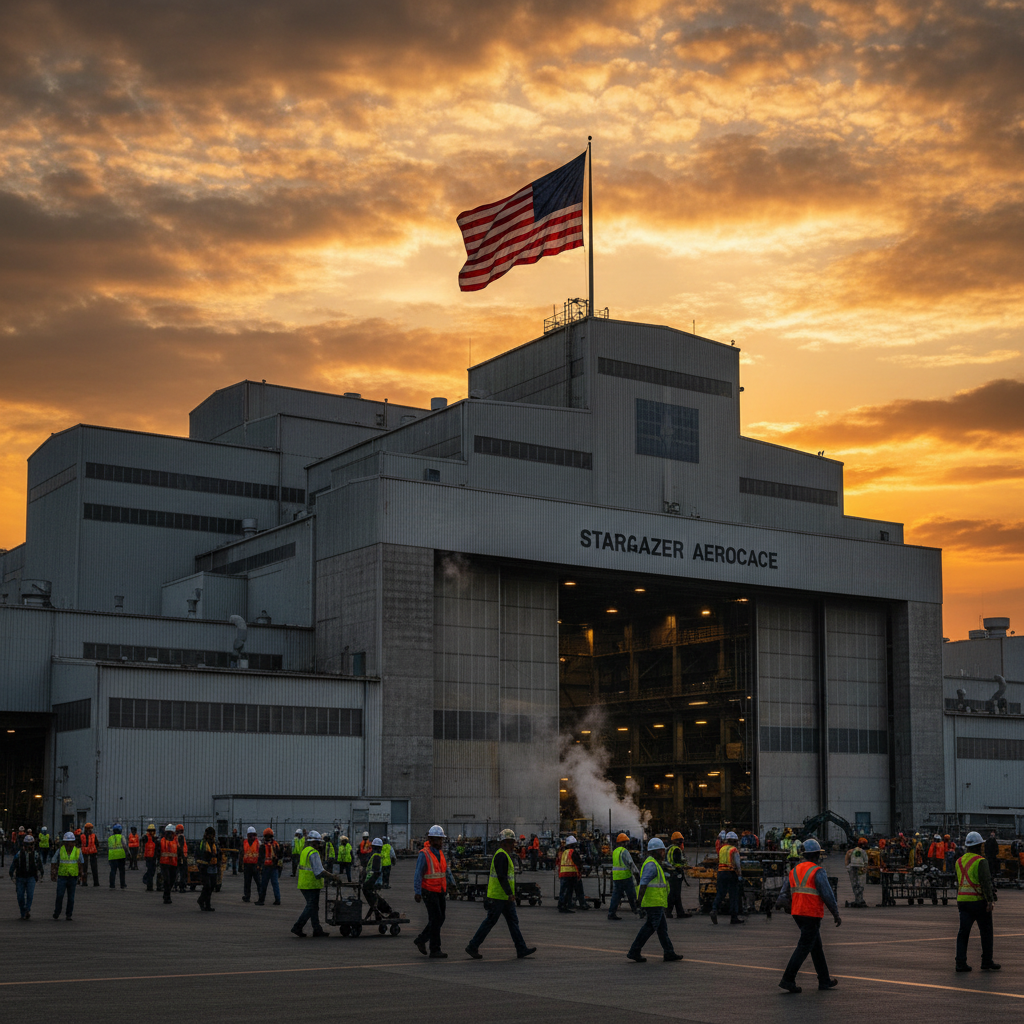

Defense Manufacturing Shifts: Spin-offs, Strategic Layoffs, and Major Production Contracts: What Manufacturing Leaders Need to Know This Week
By Marcus D. Holloway, Editor in Chief, Strata Intelligence | June 11, 2026
The U.S. defense industrial base is not restructuring gradually - it is restructuring violently, and this week's data proves it. From a landmark aerospace spin-off reshaping Arizona's economy to submarine hiring surges redefining the maritime supply chain, the decisions being made in boardrooms and Pentagon procurement offices right now will lock in competitive advantages and expose vulnerabilities for the next decade.
Executive Summary
Five major developments broke across the defense manufacturing sector in a 72-hour window ending June 11, 2026. Taken individually, each story is noteworthy. Read together, they form a coherent thesis: the defense industrial base is bifurcating into high-growth production ramps and painful workforce right-sizing events simultaneously - often within the same company category. For C-suite executives, plant managers, and procurement directors, the window to position for the growth side of this bifurcation is narrowing.
Key developments this week:
- L3Harris locks in $106M for VAMPIRE counter-drone production, accelerating Huntsville manufacturing capacity
- Honeywell Aerospace completes its spin-off trajectory, anchoring an independent aerospace giant in Phoenix
- BAE Systems cuts nearly 200 shipyard workers in Jacksonville amid Navy maintenance budget volatility
- Bell Textron lays off 285 as the MV-75 tiltrotor program transitions from development to production
- General Dynamics announces 8,000+ hires in 2026 to support the Columbia and Virginia-class submarine ramp
L3Harris VAMPIRE Contract: Counter-Drone Production Becomes a Tier-One Priority
L3Harris Technologies secured a $106 million U.S. Army contract to deliver its VAMPIRE (Vehicle-Agnostic Modular Palletized ISR Rocket Equipment) counter-unmanned aircraft systems, with production ramping at its Huntsville, Alabama facilities. Read more
This contract is not a one-off procurement win. It is a structural signal that counter-UAS capability has graduated from experimental battlefield utility to standing acquisition priority within the U.S. Army. The speed of the threat environment - drone proliferation across near-peer and asymmetric conflict zones - has compressed the typical defense acquisition timeline, and L3Harris is positioned to capture that urgency in volume production.
Immediate implications for manufacturers and suppliers:
- Huntsville, Alabama is cementing its status as a premier counter-drone manufacturing hub. Tier 2 and Tier 3 suppliers within driving distance of the Huntsville aerospace corridor should be actively pursuing qualification conversations now, not at contract award.
- High-volume production ramps require rapid supply chain scaling - precision machining, electronics integration, and composite components will face lead time pressure.
- The urgency signal from the Army suggests follow-on contract tranches are probable. Suppliers who establish relationships and production history on this contract cycle will hold incumbency advantages in future awards.
Downstream read: The global counter-drone market is compressing development cycles industry-wide. Any manufacturer with relevant subsystem capability - EO/IR sensors, launcher mechanisms, targeting software integration - needs a counter-UAS strategy on paper by Q3 2026.
Honeywell Aerospace Becomes HONA: Arizona Just Got a New Industrial Anchor
Honeywell Aerospace is completing the final steps of its spin-off into an independent, publicly traded company operating under the ticker HONA, headquartered in Phoenix, Arizona. The new entity held its inaugural Investor Day this week, articulating a long-term strategic focus on commercial aviation and defense markets. Read more
The structural significance here cannot be overstated. When a company of Honeywell Aerospace's scale - engines, avionics, navigation, mechanical systems - achieves independent corporate identity, its procurement, partnership, and investment behaviors change materially. Decisions that previously required navigation through a diversified conglomerate structure now sit with a focused leadership team accountable solely to aerospace and defense performance metrics.
"When an aerospace giant achieves independence, the supply chain reorganizes around it - and the geography it anchors becomes a magnet for capital, talent, and Tier 1 investment for years."
What this means for regional and national suppliers:
- Phoenix, Arizona is no longer merely a favorable business climate story. It is now the headquarters of a major public aerospace OEM, which will attract supplier co-location decisions, workforce development investment, and infrastructure spending.
- HONA's Investor Day framing around commercial aviation and defense signals dual-market pursuit - suppliers with crossover capability (avionics, propulsion subsystems, MRO services) should be initiating business development outreach immediately.
- As an independent public company, HONA will face quarterly earnings pressure that a conglomerate parent could absorb. This creates opportunities for suppliers who can offer cost efficiency and production flexibility - and risks for those relying on legacy sole-source relationships that haven't been renegotiated.
- Watch for campus expansion announcements, R&D partnerships with Arizona State University and University of Arizona, and potential incentive packages from the State of Arizona as HONA establishes its independent footprint.

What will it take to turn demand into delivered output?
Explore The Capacity Imperative, our report on U.S. advanced manufacturing and the priorities shaping 2027.
BAE Systems Jacksonville and Bell Textron: Reading Two Very Different Layoff Stories
Not all workforce reductions carry the same industrial message. This week produced two layoff events with fundamentally different root causes and downstream implications - and conflating them would be a strategic mistake.
BAE Systems Jacksonville: A Demand-Side Warning
BAE Systems initiated layoffs for nearly 200 workers - approximately 25% of its local workforce - at its Jacksonville, Florida shipyard. The company attributed the reduction to a temporary dip in anticipated U.S. Navy ship maintenance and repair workloads. Read more
The word "temporary" should be received with analytical skepticism. When a shipyard cuts a quarter of its workforce, the operational recovery timeline is rarely measured in quarters. Re-hiring skilled tradespeople - welders, pipe fitters, marine electricians - in a tight defense labor market takes 12–18 months at minimum. The real risk is that Jacksonville loses critical workforce density that is difficult to reconstitute when Navy contract flow recovers.
Supplier and regional implications:
- Maritime MRO suppliers operating in the Jacksonville region should model a 12–18 month demand trough and adjust inventory positioning and staffing accordingly.
- The U.S. Navy's maintenance budget volatility is a systemic issue, not a BAE-specific one. Surface warfare and amphibious ship maintenance accounts have faced persistent funding uncertainty. Suppliers diversified across depot types are better insulated.
- Workforce pipeline programs in Florida's maritime trades face near-term enrollment pressure as employment signals weaken.
Bell Textron MV-75: A Supply-Side Opportunity Disguised as a Layoff
Bell Textron laid off approximately 285 employees across Texas and Kansas facilities, directly tied to the MV-75 next-generation tiltrotor program transitioning out of advanced development and into production. Read more
This is a phase-transition event, not a demand collapse. Advanced development programs carry different labor profiles - heavy in engineers, test personnel, and program managers - than production programs, which require manufacturing technicians, quality assurance specialists, and production-line supervisors. Bell is right-sizing for what comes next.
What production-phase suppliers need to do now:
- Identify which subsystems on the MV-75 platform are not yet under long-term supply agreements.
- Initiate supplier qualification conversations - production readiness reviews will accelerate once development milestones are formally closed.
- Assess capacity: a full-rate MV-75 production program will generate sustained multi-year demand for composite structures, avionics, drive systems, and propulsion components.
- Texas and Kansas regional manufacturers should be tracking Bell's production facility expansion plans closely.
General Dynamics Electric Boat: The Single Largest Workforce Signal in U.S. Defense Manufacturing
General Dynamics Marine Systems division - operating through Electric Boat - announced plans to hire over 8,000 employees in 2026 alone, driven by a $125 billion U.S. Navy submarine procurement plan covering the Columbia-class ballistic missile submarine and Virginia-class attack submarine programs.
To put this in industrial context: 8,000 hires in a single calendar year at a single shipyard complex is one of the most concentrated workforce mobilizations in modern U.S. defense manufacturing history. Electric Boat's Groton, Connecticut and Quonset Point, Rhode Island facilities are executing a multi-billion dollar expansion to support this ramp.
The supply chain calculus is equally significant:
- Nuclear submarine construction requires the deepest, most specialized supplier ecosystem in defense manufacturing. Pressure hull sections, nuclear propulsion components, weapons system integration, acoustic dampening - nearly every subsystem requires unique certifications and manufacturing processes.
- Long-term demand visibility is Electric Boat's defining competitive asset for suppliers. Columbia-class and Virginia-class backlogs extend well into the 2030s. Tier 1 and Tier 2 suppliers who establish positions now are locking in multi-decade revenue streams.
- The workforce surge will create regional economic multiplier effects across New England. Housing, technical education, infrastructure - all will feel the pressure of this hiring ramp.
- Procurement directors at companies holding or pursuing NAVSEA supply relationships should treat this announcement as a capacity planning forcing function. Electric Boat's demand curve is not hypothetical - it is funded, contracted, and politically protected.
Editor's Take: Marcus D. Holloway's 90-Day Outlook
The manufacturing sector data from this week resolves into three actionable conclusions for the next 90 days.
First, the counter-drone supply chain will be undersupplied within 18 months. The L3Harris VAMPIRE contract is one visible procurement action in a global counter-UAS market that is accelerating across NATO allies, Indo-Pacific partners, and U.S. service branches simultaneously. Manufacturers with any relevant subsystem capability - and I mean any - need a counter-drone product strategy before the end of Q3 2026. The suppliers who wait for RFP release to begin engagement will be too late.
Second, the Honeywell Aerospace independence event is underappreciated by regional economic development actors. HONA's Investor Day is the opening bell of a multi-year supplier ecosystem reorganization centered on Phoenix. The companies that will win the most from this transition are the ones that treat June 2026 as the start date for building relationships with HONA's new independent procurement and engineering leadership - not the ones who assume legacy Honeywell relationships will carry forward unchanged.
Third, read the submarine hiring surge as a 10-year demand signal, not a 2026 headline. General Dynamics' 8,000-hire announcement is not a labor market curiosity. It is the most explicit, funded, and long-duration demand signal available to any supplier in the U.S. defense industrial base. If your product or service has any pathway to the nuclear submarine supply chain - even an indirect one - your business development investment should be disproportionately weighted toward that opportunity for the remainder of this decade.
The bifurcation is real. The winners in this environment are the organizations that read structural signals accurately and move before consensus forms. That window is open now.
- Marcus D. Holloway, Editor in Chief, Strata Intelligence
Sources: L3Harris Technologies - BusinessWire · Honeywell Aerospace Spin-off - Chamber Business News · BAE Systems Jacksonville - News4Jax · Bell Textron MV-75 - AVweb · General Dynamics Electric Boat

