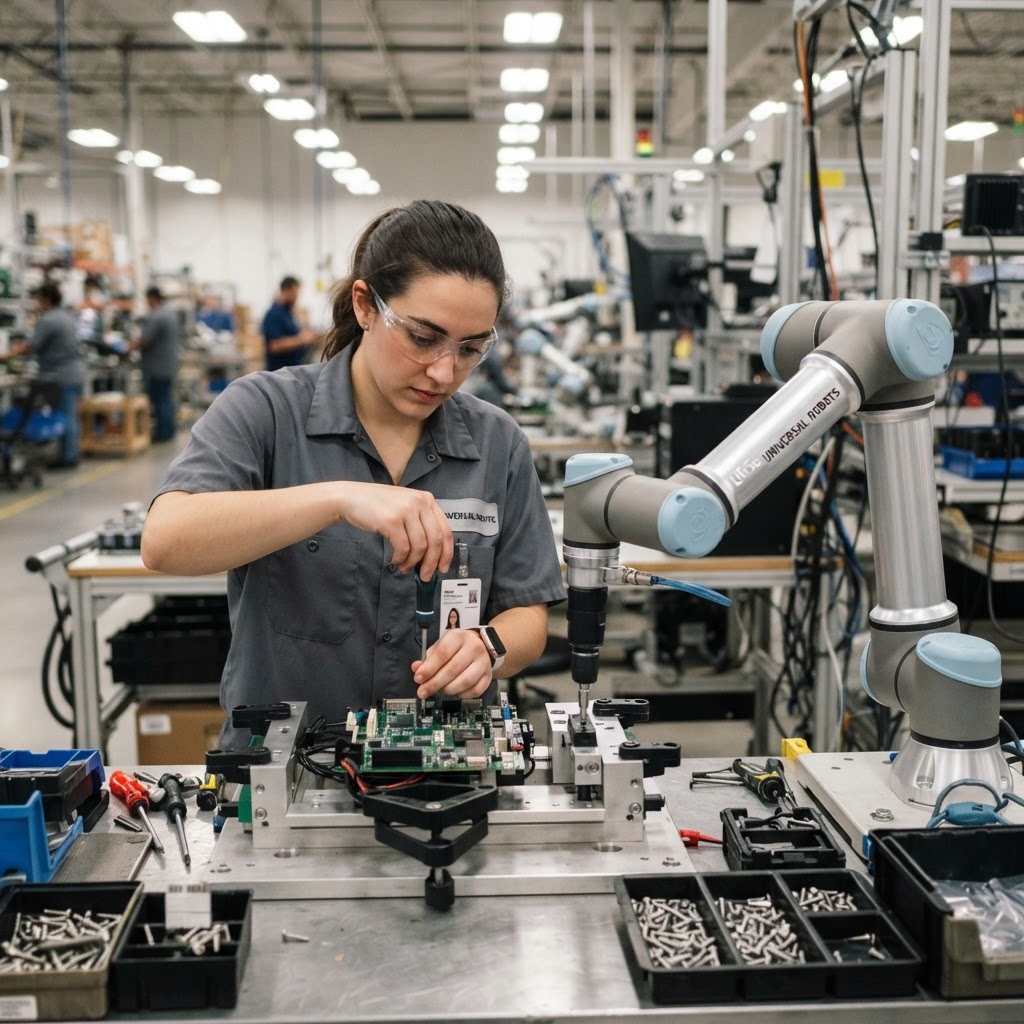

Collaborative Robots and the End of the Safety Cage Era — September 2026
Universal Robots shipped its two-millionth cobot arm in Q3 2026 — a milestone that signals the safety cage is no longer the default architecture for human-robot collaboration on the American factory floor.
The Cage Was Always a Workaround, Not a Solution
Traditional industrial robots demanded physical segregation. A six-axis FANUC M-2000 moving at full speed near an unprotected worker is a liability event waiting to happen. So manufacturers built cages, light curtains, and exclusion zones. Effective, yes. Flexible, no. Every cage is a constraint baked into your floor layout — a hard wall between throughput and adaptability.
The cobot category was built to dissolve that constraint. Force-torque sensing, vision-guided path correction, and ISO/TS 15066-compliant speed-and-separation monitoring have matured to the point where shared workspace is no longer experimental. It is production-ready, validated, and increasingly the baseline expectation from Tier 1 automotive suppliers down to mid-size fabricators.
What Changed in 2025–2026 That Made This Real
Three converging developments accelerated the cage-free shift from pilot to production:
- Sensor fusion hit price parity. LiDAR, time-of-flight, and machine vision packages that cost $18,000–$22,000 per cell in 2022 are now integrated at under $6,000 in systems from ABB's GoFa and SWIFTI families. The economics flipped.
- ISO 10218 revisions landed. The updated ISO 10218-1 and 10218-2 standards, finalized in late 2024, gave engineers a cleaner compliance pathway for power-and-force-limiting applications without custom safety assessments on every deployment.
- AI-assisted path planning matured. Rockwell Automation's FactoryTalk Optix and similar platforms now run real-time occupancy grid updates, rerouting cobot trajectories around human movement without full stops. Throughput penalties dropped from 30–40% in early shared-workspace deployments to under 8% in current validated configurations.
"The cage protected the robot's workspace. The cobot protects the worker — and that changes everything about how you design a cell."
The Hardware Landscape Is Consolidating Around Three Architectures
Not all cobots are built the same, and procurement leads need to distinguish between three deployment architectures dominating 2026 installations:
1. Power-and-Force-Limiting (PFL) Arms
- Representatives: Universal Robots UR20, FANUC CRX-25iA
- Payload range: 5–25 kg
- Mechanism: Joint torque sensors trigger sub-200ms stops on contact
- Best fit: Assembly, kitting, light machine tending
2. Speed-and-Separation Monitoring (SSM) Systems
- Representatives: ABB SWIFTI CRB 1100, integrated with SafeMove2 software
- Mechanism: Camera and LiDAR zone mapping adjusts TCP velocity as workers enter monitored zones
- Best fit: High-mix welding prep, inspection, and material handling where full stops kill cycle time
3. Mobile Cobot Platforms (Cobot-on-AMR)
- Representatives: OMRON Mobile Robotics LD series paired with TM cobot arms, MiR with UR arm integrations
- Mechanism: Autonomous navigation plus collaborative manipulation — no fixed cell footprint
- Best fit: Flexible assembly lines, intralogistics with pick-and-place handoffs
The cobot-on-AMR category deserves particular attention. It is the fastest-growing segment and the one most likely to disrupt fixed-cell thinking entirely — especially in the high-mix, low-volume shops that make up the majority of American contract manufacturing.
System Integrators Are Now the Critical Path
Hardware selection is table stakes. The deployment bottleneck in 2026 is integration and validation — and the SI community is stretched. Yaskawa Motoman certified integrator network, FANUC's Authorized System Integrator program, and Rockwell's PartnerNetwork are all reporting 14–22 week backlogs on cobot cell projects.
What this means practically:
- Lock your SI early — Q1 2027 floor deployments need integration contracts signed by November 2026
- Specify ISO 10218-2 compliance documentation as a contract deliverable, not an afterthought
- Require risk assessment reports formatted to OSHA 1910.217 machine guarding standards — your insurance carrier will ask for them
- Validate in simulation first: Siemens Process Simulate and Rockwell's Emulate3D cut physical commissioning time by 30–40% on complex shared-workspace cells
What This Means for Your Floor
If you are running a facility with legacy caged cells and evaluating your next automation cycle, the calculus has changed materially. Here is what operations directors should act on now:
- Audit your cage footprint. Every square foot inside a safety cage is dead space for human activity. Map it. Cobot conversions routinely recover 15–25% of floor area in mid-size assembly cells.
- Reassess your labor integration model. Cage-free cobots are not replacing workers — they are repositioning them. The highest-ROI deployments pair cobots with human workers on the same station for ergonomic offload: heavy lifting, repetitive torque applications, overhead fastening.
- Train your safety team before deployment, not after. ISO 10218 compliance requires documented operator training. Build that into your project timeline. OSHA's Recommended Practices for Safety and Health Programs provides a serviceable framework.
- Do not overbuy payload. The most common procurement error in first cobot deployments is specifying a 20 kg arm for a 6 kg application because it feels safer. Match payload to task — oversized arms carry unnecessary cost and reduce the speed advantages that make SSM architectures viable.
- Plan for software, not just hardware, maintenance. Cobot deployments running AI-assisted path planning require firmware update cycles, sensor recalibration schedules, and integration with your MES. Budget accordingly.
The Floor Layout Itself Is the Next Frontier
The safety cage shaped factory floor design for four decades. Its removal is not cosmetic — it rewrites the logic of how cells, aisles, and workcenter adjacencies are planned. Manufacturers who treat cage-free cobot deployment as a drop-in hardware swap will underperform those who redesign workflows around shared human-robot workspace from the ground up.
The two-millionth cobot shipped. The question for every plant manager reading this is not whether to deploy — it is whether your floor layout, your SI pipeline, and your workforce training model are ready to do it right.
Sources: Universal Robots · ISO 10218 Standard Overview · OSHA Machine Guarding Standards · Rockwell Automation FactoryTalk · ABB Collaborative Robots

