

Inside ARMS Pumps & Repairs: A Pump and Valve Manufacturing Shop Built on Precision and Pride
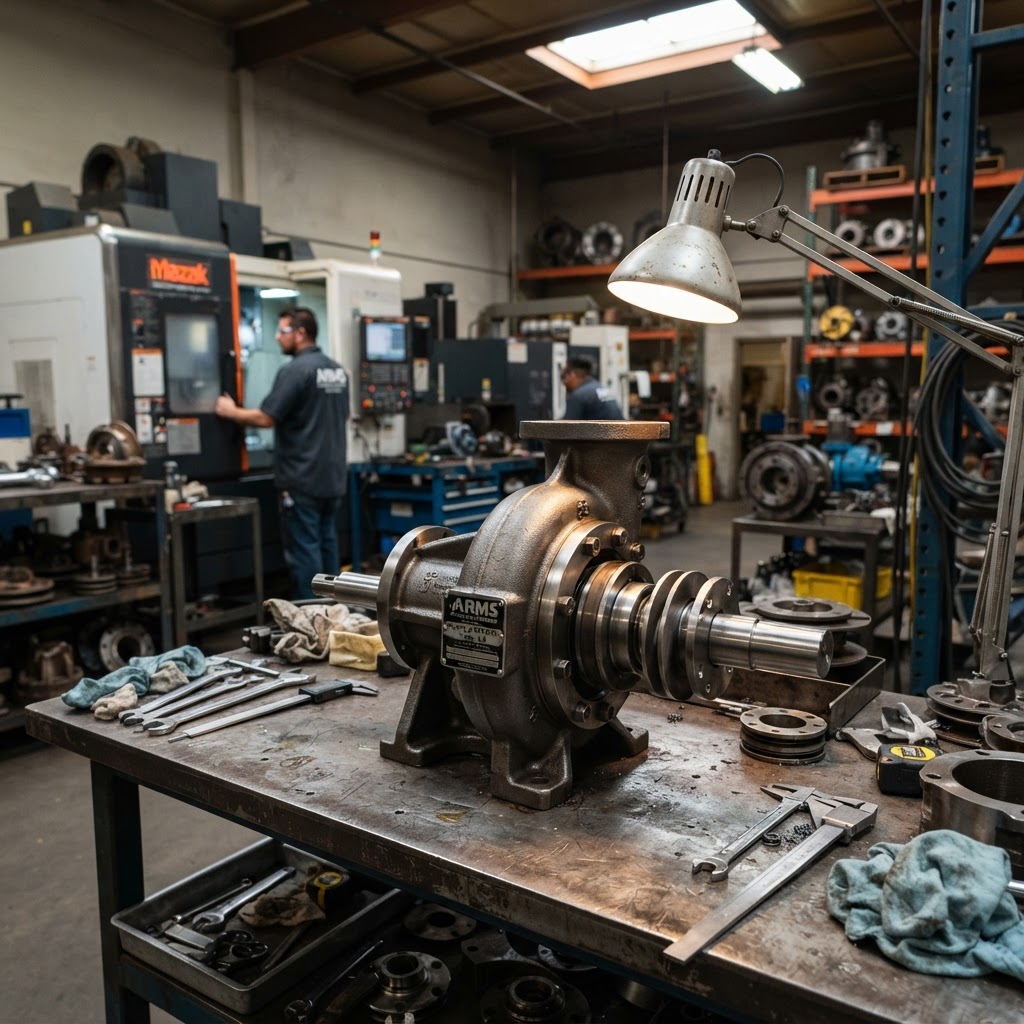
The smell hits you first — cutting fluid, metal shavings, the faint burn of a lathe working through steel. Walk into the ARMS Pumps & Repairs facility in Tracy, California, and you're inside a shop that doesn't waste square footage on anything that doesn't earn its keep. A CNC machine is running a shaft down to spec in the corner. On a bench nearby, a centrifugal pump casing sits mid-rebuild, its wear surfaces cleaned and measured, waiting on a freshly machined impeller that's being finished a few feet away. This is not a drop-ship warehouse. This is a working shop — one where the parts that go out the door were born on the floor you're standing on.
That integration — repair and fabrication under one roof — is the backbone of what ARMS has built in the San Joaquin Valley over the past two decades.
A Shop That Closes the Loop
Most pump service operations are middlemen. They pull a failed pump, send the worn components out to a machine shop across town or across the state, wait on lead times, and reassemble when the parts come back. That model works until it doesn't — when a plant is down, when the OEM no longer supports the unit, when the required geometry isn't a catalog item anymore.
ARMS Pumps & Repairs built its shop around eliminating that bottleneck.
By maintaining an in-house CNC machine shop capable of fabricating impellers, housings, shafts, and wear rings, ARMS can take a failed pump from teardown to rebuild without handing off critical work to an outside vendor. That matters enormously to plant engineers and operations managers who are running on compressed downtime windows. When the clock is ticking on a process line, the last thing you want is a parts dependency you can't control.
The shop's capabilities span the full range of pump component geometry — from turned shafts and bored housings to profiled impeller vanes that have to hold tight tolerances to balance hydraulic performance. This isn't rough work. Pump components live in demanding environments: high-pressure differentials, abrasive slurries, corrosive media. Parts that don't meet spec don't just fail — they fail fast, and they take other components with them.
Custom Fabrication for Non-Standard Applications
Here's where ARMS earns a different kind of respect from procurement teams and plant engineers: they specialize in producing custom solutions for non-standard applications.
That phrase gets thrown around loosely in manufacturing. At ARMS, it means something specific. When a customer walks in with a legacy pump — an older unit that's no longer supported by the original manufacturer, or a system that was custom-engineered for a specific process decades ago — ARMS doesn't turn them away. They measure, document, and machine. They produce the part that no longer exists in anyone's catalog.
For operations executives managing aging infrastructure, that capability is not a convenience. It is a lifeline. Capital equipment budgets don't always allow for wholesale system replacement, and finding a shop that can extend the service life of existing equipment through precision reverse engineering and fabrication has real bottom-line value.
This is the kind of work that requires machinists who actually understand pumps — not just operators running a CAM program. Knowing why an impeller is shaped the way it is, understanding how wear ring clearances affect efficiency, being able to look at a failed component and diagnose whether the failure was mechanical, hydraulic, or materials-related — that's knowledge that lives in the people, not just the equipment.

What will it take to turn demand into delivered output?
Explore The Capacity Imperative, our report on U.S. advanced manufacturing and the priorities shaping 2027.
The Technology Behind the Work
ARMS runs a CNC-equipped machine shop purpose-built for pump component production. The capability set covers the core geometries that define pump work: turning, boring, milling, and precision finishing across the range of materials common to industrial pump applications — carbon steel, stainless, bronze, and wear-resistant alloys depending on the service conditions involved.
The shop's strength is not in volume production. It's in the ability to produce single units, small batches, and tight-tolerance components that restore pump systems to correct operating specification. That's a different discipline than high-volume machining, and it requires a different kind of shop culture — one where attention to detail on a single part matters as much as throughput.
For sourcing teams evaluating potential partners, ARMS represents the category of shop that larger industrial distributors and EPC contractors often overlook: a lean, technically capable operation with deep domain expertise and the flexibility to work on problems that don't fit a standard work order.
What Makes This Shop Different
Shops that combine pump repair expertise with in-house manufacturing are not common. Most pump service companies are service companies — they turn wrenches, they swap seals, they send components out. Most machine shops are machine shops — they run programs, they hold tolerances, they don't necessarily understand the system context of the parts they're making.
ARMS sits at the intersection of both disciplines, and that position is genuinely difficult to replicate. It requires investment in equipment and in people who carry knowledge across both domains. The result is a shop where a pump rebuild isn't just an assembly job — it's an engineered outcome, with fabricated components matched to the specific requirements of the unit and the application.
For plant engineers who have dealt with rebuilt pumps that didn't perform to spec, or machined replacement parts that fit dimensionally but failed prematurely, that distinction is not a small one.
Procurement managers and operations teams looking to qualify pump repair and fabrication vendors in the Western United States should have ARMS on their shortlist. The shop's capabilities and service approach are documented at Visit ARMS Pumps & Repairs, where sourcing teams can review their work and make direct contact.
About ARMS Pumps & Repairs
- Location: Tracy, California
- Founded: Early 2000s
- Employees: 10–50
- Core Capabilities: Pump repair and rebuild, CNC precision machining, custom parts fabrication
- Components Produced: Impellers, housings, shafts, wear rings, and custom-machined pump components
- Facility Model: All-under-one-roof pump service and manufacturing
- Niche: Pump and valve manufacturing, repair, and custom solutions for non-standard applications
- Website: armspumps.net
Where to Find Them
ARMS Pumps & Repairs operates out of Tracy, California, positioned in the heart of the San Joaquin Valley with access to industrial customers across Northern California and the broader Western U.S. market.
For procurement teams, plant engineers, and operations managers looking to source pump components, qualify a repair vendor, or find a shop capable of fabricating custom parts for legacy systems, the best starting point is their website.
Strata Intelligence covers American manufacturers across every region and every discipline. If your shop does work worth knowing about, we want to hear from you.
Sponsored by Manufacturing Ultra
This Manufacturer Spotlight is brought to you by Manufacturing Ultra — a zero-upfront-cost website development and digital growth program built exclusively for American manufacturers. Whether you need a modern website, SEO, or digital marketing, Manufacturing Ultra delivers without the upfront cost. Visit manufacturingultra.com to learn how they help shops like ARMS Pumps & Repairs grow their digital presence.

