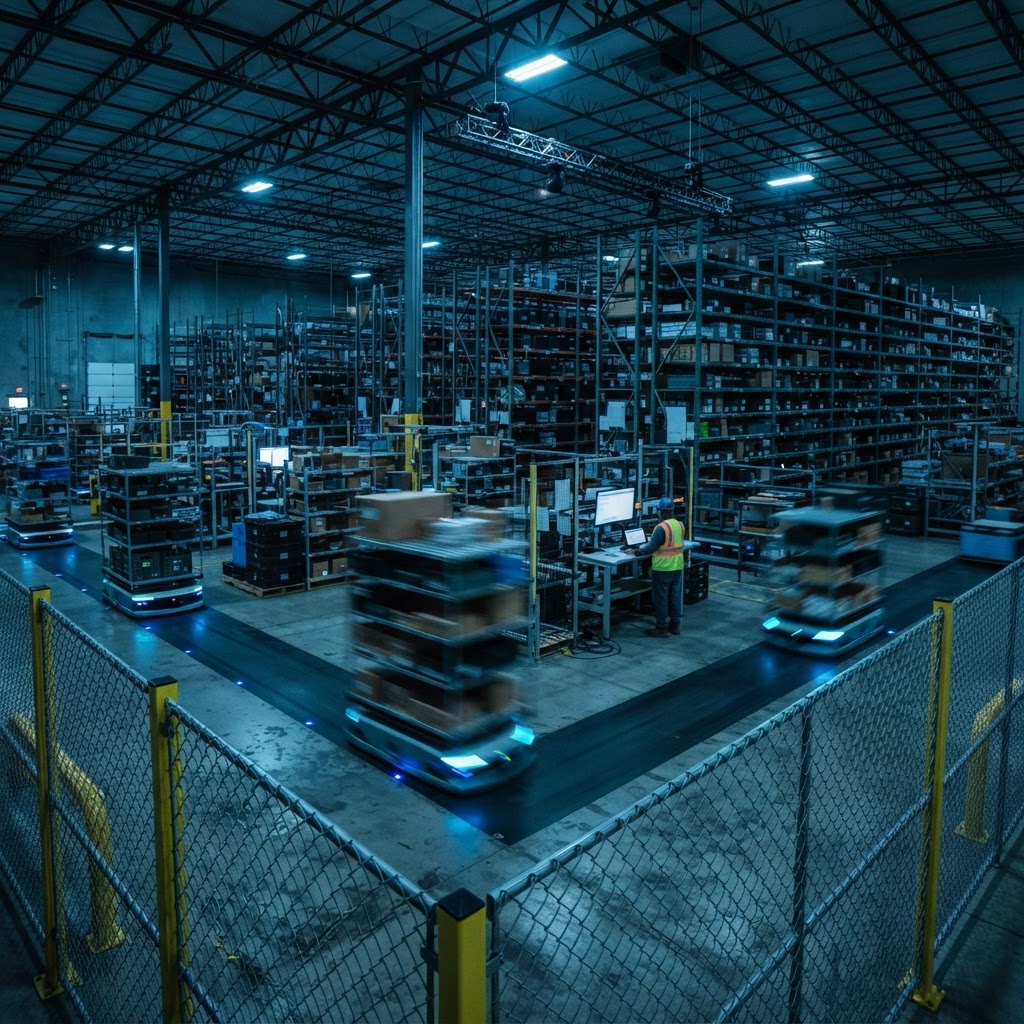

The Rise of Mobile Autonomous Robots in Warehouse and Distribution — October 2026
AMR deployments in North American distribution centers crossed 85,000 active units in Q3 2026 — and the facilities still running fixed conveyor-only fulfillment are already losing ground on labor cost and throughput.
AMRs Have Moved From Pilot Projects to Production Infrastructure
The shift happened fast. Eighteen months ago, most distribution operators were still treating autonomous mobile robots as experimental. Today, Fetch Robotics — now fully integrated under Zebra Technologies — is deploying AMR fleets in eight-figure unit counts for Tier 1 retail and e-commerce clients. Boston Dynamics Stretch units are running trailer unload cycles at major 3PL hubs. The pilot phase is over.
What changed? Three compounding pressures:
- Labor availability collapsed further. Warehouse turnover rates still hover above 70% annually in high-volume regions, per Bureau of Labor Statistics sector tracking.
- Order cycle compression hit a new floor. Same-day and next-morning delivery windows are now the baseline expectation in B2C and increasingly in B2B distribution.
- AMR unit economics crossed a threshold. Fleet payback periods under 24 months are now achievable at mid-scale deployments, down from 36–48 months in 2023.
The Hardware Tier Has Stratified — Know What You're Buying
Not all AMRs are solving the same problem. The market has stratified into three functional tiers, and buying the wrong tier for your operation is an expensive mistake.
Tier 1 — Goods-to-Person (G2P) Carriers
- Vendors: Locus Robotics, 6 River Systems (Shopify), Geek+
- Function: Escort-style picking support, travel elimination for human pickers
- Payload range: 100–400 lbs
- Best fit: High-SKU e-commerce, multi-zone pick paths
Tier 2 — Autonomous Pallet Movers
- Vendors: Seegrid, Gideon Brothers, Vecna Robotics
- Function: Full pallet transport, dock-to-rack movements, trailer staging
- Payload range: 2,000–6,000 lbs
- Best fit: Inbound receiving, cross-dock operations, automotive parts distribution
Tier 3 — Manipulation + Mobility Integrated Systems
- Vendors: Boston Dynamics Stretch, Mujin with mobile base integration
- Function: Depalletization, trailer unload, case handling at variable heights
- Best fit: High-volume inbound where human ergonomic injury risk is highest
"The operations directors winning in 2026 aren't asking 'should we deploy AMRs' — they're asking which tier solves the bottleneck that's actually costing them margin."
Fleet Orchestration Is Now the Differentiating Layer
The robot itself is increasingly commoditized. The competitive advantage lives in the software orchestrating the fleet — and this is where integration complexity separates serious deployments from expensive science projects.
Rockwell Automation has pushed hard into AMR orchestration through its Plex and Pavilion platforms, connecting fleet management to WMS and ERP data layers. Honeywell Intelligrated offers multi-vendor AMR orchestration inside its Momentum WES. MassRobotics-aligned integrators are increasingly standing up heterogeneous fleets — mixing vendors across tiers — managed under a single traffic control layer.

What will it take to turn demand into delivered output?
Explore The Capacity Imperative, our report on U.S. advanced manufacturing and the priorities shaping 2027.
Key orchestration capabilities your vendor must demonstrate before contract:
- Multi-vendor interoperability: Confirm support for MassRobotics AMR Interoperability Standard — non-negotiable for mixed fleets
- Dynamic task reallocation: Fleet should rebalance in real time as order velocity shifts across zones
- WMS bi-directional sync: Robot task queues must update with WMS order waves — not run on static preprogrammed routes
- Downtime self-reporting: Automated flagging to maintenance teams with fault codes, not just stopped units
Infrastructure Readiness Determines Your Actual Throughput Ceiling
The fastest AMR fleet runs at the speed of the infrastructure around it. Facilities that deploy robots without addressing these four factors will not hit vendor throughput projections:
- Floor flatness and surface condition. F-number ratings matter. AMRs lose navigation accuracy and experience premature wheel wear on floors below FF35 flatness tolerance. Audit before deployment.
- Network density. AMR fleets running at scale require dense Wi-Fi 6 coverage with no dead zones. Sub-50ms latency is the operational threshold for real-time fleet coordination.
- Charging infrastructure placement. Opportunity charging stations must be positioned to match shift patterns — a fleet that's charging can't be picking. Model this before you finalize layout.
- Rack and aisle geometry. Most AMR platforms require minimum 8-foot aisle widths for bidirectional operation. Older racking configurations designed for reach trucks frequently require modification.
FANUC and ABB Robotics — primarily known for fixed industrial arms — are both expanding into mobile manipulation integration, which means AMR infrastructure standards will need to accommodate higher payload and reach envelope requirements over the next 18 months.
What This Means for Your Floor
If you're an operations director or plant manager evaluating AMR deployment heading into 2027 planning cycles, here's the actionable framework:
- Start with the bottleneck, not the technology. Map your highest labor-hour consumption and injury-risk tasks first. The right AMR tier follows from that analysis, not from vendor demos.
- Demand an interoperability commitment in writing. Vendor lock-in at the fleet management layer is the primary cause of costly AMR program failures. MassRobotics interoperability compliance is your contractual floor.
- Budget for infrastructure alongside hardware. A realistic AMR deployment budget allocates 20–30% of total program cost to floor, network, and racking modifications. Underbidding this kills ROI.
- Run a 90-day parallel operation before full cutover. Keep your existing process running alongside the AMR deployment for the first quarter. Real throughput data from your SKU mix, your shift patterns, your building beats any vendor simulation.
- Integrate your WMS before go-live, not after. AMRs running off static task lists without live WMS sync are not autonomous — they're expensive carts. Rockwell and Honeywell Intelligrated both offer pre-built WMS connectors worth evaluating.
The distribution operations that execute this correctly in the next 12 months will have a structural labor cost and throughput advantage that competitors running 2022-era fulfillment models cannot close on incremental headcount alone.
Sources: Zebra Technologies / Fetch Robotics · MassRobotics AMR Interoperability Standard · Bureau of Labor Statistics — Warehousing Sector · Rockwell Automation · Boston Dynamics Stretch

