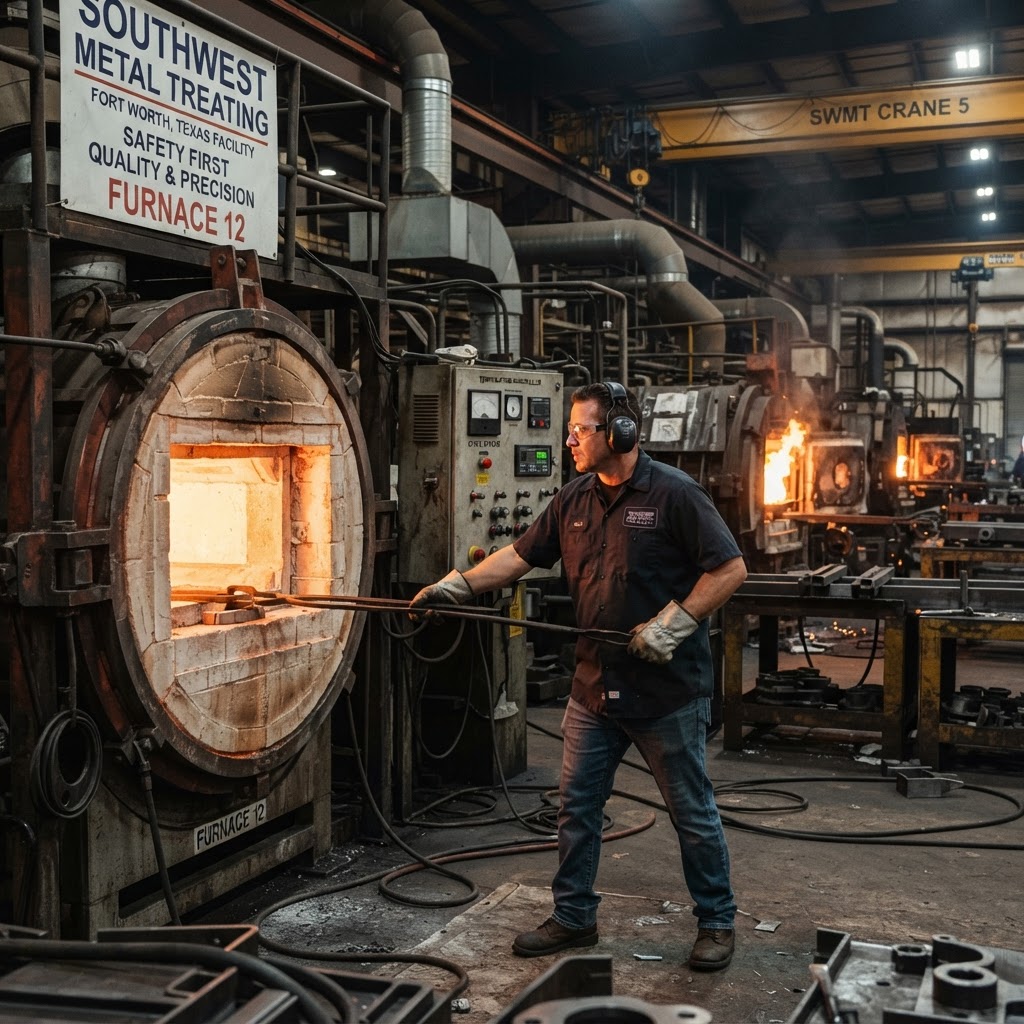


Inside Southwest Metal Treating: A Forging and Heat Treatment Shop Built on Precision and Pride
The glow from a vacuum furnace doesn't look like much from the outside — a sealed chamber, a few instrument panels, a technician watching temperature curves climb toward 1,900 degrees Fahrenheit. But inside that furnace, something critical is happening. A batch of forged steel components — maybe aerospace brackets, maybe industrial tooling, maybe drivetrain parts headed for heavy equipment — is being transformed at the molecular level. The surface scale is gone. The carbon profile is controlled. The grain structure is tightening up exactly the way the metallurgical spec demands. At Southwest Metal Treating in Fort Worth, Texas, this is not a dramatic moment. It's Tuesday.
That matter-of-fact mastery is exactly what four decades in the heat treating business looks like.
Forty Years in the Fire
Founded in 1984, Southwest Metal Treating has been running thermal cycles in the Fort Worth area since before most of today's manufacturing engineers graduated high school. That kind of tenure in a specialty process shop isn't accidental. It comes from building a reputation one job at a time, solving problems that other shops wave off, and understanding the forging industry deeply enough to anticipate what a customer needs before the purchase order lands.
The company has carved out a specific and defensible niche: dedicated heat treating for the forging industry. That focus matters. Forgings present challenges that stamped or machined parts simply don't. The thermal cycles involved in forging — the repeated heating and working of steel — leave behind residual stresses, inconsistent microstructures, and surface conditions that require careful post-forge thermal processing to correct. Surface oxidation, decarburization (the loss of carbon from the surface layer that degrades hardness and fatigue resistance), and internal stress concentrations are the enemy. Controlled thermal processing is the answer, and Southwest Metal Treating has been providing that answer for over four decades.
What They Do — And How They Do It
Southwest Metal Treating's capabilities fall into two broad process families: vacuum heat treating and atmosphere heat treating, supported by specialized surface treatment processes. The distinction between these two approaches is not cosmetic — it defines what kinds of parts you can run, what surface quality you can hold, and what metallurgical outcomes are achievable.
Vacuum heat treating uses furnaces that evacuate oxygen from the processing environment before and during thermal cycling. The result is a clean, oxide-free surface on the finished component. For forged parts that require tight dimensional tolerances, or for high-alloy steels that are particularly sensitive to atmospheric contamination, vacuum processing is often the only acceptable path. Southwest Metal Treating's vacuum furnace capacity allows them to handle this work with the kind of process control that aerospace, defense, and precision industrial customers require.
Atmosphere-controlled furnaces give the shop flexibility to run a broader range of ferrous materials under carefully managed gas environments — whether that means maintaining a neutral atmosphere to prevent scaling, or introducing reactive gases to drive specific surface chemistry changes. This is where carburizing and nitriding come into play. Carburizing diffuses carbon into the surface layer of low-carbon steel components, building a hard case over a tough core — a combination that's essential for gear teeth, bearing surfaces, and wear-prone forged components. Nitriding introduces nitrogen into the surface at lower temperatures, producing extreme surface hardness with minimal distortion, a critical advantage when you're working with components that are already at or near final dimensions.
Rounding out the capability set are quenching and tempering operations — the workhorses of heat treat shops everywhere, but processes that require genuine process discipline to execute consistently. Quench rate, quench media, and tempering temperature windows are tightly controlled variables. Get them wrong and you get warped parts, cracked sections, or mechanical properties that fall short of spec. Get them right, consistently, across thousands of cycles over forty years, and you build the kind of customer relationships that sustain a shop through multiple industrial cycles.
What Makes This Shop Different
The honest answer is specialization and longevity — and the combination of the two.
A lot of heat treat shops are generalists. They'll run whatever comes through the door: castings, machined components, stamped parts, bar stock. That's a viable business model. But it means the shop's knowledge base is spread thin, and the process setups are constantly shifting to accommodate different incoming conditions.
Southwest Metal Treating has oriented itself around the forging industry's specific requirements for long enough that the institutional knowledge in that building runs deep. Their team understands forging-related defects — not just how to mitigate them after the fact, but how to structure thermal cycles proactively to prevent them. That's a different level of expertise than generic heat treating, and it shows in the quality outcomes their customers have relied on for forty-plus years.
For procurement managers and materials engineers sourcing post-forge thermal processing, that kind of specialized knowledge translates directly into reduced risk. Fewer rejected lots. Less rework. Tighter compliance with material specs on the first pass. Over a production run of any significant length, that consistency has real dollar value.
The shop's location in Fort Worth, Texas also deserves a mention in any honest assessment. The DFW Metroplex has a substantial industrial manufacturing base — aerospace, defense, oil and gas, heavy equipment — all of which generate forged components that need exactly the kind of processing Southwest Metal Treating provides. Geographic proximity to a major industrial cluster isn't a guarantee of quality, but it does create the kind of volume and variety of work that keeps a specialty shop sharp.
Procurement and sourcing teams looking to qualify Southwest Metal Treating as a vendor can find detailed capability information at Visit Southwest Metal Treating. The site is a straightforward resource for understanding their process offerings and initiating contact.
About Southwest Metal Treating
- Founded: 1984
- Location: Fort Worth, Texas
- Employees: 50–100
- Specialties: Vacuum Heat Treating, Atmosphere Heat Treating, Surface Treatment
- Key Processes: Quenching, Tempering, Carburizing, Nitriding
- Primary Niche: Post-forge thermal processing for the forging industry
- Equipment: Vacuum furnaces, atmosphere-controlled furnaces, specialized quenching systems
- Years in Operation: 40+
Where to Find Them
Southwest Metal Treating operates out of Fort Worth, Texas, serving forging industry customers across the region and beyond. For capability inquiries, vendor qualification, or sourcing discussions, their full process information is available directly at:
Visit Southwest Metal Treating
Four decades is a long time to stay focused on one industry and one discipline. In American manufacturing, that kind of staying power means something. It means the shop has seen enough to know what they're doing — and built enough trust to keep the orders coming back.
Sponsored by Manufacturing Ultra
This Manufacturer Spotlight is brought to you by Manufacturing Ultra — a zero-upfront-cost website development and digital growth program built exclusively for American manufacturers. Whether you need a modern website, SEO, or digital marketing, Manufacturing Ultra delivers without the upfront cost. Visit manufacturingultra.com to learn how they help shops like Southwest Metal Treating grow their digital presence.

