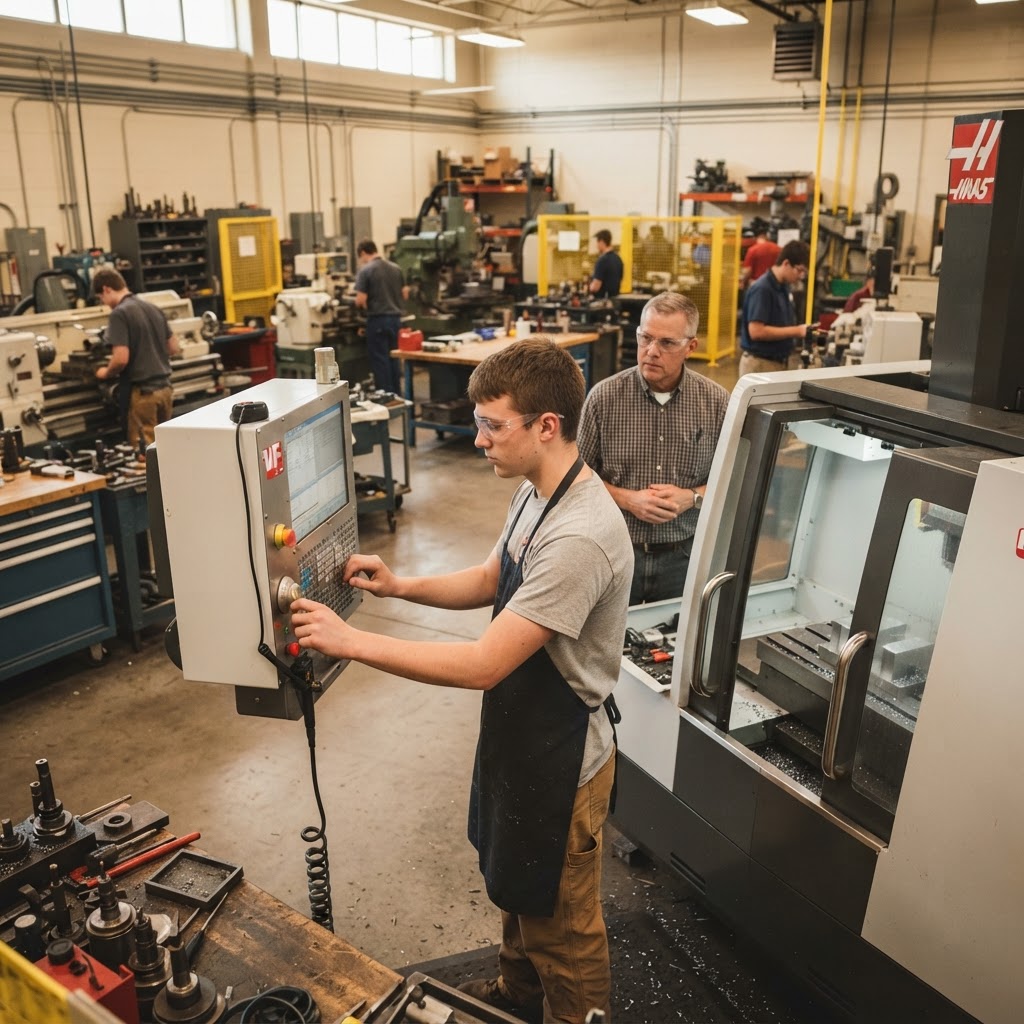

The Classroom Is Now a Machine Shop — and That Changes Everything
Community colleges are quietly solving one of American manufacturing's most stubborn problems: a shortage of skilled CNC machinists that threatens to stall the reshoring momentum the industry has spent a decade building. The fix isn't coming from four-year universities or corporate training budgets alone — it's coming from two-year programs in places like Rockford, Illinois, and Tulsa, Oklahoma, where students are learning to run half-million-dollar machines before they're old enough to rent a car.
Marcus Learned to Make Parts. Now He Trains Others.
Marcus Tillman was working overnight shifts at a distribution center in suburban Cleveland when his brother-in-law told him about a CNC machining certificate program at Cuyahoga Community College. Eighteen months later, he was running a Haas VF-2 vertical machining center — a computer-controlled milling machine that carves precise metal components from solid stock — at a Tier 2 automotive supplier outside Lorain. Two years after that, he was the one walking new hires through their first setup.
"I didn't know what G-code was when I walked in," Marcus told a workforce panel at a regional manufacturing summit earlier this year, referring to the programming language CNC machines use to follow cutting instructions. "Now I'm writing it in my sleep."
Marcus's story isn't an outlier. It's a pattern that workforce development directors across the Midwest and South are deliberately engineering — and the data is starting to prove it works.
The Numbers Behind the Shortage Are Not Abstract
The Bureau of Labor Statistics projects roughly 47,500 annual openings for machinists and tool-and-die makers through 2032, driven by both retirements and new demand from reshored production. The average age of a working CNC machinist in the United States is north of 50. The pipeline replacement math is unforgiving.
What community colleges offer that four-year programs don't:
- Speed. Certificate and associate degree programs typically run 12 to 24 months, getting workers onto the floor faster.
- Cost. Tuition at most community colleges runs a fraction of university programs, and many are now covered by state workforce grants or employer tuition reimbursement.
- Proximity. Programs are embedded in the communities where the manufacturing jobs actually exist — not two states away.
- Industry alignment. The best programs are co-designed with local employers, meaning students train on the same equipment brands — Haas Automation, Mazak, DMG Mori — they'll operate on day one of the job.
Tooling U-SME, a workforce training arm of the Society of Manufacturing Engineers, reports that structured training programs tied to stackable credentials reduce time-to-productivity for new machinists by as much as 40 percent compared to purely on-the-job learning.
Programs That Are Already Delivering Results
A handful of programs have moved from promising pilots to proven pipelines.
Tulsa Community College's Advanced Manufacturing program places more than 80 percent of completers in manufacturing roles within six months of graduation, according to institutional reporting. The program runs live production contracts alongside coursework, meaning students aren't just practicing — they're making real parts for real customers under instructor supervision.

What will it take to turn demand into delivered output?
Explore The Capacity Imperative, our report on U.S. advanced manufacturing and the priorities shaping 2027.
Moraine Valley Community College outside Chicago has formalized apprenticeship partnerships with local metalforming and precision machining shops, blending classroom instruction with paid on-the-job hours. This earn-while-you-learn structure — supported in part by the Department of Labor's Registered Apprenticeship program — addresses the economic reality that many community college students can't afford to stop working while they train.
The federal CHIPS and Science Act has also begun flowing workforce development dollars toward semiconductor-adjacent precision machining, creating new alignment between community college CNC programs and the advanced fabrication demands of domestic chip production supply chains. Machine shops feeding component parts into that ecosystem need the same five-axis machining and metrology skills that aerospace has required for decades — and community colleges are now being asked to deliver both.
"The community college is the most efficient workforce development infrastructure America already owns — we just forgot to fund it like it matters."
What Plant Managers Are Actually Seeing
Operations directors who have formalized community college partnerships describe a different kind of new hire — one who arrives with baseline safety culture, measurement literacy, and machine familiarity already established.
"We used to budget six months before a new machinist was running unsupervised," said one production manager at a precision components shop in western Michigan. "With the Tri-C grads, we're at three months, sometimes less. That's real capacity."
The candid version of that story includes friction, too. Community college programs vary dramatically in equipment quality and instructor depth. A program running 1990s-era manual mills isn't preparing anyone for a modern five-axis cell. Employers who want pipeline results are increasingly being asked to invest in it — donating equipment, providing adjunct instructors from their own floor, and committing to hire cohorts rather than cherry-picking individuals.
That ask is reasonable. It's also a shift in how many manufacturers have historically thought about workforce development as someone else's job.
The Road Ahead Is Narrower Than It Looks
The reshoring wave is real. The CNC machinist shortage is real. The community college infrastructure capable of bridging the two exists in nearly every manufacturing county in the country. What remains uneven is the quality, the funding, and the depth of employer commitment needed to make these programs durably effective rather than cyclically underfunded.
Marcus Tillman is now a lead machinist and informal mentor. The program that changed his trajectory is still running — but it's waiting on equipment funding to expand its second shift of students. That's the honest version of this story: the model works, the demand is there, and the gap between potential and delivery is still, stubbornly, a funding and partnership problem that no single program can solve alone.
The next generation of CNC machinists is already sitting in those classrooms. Whether the industry shows up to meet them is the only open question left.
Sources: Bureau of Labor Statistics — Machinists Outlook · Department of Labor Registered Apprenticeship · Tooling U-SME · CHIPS and Science Act Workforce · Haas Automation Education

