
Inside Asheville Thermoform Plastics: An Industrial Plastics and Thermoforming Shop Built on Precision and Pride
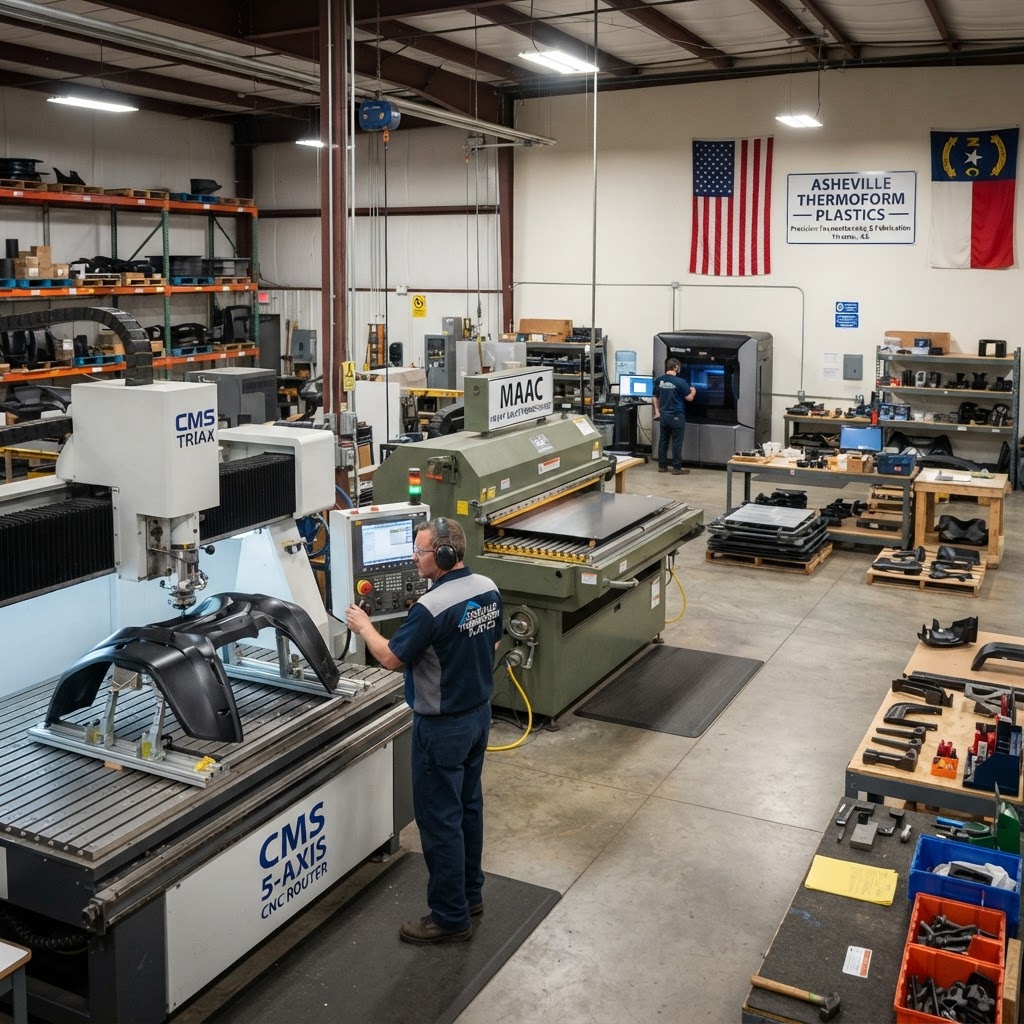
The smell of warm plastic hits you before you clear the door. Inside a working shop in Fletcher, North Carolina, sheets of material move from rack to forming table with the kind of quiet efficiency that only comes from a team that has been doing this long enough to stop thinking about the individual steps. A technician checks the draw on a freshly pulled part, running a thumb along the edge with the confidence of someone who has seen thousands of them come off the line. This is not a flashy operation. It is a serious one.
Asheville Thermoform Plastics has been at this since 2016, and in fewer than ten years, they have built a reputation in the Western North Carolina region and well beyond it as a shop that can handle the full arc of a custom plastic component — from the first sketch to the finished, packaged part.
A Full-Service Operation in a Compact Footprint
What separates a capable thermoforming shop from a commodity one is how far into the process they are willing to go. A lot of operations will take your print, run your part, and hand it back. Asheville Thermoform Plastics goes considerably further.
Their capabilities span initial design and engineering, reverse engineering, prototyping, production thermoforming, and assembly and fabrication. For procurement teams dealing with a component that exists only as a worn-out sample or a rough sketch on a napkin, that reverse engineering capability is not a minor detail — it is the difference between getting a project off the ground and stalling out.
On the design side, they work in CAD and SolidWorks, which means they can communicate in the same technical language as the engineers sitting in your building. Files move cleanly. Tolerances get discussed with specificity. That integration between design software and shop floor execution is what keeps a low-volume run from becoming an expensive guessing game.
The Technology Doing the Work
Thermoforming is one of the more accessible plastic forming processes in theory — heat a sheet, pull it over a mold, trim it to shape. In practice, the difference between a mediocre shop and a precise one shows up in the trimming and finishing, and that is where 5-axis CNC routing earns its keep.
Five-axis capability means the router is not limited to simple planar cuts. Complex contours, angled trim lines, cutouts on formed surfaces — the geometry that would require multiple setups on a 3-axis machine gets handled in a single operation. For tight-tolerance components, that reduction in handling is a direct quality benefit, not just a cycle-time advantage.
They also run 3D printing in-house, which feeds directly into their prototyping workflow. Before a thermoform tool gets cut, a printed prototype can validate fit, form, and function. For customers developing new components, that is a meaningful cost reduction. You find out what does not work on a printed prototype rather than on a machined aluminum tool.
The combination of 3D printing for prototyping, SolidWorks for design, and 5-axis CNC for precision trimming gives this shop a tighter loop between concept and production than you would expect from an operation of their size.
What They Make and Who They Serve
Asheville Thermoform Plastics works across both heavy-gauge and thin-gauge thermoforming, which opens up a wide range of part types and end markets. Heavy-gauge work tends toward structural and semi-structural components — housings, enclosures, panels, trays. Thin-gauge work gets into packaging and lighter-duty components.

What will it take to turn demand into delivered output?
Explore The Capacity Imperative, our report on U.S. advanced manufacturing and the priorities shaping 2027.
Their product range includes face shields, sneeze guards, and custom-formed components for diverse industrial applications. The face shields and sneeze guards are instructive — these are parts where dimensional consistency matters for fit and function, and where clarity and surface quality in the material are non-negotiable. Getting those right at any volume requires process discipline.
Their sweet spot is low-to-medium volume production, and that positioning is deliberate. High-volume commodity thermoforming is a different business with different economics — large press runs, dedicated tooling, thin margins managed through sheer volume. Asheville Thermoform Plastics is built for the customer who needs hundreds or a few thousand parts, not hundreds of thousands. That might be a regional manufacturer needing custom enclosures, a medical device supplier requiring formed components with close tolerances, or an OEM bridging the gap between prototype and full production.
For sourcing and procurement teams, that low-to-medium volume capability is worth noting. Many thermoformers will quote your 500-piece job and then deprioritize it the moment a larger order hits the floor. A shop structured around that volume range treats your 500 pieces as the core business, not an afterthought.
What Makes This Shop Different
Family-owned operations have a reputation — sometimes earned, sometimes not — for a different level of accountability than larger contract manufacturers. At Asheville Thermoform Plastics, the family ownership is not a marketing angle. It shapes how the shop operates.
With a team in the 10-to-50 employee range, everyone on the floor has line of sight to the finished product and to the customer relationship that depends on it. There is no large organizational buffer between the person pulling a part off the tool and the person who quoted the job and will answer the phone when you call. That compression of accountability is a real operational advantage for customers who need responsiveness and do not have time to navigate a customer service hierarchy.
Their willingness to take a project from design through production under one roof also reduces the coordination overhead that plagues multi-vendor programs. When the design team and the production team are in the same building talking to each other daily, the translation errors that creep in between a design house and a contract manufacturer simply do not happen.
Procurement and operations teams evaluating domestic plastic component suppliers should spend time on their website — it lays out their capabilities clearly and provides a direct line to the team for RFQ and sourcing inquiries.
About Asheville Thermoform Plastics
- Founded: 2016
- Location: Fletcher, North Carolina
- Employees: 10–50
- Ownership: Family-owned and operated
- Specialties: Custom thermoforming, prototyping, assembly and fabrication
- Equipment: 5-axis CNC routing, 3D printing, CAD/SolidWorks design
- Production Range: Low-to-medium volume custom runs
- Markets Served: Industrial, medical, commercial, and OEM sectors
- Website: ashevillethermoformplastics.com
Where to Find Them
Asheville Thermoform Plastics operates out of Fletcher, North Carolina, in the Asheville metro area — well-positioned to serve manufacturers across the Southeast and within reasonable logistics reach of the broader Eastern Seaboard and Midwest.
For engineering teams, procurement managers, and operations executives looking for a domestic thermoforming partner with full-service capabilities and the accountability that comes with family ownership, this shop is worth a conversation.
Visit Asheville Thermoform Plastics
Sponsored by Manufacturing Ultra
This Manufacturer Spotlight is brought to you by Manufacturing Ultra — a zero-upfront-cost website development and digital growth program built exclusively for American manufacturers. Whether you need a modern website, SEO, or digital marketing, Manufacturing Ultra delivers without the upfront cost. Visit manufacturingultra.com to learn how they help shops like Asheville Thermoform Plastics grow their digital presence.

