
Edge Computing Is Transforming How Factories Process Real-Time Data
Every second a conveyor line runs with a failing bearing, the cost compounds. Vibration data sits in a sensor. The sensor pings a cloud server. The cloud server responds - 200 milliseconds later, if you're lucky. By then, the damage is done. That latency gap is exactly what edge computing is closing, and the factories that understand it are pulling ahead fast.
The Problem With Cloud-First Architecture on the Plant Floor
Cloud computing transformed enterprise IT. It did not transform manufacturing operations. The architecture that works for quarterly reporting fails catastrophically when you're monitoring a CNC spindle at 20,000 RPM or tracking weld quality across 400 touch points per shift.
Latency is the central problem. Round-trip cloud processing introduces delays that render real-time control impossible. But the challenges run deeper:
- Bandwidth saturation: A single modern production line can generate gigabytes of sensor data per hour. Streaming everything to the cloud isn't scalable - it's expensive and increasingly unreliable under load.
- Connectivity dependency: Cloud-reliant systems go dark when network connections drop. In a steel mill or an automotive stamping plant, that's not a minor inconvenience - it's a production stoppage.
- Data governance risk: Sending raw operational data off-site creates compliance exposure, especially for defense contractors and regulated manufacturers.
The result? Manufacturers built sophisticated sensor networks and still made decisions on stale data.
What Edge Actually Changes
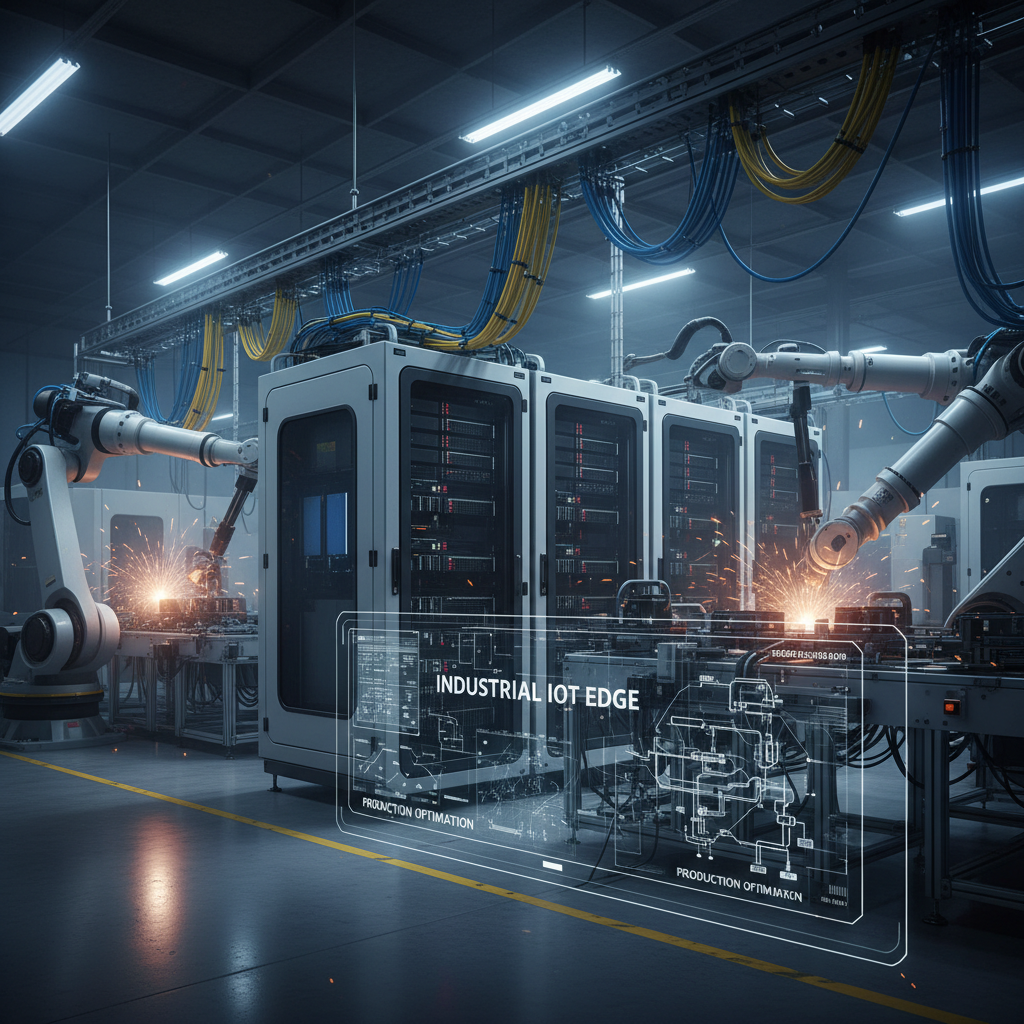
Edge computing relocates the processing power. Instead of sending raw sensor streams to a distant server, edge nodes - ruggedized compute hardware deployed at or near the machine - filter, analyze, and act on data locally. The cloud receives only summarized outputs, exceptions, and archival records.
This shift matters operationally in three specific ways.
First, response times drop from hundreds of milliseconds to single digits. That difference separates a system that monitors from a system that controls. Real-time process adjustments - throttling pressure, flagging a dimensional variance, triggering an e-stop - become executable at machine speed.
Second, edge enables continuous operation regardless of network status. Local intelligence doesn't need a handshake with a remote server to keep running. Plants operating in remote locations or facilities with constrained IT infrastructure stop treating connectivity as a ceiling on their capabilities.

What will it take to turn demand into delivered output?
Explore The Capacity Imperative, our report on U.S. advanced manufacturing and the priorities shaping 2027.
Third, data filtering at the edge reduces cloud costs significantly. Raw sensor data contains enormous amounts of noise. Edge nodes discard irrelevant readings locally, sending only actionable information upstream. For large facilities running hundreds of connected assets, this alone produces meaningful infrastructure savings.
Siemens, Rockwell Automation, and Honeywell have all moved aggressively into edge-capable industrial platforms over the past several years. The IIoT ecosystem has standardized around architectures like the ISA-95 model and frameworks from the Industrial Internet Consortium specifically because distributed edge processing requires common integration standards to function at scale.
Where This Is Playing Out Right Now
Automotive manufacturing has been the early proving ground. High-volume assembly environments - with tight tolerances, rapid cycle times, and enormous quality cost exposure - have the most to gain from sub-10ms response loops. Ford, GM, and their Tier 1 suppliers have invested heavily in edge-enabled quality inspection systems where vision AI models run locally on the line, catching defects before the part moves to the next station.
Food and beverage processing is accelerating adoption driven by food safety compliance pressure. Edge nodes monitoring temperature, pressure, and flow in real time give FSMA-compliant operations a defensible audit trail without the latency risk of cloud-dependent logging.
Discrete manufacturers using collaborative robots are deploying edge compute as the local brain for human-robot interaction safety systems - where a 300ms delay in detecting a human entering a work cell is categorically unacceptable.
What Operations Leaders Should Prioritize
If you're evaluating edge deployment, three decisions define your outcome:
- Start with your highest-consequence assets, not your easiest integration points. The ROI case for edge compute is strongest where latency or downtime carries real financial weight.
- Treat edge hardware as plant infrastructure, not an IT purchase. Ruggedization, thermal tolerance, and mean time between failure matter more than processing benchmarks in a factory environment.
- Establish a unified data model before you scale. Edge nodes from different vendors create integration debt fast. Align on OPC-UA or a comparable interoperability standard before you're managing a fragmented architecture across 40 machines.
The Competitive Divide Is Opening
Edge computing isn't a future capability - it's a current differentiator. Plants running real-time local intelligence are compressing defect detection cycles, extending equipment life, and operating with a level of process control that cloud-dependent competitors simply cannot match at machine speed. The latency gap is closing in the facilities smart enough to close it. Every month you defer that decision, it widens somewhere else - on your competitor's floor.

