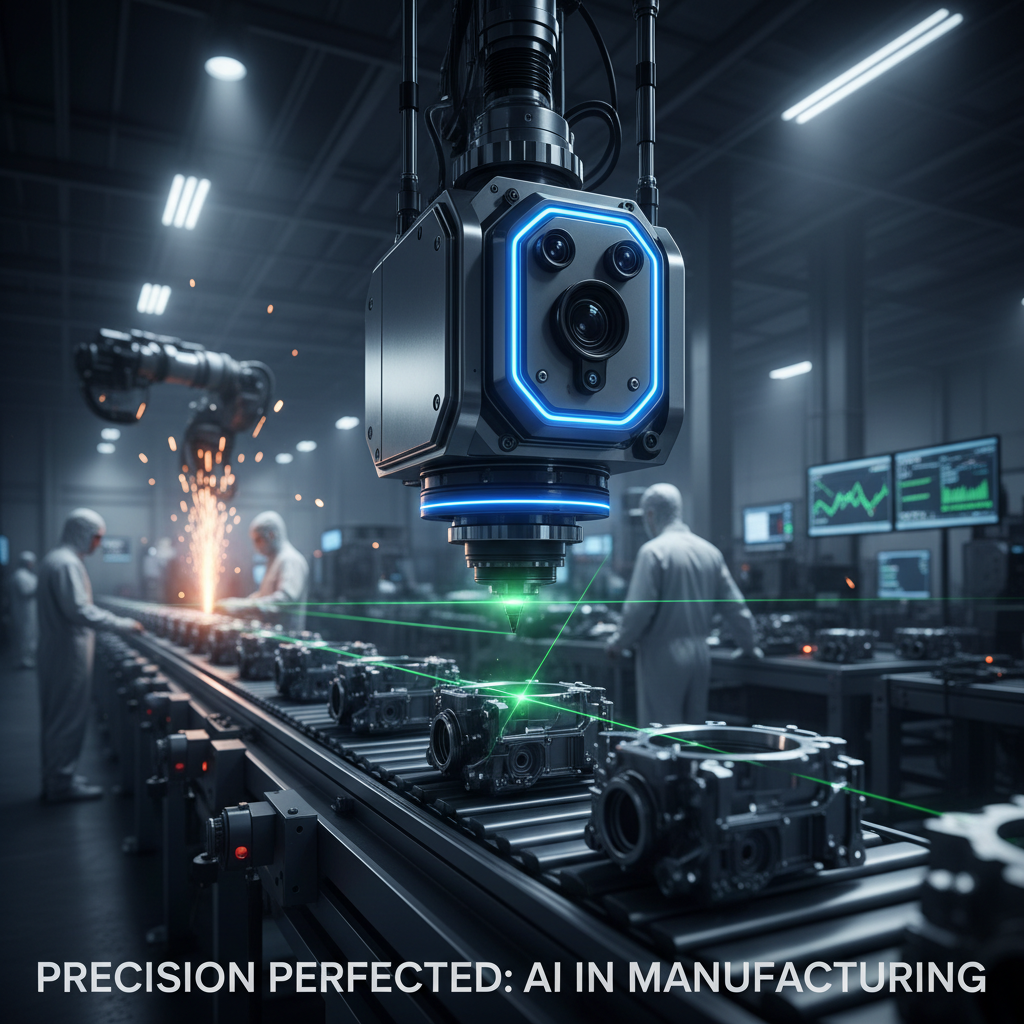

AI Vision Systems Are Outperforming Human Quality Inspectors
A human inspector working an eight-hour shift will miss defects at a rate that climbs steadily after hour four. Fatigue, lighting variation, repetitive motion, cognitive load - the variables stacking against consistent human visual inspection are well-documented and, frankly, structural. The question manufacturers are now confronting isn't whether AI vision systems can outperform human inspectors. It's why some operations are still debating it.
The Baseline Problem With Human Vision
This isn't an indictment of your workforce. It's physics and biology.
Human inspectors operating in high-throughput environments - automotive stamping lines, PCB assembly, precision metal fabrication - face a detection ceiling that no amount of training fully overcomes. The human eye resolves detail beautifully in controlled conditions. Production floors are not controlled conditions. Ambient light shifts. Parts arrive at inconsistent orientations. Line speeds accelerate to meet demand.
The result: false-negative rates (missed defects that ship) and false-positive rates (good parts rejected) that drive real cost - rework, warranty claims, customer returns, and the downstream brand erosion that's harder to put on a spreadsheet.
Industry analysts at ABI Research and McKinsey's manufacturing practice have consistently flagged quality inspection as one of the highest-ROI entry points for AI deployment in manufacturing. It's not hype. It's where the math works fastest.
What AI Vision Actually Does Differently
Modern AI vision systems don't just take pictures and compare them to a template. The architecture has evolved significantly.
Current deployments typically combine:
- High-resolution industrial cameras (often multi-angle, multi-spectrum) capturing data at line speed
- Deep learning models trained on thousands of labeled defect images - surface cracks, dimensional variance, assembly errors, contamination
- Edge computing hardware that processes inspection data in milliseconds without round-tripping to a cloud server
- Feedback loops that flag ambiguous cases, retrain on new defect types, and continuously sharpen detection thresholds
The critical differentiator: these systems don't get tired. They don't get distracted. And unlike a human inspector who might unconsciously adjust their standard after three hours of near-perfect parts, the algorithm holds the line.
Case in Focus: Automotive and Electronics Lead the Deployment Curve
Look at where serious AI vision adoption is happening and you find two sectors pushing hardest: automotive manufacturing and consumer electronics.
On the automotive side, Tier 1 suppliers have been integrating vision-based inspection systems into stamping, welding, and paint operations for several years now. Companies in the BMW and Toyota supply chains have publicly discussed AI vision deployments that flag micro-cracks and surface anomalies invisible to the naked eye - defects that, left undetected, become warranty claims or safety incidents downstream.
In electronics, the pressure is even more acute. Foxconn, operating some of the world's highest-volume assembly operations, has been a visible advocate for AI-driven inspection as part of its broader factory automation push. Cognex and Keyence - two of the dominant players in industrial machine vision hardware and software - have both reported sustained demand growth from manufacturers replacing or augmenting human inspection stations.

What will it take to turn demand into delivered output?
Explore The Capacity Imperative, our report on U.S. advanced manufacturing and the priorities shaping 2027.
Landmark AI companies including Landing AI (founded by Andrew Ng, specifically targeting manufacturing visual inspection) have built entire platform strategies around the gap between what human inspectors can sustain and what trained vision models can deliver consistently.
Where Human Inspectors Still Hold Ground
Being precise matters here. AI vision systems are not a universal replacement - yet.
They currently struggle with:
- Novel defect types they haven't been trained on - a system trained on ten defect categories won't reliably catch an eleventh without retraining
- Highly variable, low-volume production where training data is thin
- Contextual judgment calls that require understanding upstream process context - experienced inspectors sometimes catch systemic problems, not just individual defects
- Physical handling tasks that accompany inspection in some operations
The honest framing: AI vision systems are extraordinarily good at doing the same inspection task, at high volume, with perfect consistency. They are less suited to the flexible, contextual pattern recognition that a sharp senior inspector brings to a novel problem.
The smart deployment model isn't full replacement - it's stratified inspection, where AI handles the high-volume, repetitive detection work and human expertise is redirected toward process investigation, edge-case review, and quality system management.
The Deployment Friction That's Slowing Adoption
If the ROI case is solid, why aren't more plants running AI vision at scale?
Three friction points dominate:
- Training data quality - Models are only as good as their labeled datasets. Plants without historical defect documentation face a cold-start problem that takes time and investment to solve.
- Integration with legacy line infrastructure - Retrofitting vision systems onto older equipment requires engineering work that's frequently underestimated in initial project scopes.
- Workforce transition anxiety - Operations leaders who manage the human side of the floor understand that displacing inspection roles carries cultural and operational risk. The transition plan matters as much as the technology.
None of these friction points are insurmountable. They are, however, real - and vendors who paper over them in sales conversations do their customers a disservice.
What This Means for Your Floor
If you're running a quality inspection operation that depends heavily on human visual review, here's the direct read:
Your defect escape rate is almost certainly higher than your current data suggests. Human inspection misses things. That's not a management failure - it's a biological constraint. The question is whether your operation can absorb those escapes or whether they're showing up in warranty, rework, or customer relationships.
The entry cost has dropped significantly. The vision hardware and software stack that required seven-figure capital expenditure five years ago is increasingly accessible at price points that pencil out for mid-size manufacturers, not just Tier 1 giants.
Start with your highest-volume, most-repetitive inspection checkpoint. Don't try to solve the entire quality floor in phase one. Find the single station where volume is highest, defect types are well-defined, and your current false-negative rate is most painful. Build your training dataset there. Deploy. Measure.
Protect your best inspectors by repositioning them, not eliminating them. The operators who've been catching subtle defects for years carry institutional knowledge your AI system needs to get smarter. Their judgment is your training data.
The manufacturers who treat AI vision as a future consideration are already falling behind peers who've spent the last two years building detection accuracy advantages. In quality, every escaped defect has a cost. The technology to dramatically reduce that escape rate is available now, proven in production, and no longer experimental. The question left on the table isn't technical - it's whether your organization is moving fast enough to close the gap.

